
Pulp Fiction, 1924 · page 55 of 204
Adventure Magazine Cover — page 55: what you’re looking at
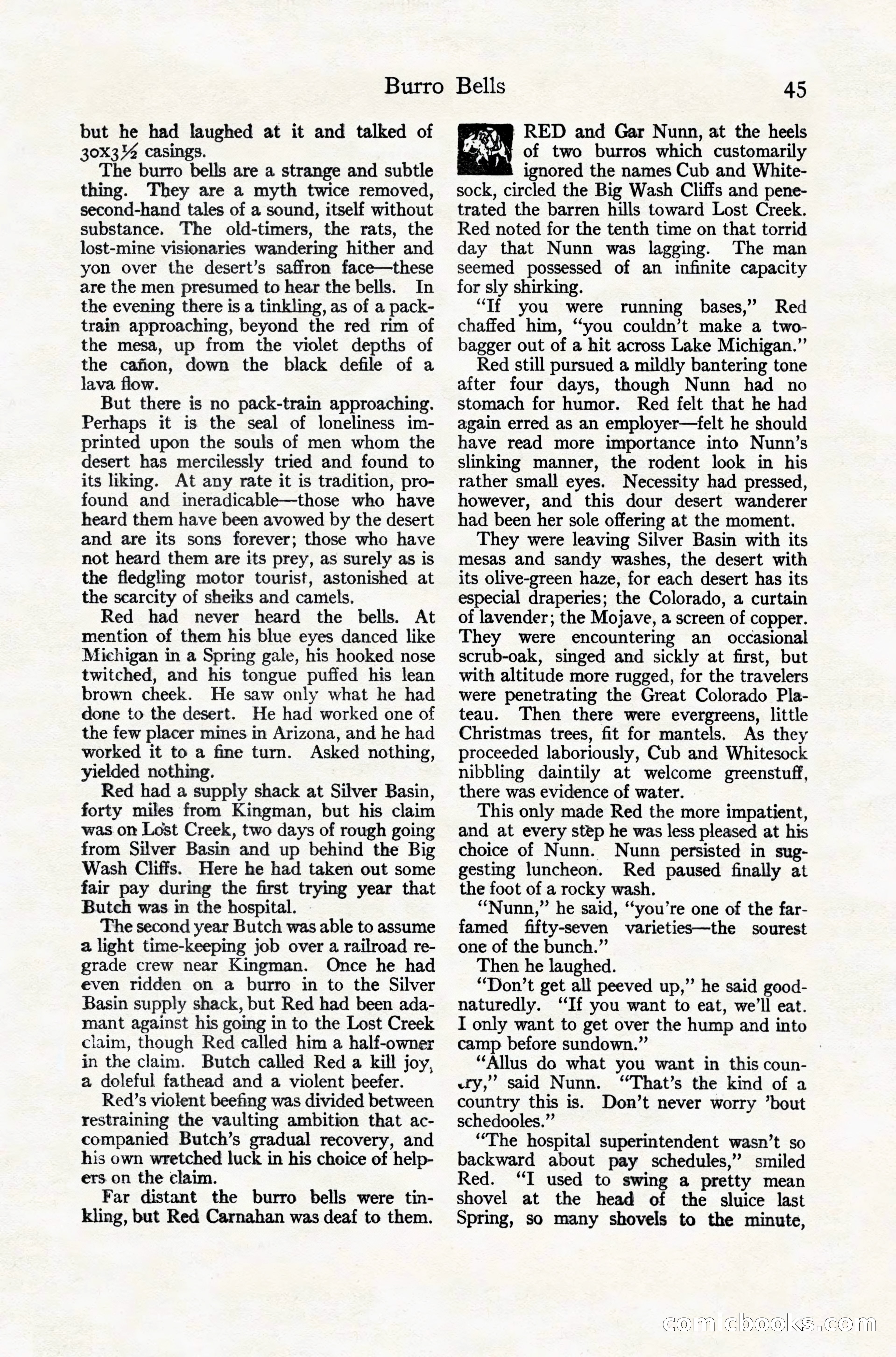
A restored page from Pulp Fiction, 1924. Page through the whole issue in the reader above.
📄 Transcribed text from this page (OCR, searchable)
Machine-transcribed from the original scan — historical spelling and the odd misread are preserved.
Burro Bells but he had laughed at it and talked of 30X3%% casings. The burro bells are a strange and subtle thing. They are a myth twice removed, second-hand tales of a sound, itself without substance. The old-timers, the rats, the lost-mine visionaries wandering hither and yon over the desert’s saffron face—these are the men presumed to hear the bells. In the evening there is a tinkling, as of a pack- train approaching, beyond the red rim of the mesa, up from the violet depths of the cafion, down the black defile of a lava flow. But there is no pack-train approaching. Perhaps it is the seal of loneliness im- printed upon the souls of men whom the desert has mercilessly tried and found to its liking. At any rate it is tradition, pro- found and ineradicable—those who have heard them have been avowed by the desert and are its sons forever; those who have not heard them are its prey, as surely as is the fledgling motor tourist, astonished at the scarcity of sheiks and camels. Red had never heard the bells. At mention of them his blue eyes danced like Michigan in a Spring gale, his hooked nose twitched, and his tongue puffed his lean brown cheek. He saw only what he had done to the desert. He had worked one of the few placer mines in Arizona, and he had worked it to a fine turn. Asked nothing, yielded nothing. Red had a supply shack at Silver Basin, forty miles from Kingman, but his claim was on Lost Creek, two days of rough going from Silver Basin and up behind the Big Wash Cliffs. Here he had taken out some fair pay during the first trying year that Butch was in the hospital. The second year Butch was able to assume a light time-keeping job over a railroad re- grade crew near Kingman. Once he had even ridden on a burro in to the Silver Basin supply shack, but Red had been ada- mant against his going in to the Lost Creek claim, though Red called him a half-owner in the claim. Butch called Red a kill joy, a doleful fathead and a violent beefer. Red’s violent beefing was divided between restraining the vaulting ambition that ac- companied Butch’s gradual recovery, and his own wretched luck in his choice of help- ers on the claim. Far distant the burro bells were tin- kling, but Red Carnahan was deaf to them. 45 RED and Gar Nunn, at the heels ~¥ Of two burros which customarily ignored the names Cub and White- sock, circled the Big Wash Cliffs and pene- trated the barren hills toward Lost Creek. Red noted for the tenth time on that torrid day that Nunn was lagging. The man seemed possessed of an infinite capacity for sly shirking. “Tf you were running bases,” Red chaffed him, “‘you couldn’t make a two- bagger out of a hit across Lake Michigan.” Red still pursued a mildly bantering tone after four days, though Nunn had no stomach for humor. Red felt that he had again erred as an employer—felt he should have read more importance into Nunn’s slinking manner, the rodent look in his rather small eyes. Necessity had pressed, however, and this dour desert wanderer had been her sole offering at the moment. They were leaving Silver Basin with its mesas and sandy washes, the desert with its olive-green haze, for each desert has its especial draperies; the Colorado, a curtain of lavender; the Mojave, a screen of copper. They were encountering an_ occasional scrub-oak, singed and sickly at first, but with altitude more rugged, for the travelers were penetrating the Great Colorado Pla- teau. Then there were evergreens, little Christmas trees, fit for mantels. As they proceeded laboriously, Cub and Whitesock nibbling daintily at welcome greenstuff, there was evidence of water. This only made Red the more impatient, and at every step he was less pleased at his choice of Nunn. Nunn persisted in sug- gesting luncheon. Red paused finally at the foot of a rocky wash. ‘“‘Nunn,” he said, “‘you’re one of the far- famed fifty-seven varieties—the sourest one of the bunch.” Then he laughed. “Don’t get all peeved up,” he said good- naturedly. “If you want to eat, we'll eat. I only want to get over the hump and into camp before sundown.” “Allus do what you want in this coun- wy,’ said Nunn. “That’s the kind of a country this is. Don’t never worry ‘bout schedooles.”’ “The hospital superintendent wasn’t so backward about pay schedules,” smiled Red. “I used to swing a pretty mean shovel at the head of the sluice last Spring, so many shovels to the minute, Go DOOK 1 @)