
Pulp Fiction, 1924 · page 40 of 204
Adventure Magazine Cover — page 40: what you’re looking at
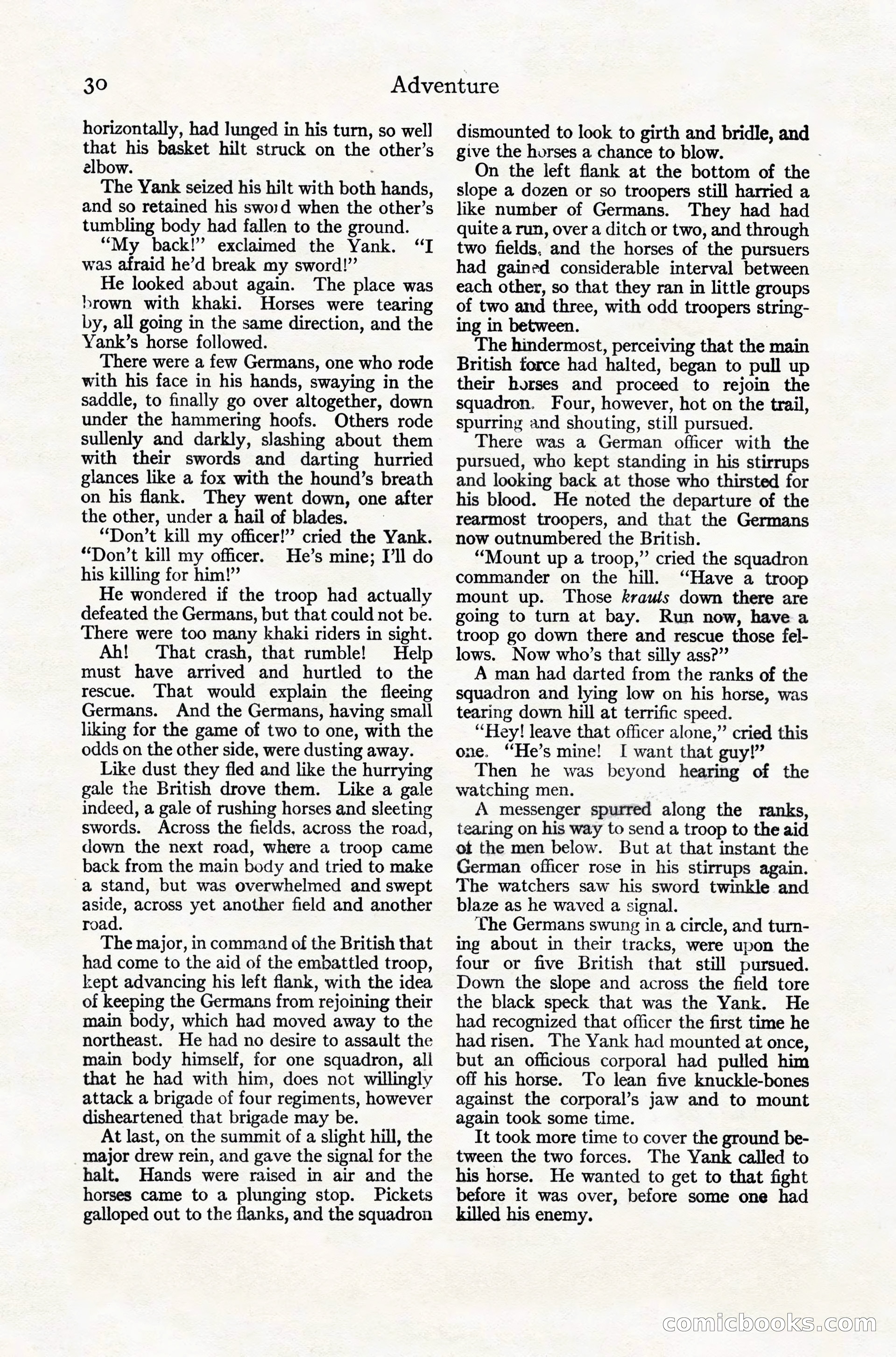
A restored page from Pulp Fiction, 1924. Page through the whole issue in the reader above.
📄 Transcribed text from this page (OCR, searchable)
Machine-transcribed from the original scan — historical spelling and the odd misread are preserved.
30 horizontally, had lunged in his turn, so well that his basket hilt struck on the other’s elbow. The Yank seized his hilt with both hands, and so retained his swosd when the other’s tumbling body had fallen to the ground. “My back!” exclaimed the Yank. was afraid he’d break my sword!” He looked about again. The place was brown with khaki. Horses were tearing by, all going in the same direction, and the Yank’s horse followed. There were a few Germans, one who rode with his face in his hands, swaying in the saddle, to finally go over altogether, down under the hammering hoofs. Others rode sullenly and darkly, slashing about them with their swords and darting hurried glances like a fox with the hound’s breath on his flank. They went down, one after the other, under a hail of blades. “Don’t kill my officer!’’ cried the Yank. “Don’t kill my officer. He’s mine; I’ll do his killing for him!” He wondered if the troop had actually defeated the Germans, but that could not be. There were too many khaki riders in sight. Ah! That crash, that rumble! Help must have arrived and hurtled to the rescue. That would explain the fleeing Germans. And the Germans, having small liking for the game of two to one, with the odds on the other side, were dusting away. Like dust they fled and like the hurrying gale the British drove them. Like a gale indeed, a gale of rushing horses and sleeting swords. Across the fields, across the road, down the next road, where a troop came back from the main body and tried to make -a stand, but was overwhelmed and swept aside, across yet another field and another road. The major, in command of the British that had come to the aid of the embattled troop, kept advancing his left flank, with the idea of keeping the Germans from rejoining their main body, which had moved away to the northeast. He had no desire to assault the main body himself, for one squadron, all that he had with him, does not willingly attack a brigade of four regiments, however disheartened that brigade may be. At last, on the summit of a slight hill, the major drew rein, and gave the signal for the halt. Hands were raised in air and the horses came to a plunging stop. Pickets galloped out to the flanks, and the squadron al | Adventure dismounted to look to girth and bridle, and give the horses a chance to blow. On the left flank at the bottom of the | slope a dozen or so troopers still harried a like number of Germans. They had had quite a run, over a ditch or two, and through two fields, and the horses of the pursuers had gained considerable interval between each other, so that they ran in little groups of two and three, with odd troopers string- ing in between. : The hindermost, perceiving that the main British force had halted, began to pull up their horses and proceed to rejoin the squadron. Four, however, hot on the trail, spurring and shouting, still pursued. There was a German officer with the pursued, who kept standing in his stirrups and looking back at those who thirsted for his blood. He noted the departure of the rearmost troopers, and that the Germans now outnumbered the British. “Mount up a troop,” cried the squadron commander on the hill. “Have a troop mount up. Those krauts down there are going to turn at bay. Run now, have a troop go down there and rescue those fel- lows. Now who’s that silly ass?” A man had darted from the ranks of the squadron and lying low on his horse, was tearing down hill at terrific speed. ‘Hey! leave that officer alone,” cried this one. “He’s mine! I want that guy!” Then he was beyond hearing of the watching men. A messenger spurred along the ranks, tearing on his way to send a troop to the aid of the men below. But at that instant the German officer rose in his stirrups again. The watchers saw his sword twinkle and blaze as he waved a signal. The Germans swung in a circle, and turn- ing about in their tracks, were upon the four or five British that still pursued. Down the slope and across the field tore the black speck that was the Yank. He had recognized that officer the first time he had risen. The Yank had mounted at once, but an officious corporal had pulled him off his horse. To lean five knuckle-bones against the corporal’s jaw and to mount again took some time. It took more time to cover the ground be- tween the two forces. The Yank called to his horse. He wanted to get to that fight before it was over, before some one had killed his enemy. Go DOOLK 1O)