
Pulp Fiction, 1924 · page 198 of 204
Adventure Magazine Cover — page 198: what you’re looking at
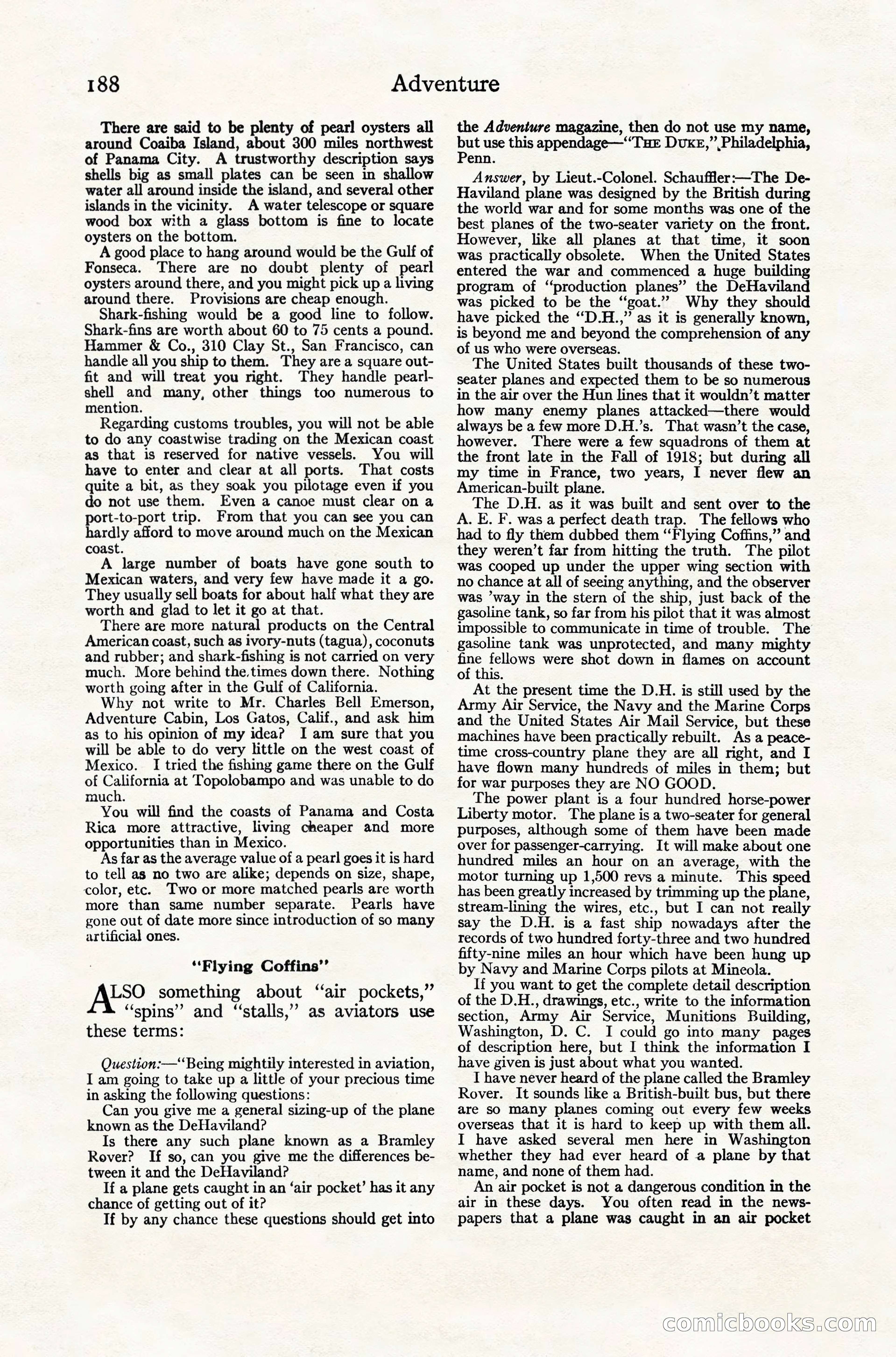
A restored page from Pulp Fiction, 1924. Page through the whole issue in the reader above.
📄 Transcribed text from this page (OCR, searchable)
Machine-transcribed from the original scan — historical spelling and the odd misread are preserved.
188 There are said to be plenty of pearl oysters all around Coaiba Island, about 300 miles northwest of Panama City. A trustworthy description says shells big as small plates can be seen in shallow water all around inside the island, and several other islands in the vicinity. A water telescope or square wood box with a glass bottom is fine to locate oysters on the bottom. A good place to hang around would be the Gulf of Fonseca. There are no doubt plenty of pearl oysters around there, and you might pick up a living around there. Provisions are cheap enough. Shark-fishing would be a good line to follow. Shark-fins are worth about 60 to 75 cents a pound. Hammer & Co., 310 Clay St., San Francisco, can handle all you ship to them. They are a square out- fit and will treat you right. They handle pearl- shell and many, other things too numerous to mention. Regarding customs troubles, you will not be able to do any coastwise trading on the Mexican coast as that is reserved for native vessels. You will have to enter and clear at all ports. That costs quite a bit, as they soak you pilotage even if you do not use them. Even a canoe must clear on a port-to-port trip. From that you can see you can hardly afford to move around much on the Mexican coast. A large number of boats have gone south to Mexican waters, and very few have made it a go. They usually sell boats for about half what they are worth and glad to let it go at that. There are more natural products on the Central American coast, such as ivory-nuts (tagua), coconuts and rubber; and shark-fishing is not carried on very much. More behind the,times down there. Nothing worth going after in the Gulf of California. Why not write to Mr. Charles Bell Emerson, Adventure Cabin, Los Gatos, Calif., and ask him as to his opinion of my idea? I am sure that you will be able to do very little on the west coast of Mexico. I tried the fishing game there on the Gulf of California at Topolobampo and was unable to do much. You will find the coasts of Panama and Costa Rica more attractive, living cheaper and more opportunities than in Mexico. As far as the average value of a pearl goes it is hard to tell as no two are alike; depends on size, shape, color, etc. Two or more matched pearls are worth more than same number separate. Pearls have gone out of date more since introduction of so many artificial ones. “Flying Coffins’’ ples something about “air pockets,” “spins” and “stalls,” as aviators use these terms: Question: —“‘Being mightily interested in aviation, I am going to take up a little of your precious time in asking the following questions: Can you give me a general sizing-up of the plane known as the DeHaviland? Is there any such plane known as a Bramley Rover? If so, can you give me the differences be- tween it and the DeHaviland? If a plane gets caught in an ‘air pocket’ has it any chance of getting out of it? If by any chance these questions should get into Adventure the Adventure magazine, then do not use my name, ae use this appendage—“‘THE DUKE,” Philadelphia, enn. Answer, by Lieut.-Colonel. Schauffler:—The De- Haviland plane was designed by the British during the world war and for some months was one of the best planes of the two-seater variety on the front. However, like all planes at that time, it soon was practically obsolete. When the United States entered the war and commenced a huge building program of “production planes” the DeHaviland was picked to be the “goat.” Why they should have picked the “‘D.H.,”’ as it is generally known, is beyond me and beyond the comprehension of any of us who were overseas. The United States built thousands of these two- seater planes and expected them to be so numerous in the air over the Hun lines that it wouldn’t matter how many enemy planes attacked—there would always be a few more D.H.’s. That wasn’t the case, however. There were a few squadrons of them at the front late in the Fall of 1918; but during all my time in France, two years, I never flew an American-built plane. The D.H. as it was built and sent over to the A. E. F. was a perfect death trap. The fellows who had to fly them dubbed them ‘Flying Coffins,’ and they weren’t far from hitting the truth. The pilot was cooped up under the upper wing section with no chance at all of seeing anything, and the observer was ’way in the stern of the ship, just back of the gasoline tank, so far from his pilot that it was almost impossible to communicate in time of trouble. The gasoline tank was unprotected, and many mighty fine fellows were shot down in flames on account of this. At the present time the D.H. is still used by the Army Air Service, the Navy and the Marine Corps and the United States Air Mail Service, but these machines have been practically rebuilt. As a peace- time cross-country plane they are all right, and I have flown many hundreds of miles in them; but for war purposes they are NO GOOD. The power plant is a four hundred horse-power Liberty motor. The plane is a two-seater for general purposes, although some of them have been made over for passenger-carrying. It will make about one hundred miles an hour on an average, with the motor turning up 1,500 revs a minute. This speed has been greatly increased by trimming up the plane, stream-lining the wires, etc., but I can not really say the D.H. is a fast ship nowadays after the records of two hundred forty-three and two hundred fifty-nine miles an hour which have been hung up by Navy and Marine Corps pilots at Mineola. If you want to get the complete detail description of the D.H., drawings, etc., write to the information section, Army Air Service, Munitions Building, Washington, D. C. I could go into many pages of description here, but I think the information I have given is just about what you wanted. I have never heard of the plane called the Bramley Rover. It sounds like a British-built bus, but there are so many planes coming out every few weeks overseas that it is hard to keep up with them all. I have asked several men here in Washington whether they had ever heard of a plane by that name, and none of them had. An air pocket is not a dangerous condition in the air in these days. You often read in the news- papers that a plane was caught in an air pocket 1OOOLK (C@