
Pulp Fiction, 1924 · page 189 of 204
Adventure Magazine Cover — page 189: what you’re looking at
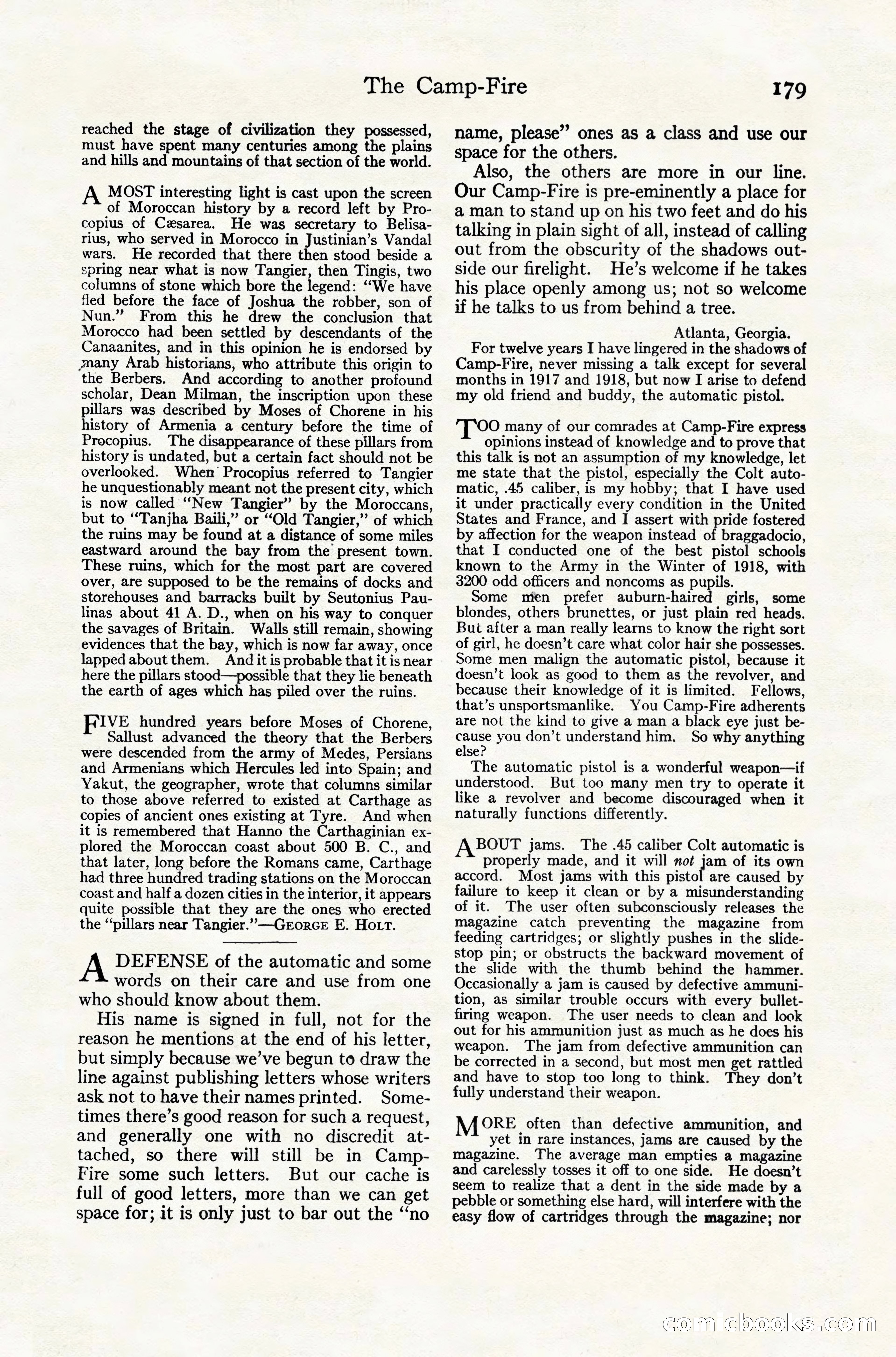
A restored page from Pulp Fiction, 1924. Page through the whole issue in the reader above.
📄 Transcribed text from this page (OCR, searchable)
Machine-transcribed from the original scan — historical spelling and the odd misread are preserved.
The Camp-Fire reached the stage of civilization they possessed, must have spent many centuries among the plains and hills and mountains of that section of the world. MOST interesting light is cast upon the screen of Moroccan history by a record left by Pro- copius of Cesarea. He was secretary to Belisa- rius, who served in Morocco in Justinian’s Vandal wars. He recorded that there then stood beside a spring near what is now Tangier, then Tingis, two columns of stone which bore the legend: “We have fled before the face of Joshua the robber, son of Nun.” From this he drew the conclusion that Morocco had been settled by descendants of the Canaanites, and in this opinion he is endorsed by ymany Arab historians, who attribute this origin to the Berbers. And according to another profound scholar, Dean Milman, the inscription upon these pillars was described by Moses of Chorene in his history of Armenia a century before the time of Procopius. The disappearance of these pillars from history is undated, but a certain fact should not be overlooked. When Procopius referred to Tangier he unquestionably meant not the present city, which is now called “New Tangier” by the Moroccans, but to “Tanjha Baili,”’ or “Old Tangier,” of which the ruins may be found at a distance of some miles eastward around the bay from the present town. These ruins, which for the most part are covered over, are supposed to be the remains of docks and storehouses and barracks built by Seutonius Pau- linas about 41 A. D., when on his way to conquer the savages of Britain. Walls still remain, showing evidences that the bay, which is now far away, once lapped about them. And it is probable that it is near here the pillars stood—possible that they lie beneath the earth of ages which has piled over the ruins. FIVE hundred years before Moses of Chorene, Sallust advanced the theory that the Berbers were descended from the army of Medes, Persians and Armenians which Hercules led into Spain; and Yakut, the geographer, wrote that columns similar to those above referred to existed at Carthage as copies of ancient ones existing at Tyre. And when it is remembered that Hanno the Carthaginian ex- plored the Moroccan coast about 500 B. C., and that later, long before the Romans came, Carthage had three hundred trading stations on the Moroccan coast and half a dozen cities in the interior, it appears quite possible that they are the ones who erected the “pillars near Tangier.”—GrorGE E. Hott. DEFENSE of the automatic and some words on their care and use from one who should know about them. His name is signed in full, not for the reason he mentions at the end of his letter, but simply because we’ve begun to draw the line against publishing letters whose writers ask not to have their names printed. Some- times there’s good reason for such a request, and generally one with no discredit at- tached, so there will still be in Camp- Fire some such letters. But our cache is full of good letters, more than we can get space for; it is only just to bar out the “‘no 179 name, please” ones as a class and use our space for the others. Also, the others are more in our line. Our Camp-Fire is pre-eminently a place for a man to stand up on his two feet and do his talking in plain sight of all, instead of calling out from the obscurity of the shadows out- side our firelight. He’s welcome if he takes his place openly among us; not so welcome if he talks to us from behind a tree. Atlanta, Georgia. For twelve years I have lingered in the shadows of Camp-Fire, never missing a talk except for several months in 1917 and 1918, but now I arise to defend my old friend and buddy, the automatic pistol. OO many of our comrades at Camp-Fire express opinions instead of knowledge and to prove that this talk is not an assumption of my knowledge, let me state that the pistol, especially the Colt auto- matic, .45 caliber, is my hobby; that I have used it under practically every condition in the United States and France, and I assert with pride fostered by affection for the weapon instead of braggadocio, that I conducted one of the best pistol schools known to the Army in the Winter of 1918, with 3200 odd officers and noncoms as pupils. Some mien prefer auburn-haired girls, some blondes, others brunettes, or just plain red heads. But after a man really learns to know the right sort of girl, he doesn’t care what color hair she possesses. Some men malign the automatic pistol, because it doesn’t look as good to them as the revolver, and because their knowledge of it is limited. Fellows, that’s unsportsmanlike. You Camp-Fire adherents are not the kind to give a man a black eye just be- Sige you don’t understand him. So why anything else? The automatic pistol is a wonderful weapon—if understood. But too many men try to operate it like a revolver and become discouraged when it naturally functions differently. BOUT jams. The .45 caliber Colt automatic is properly made, and it will not jam of its own accord. Most jams with this pistol are caused by failure to keep it clean or by a misunderstanding of it. The user often subconsciously releases the magazine catch preventing the magazine from feeding cartridges; or slightly pushes in the slide- stop pin; or obstructs the backward movement of the slide with the thumb behind the hammer. Occasionally a jam is caused by defective ammuni- tion, as similar trouble occurs with every bullet- firing weapon. The user needs to clean and look out for his ammunition just as much as he does his weapon. ‘The jam from defective ammunition can be corrected in a second, but most men get rattled and have to stop too long to think. They don’t fully understand their weapon. ORE often than defective ammunition, and yet in rare instances, jams are caused by the magazine. The average man empties a magazine and carelessly tosses it off to one side. He doesn’t seem to realize that a dent in the side made by a pebble or something else hard, will interfere with the easy flow of cartridges through the magazine; nor LOOOLK 1 O)