
Pulp Fiction, 1924 · page 186 of 204
Adventure Magazine Cover — page 186: what you’re looking at
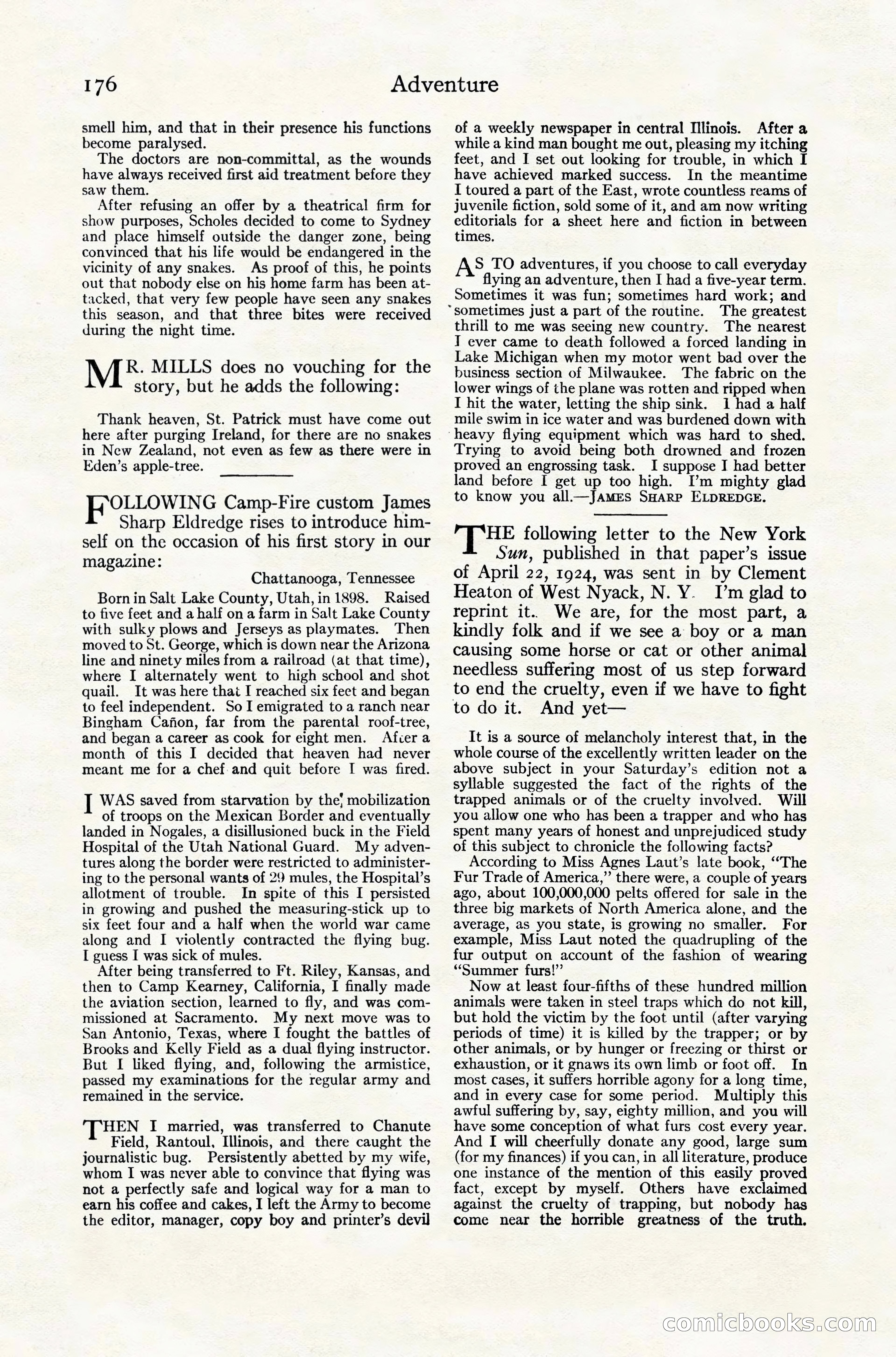
A restored page from Pulp Fiction, 1924. Page through the whole issue in the reader above.
📄 Transcribed text from this page (OCR, searchable)
Machine-transcribed from the original scan — historical spelling and the odd misread are preserved.
176 smell him, and that in their presence his functions become paralysed. The doctors are non-committal, as the wounds have always received first aid treatment before they saw them. After refusing an offer by a theatrical firm for show purposes, Scholes decided to come to Sydney and place himself outside the danger zone, being convinced that his life would be endangered in the vicinity of any snakes. As proof of this, he points out that nobody else on his home farm has been at- tacked, that very few people have seen any snakes this season, and that three bites were received during the night time. M:& MILLS does no vouching for the story, but he adds the following: Thank heaven, St. Patrick must have come out here after purging Ireland, for there are no snakes in New Zealand, not even as few as there were in Eden’s apple-tree. pe G Camp-Fire custom James Sharp Eldredge rises to introduce him- self on the occasion of his first story in our magazine: Chattanooga, Tennessee Born in Salt Lake County, Utah, in 1898. Raised to five feet and a half on a farm in Salt Lake County with sulky plows and Jerseys as playmates. Then moved to St. George, which is down near the Arizona line and ninety miles from a railroad (at that time), where I alternately went to high school and shot quail. It was here thai I reached six feet and began to feel independent. So I emigrated to a ranch near Bingham Cafion, far from the parental roof-tree, and began a career as cook for eight men. Afcera month of this I decided that heaven had never meant me for a chef and quit before I was fired. WAS saved from starvation by the} mobilization of troops on the Mexican Border and eventually landed in Nogales, a disillusioned buck in the Field Hospital of the Utah National Guard. My adven- tures along the border were restricted to administer- ing to the personal wants of 29 mules, the Hospital’s allotment of trouble. In spite of this I persisted in growing and pushed the measuring-stick up to six feet four and a half when the world war came along and I violently contracted the flying bug. I guess I was sick of mules. After being transferred to Ft. Riley, Kansas, and then to Camp Kearney, California, I finally made the aviation section, learned to fly, and was com- missioned at Sacramento. My next move was to San Antonio, Texas, where I fought the battles of Brooks and Kelly Field as a dual flying instructor. But I liked flying, and, following the armistice, passed my examinations for the regular army and remained in the service. "THEN I married, was transferred to Chanute Field, Rantoul, Illinois, and there caught the journalistic bug. Persistently abetted by my wife, whom I was never able to convince that flying was not a perfectly safe and logical way for a man to earn his coffee and cakes, I left the Army to become the editor, manager, copy boy and printer’s devil “sometimes just a part of the routine. Adventure of a weekly newspaper in central Illinois. After a while a kind man bought me out, pleasing my itching feet, and I set out looking for trouble, in which I have achieved marked success. In the meantime I toured a part of the East, wrote countless reams of juvenile fiction, sold some of it, and am now writing editorials for a sheet here and fiction in between times. A® TO adventures, if you choose to call everyday flying an adventure, then I had a five-year term. Sometimes it was fun; sometimes hard work; and The greatest thrill to me was seeing new country. The nearest T ever came to death followed a forced landing in Lake Michigan when my motor went bad over the business section of Milwaukee. The fabric on the lower wings of the plane was rotten and ripped when I hit the water, letting the ship sink. 1 had a half mile swim in ice water and was burdened down with ‘heavy flying equipment which was hard to shed. Trying to avoid being both drowned and frozen proved an engrossing task. I suppose I had better land before I get up too high. I’m mighty glad to know you all.—James SHARP ELDREDGE. "THE following letter to the New York Sun, published in that paper’s issue of April 22, 1924, was sent in by Clement Heaton of West Nyack, N. Y. I’m glad to reprint it. We are, for the most part, a kindly folk and if we see a boy or a man causing some horse or cat or other animal needless suffering most of us step forward to end the cruelty, even if we have to fight to do it. And yet— It is a source of melancholy interest that, in the whole course of the excellently written leader on the above subject in your Saturday’s edition not a syllable suggested the fact of the rights of the trapped animals or of the cruelty involved. Will you allow one who has been a trapper and who has spent many years of honest and unprejudiced study of this subject to chronicle the following facts? According to Miss Agnes Laut’s late book, ‘“The Fur Trade of America,” there were, a couple of years ago, about 100,000,000 pelts offered for sale in the three big markets of North America alone, and the average, as you state, is growing no smaller. For example, Miss Laut noted the quadrupling of the fur output on account of the fashion of wearing “Summer furs!” Now at least four-fifths of these hundred million animals were taken in steel traps which do not kill, but hold the victim by the foot until (after varying periods of time) it is killed by the trapper; or by other animals, or by hunger or freezing or thirst or exhaustion, or it gnaws its own limb or foot off. In most cases, it suffers horrible agony for a long time, and in every case for some period. Multiply this awful suffering by, say, eighty million, and you will have some conception of what furs cost every year. And I will cheerfully donate any good, large sum (for my finances) if you can, in all literature, produce one instance of the mention of this easily proved fact, except by myself. Others have exclaimed against the cruelty of trapping, but nobody has come near the horrible greatness of the truth. 1DOOLK (©