
Pulp Fiction, 1924 · page 179 of 204
Adventure Magazine Cover — page 179: what you’re looking at
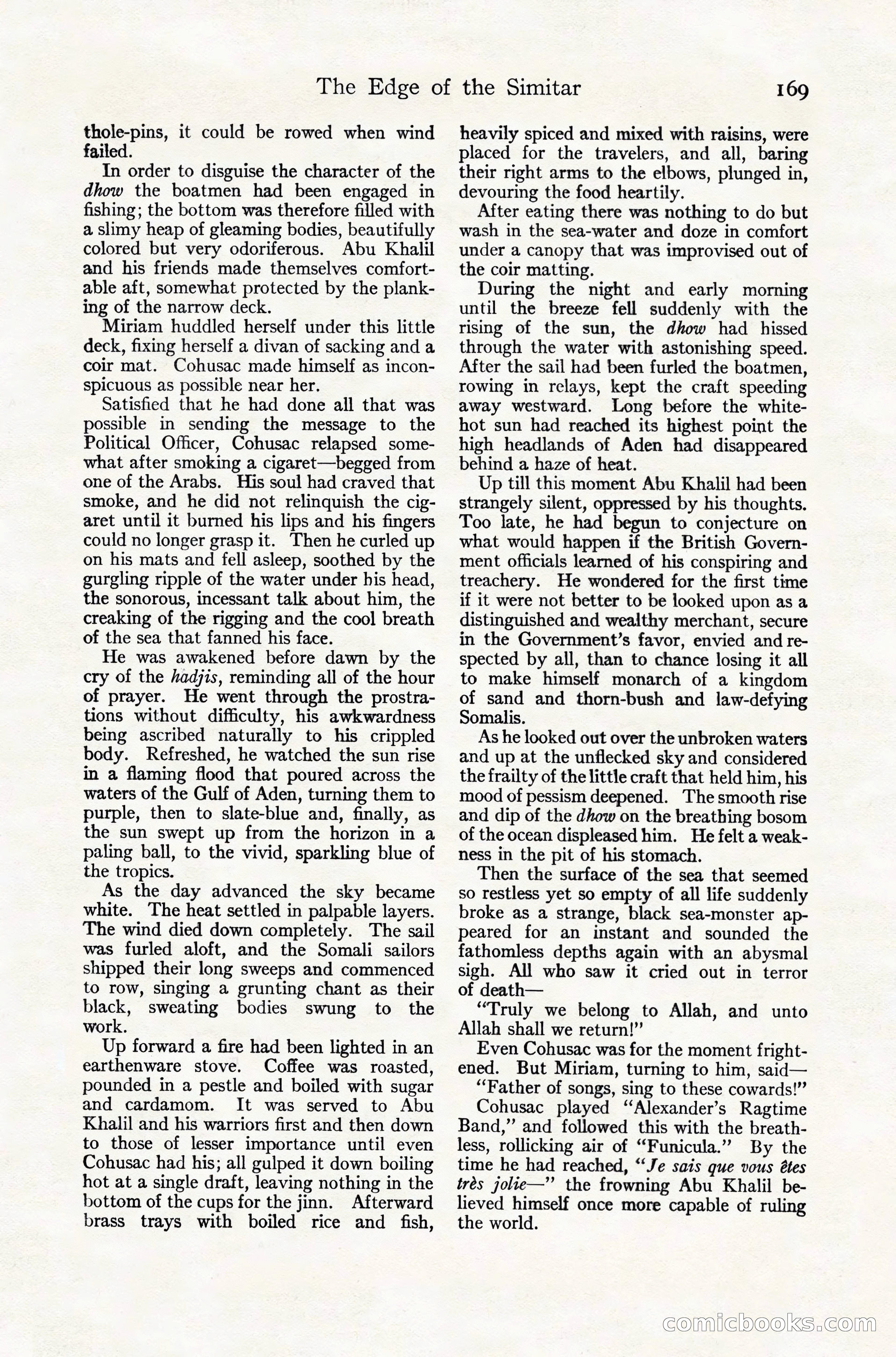
A restored page from Pulp Fiction, 1924. Page through the whole issue in the reader above.
📄 Transcribed text from this page (OCR, searchable)
Machine-transcribed from the original scan — historical spelling and the odd misread are preserved.
The Edge of the Simitar thole-pins, it could be rowed when wind failed. In order to disguise the character of the dhow the boatmen had been engaged in fishing; the bottom was therefore filled with a slimy heap of gleaming bodies, beautifully colored but very odoriferous. Abu Khalil and his friends made themselves comfort- able aft, somewhat protected by the plank- ing of the narrow deck. Miriam huddled herself under this little deck, fixing herself a divan of sacking and a coir mat. Cohusac made himself as incon- spicuous as possible near her. Satisfied that he had done all that was possible in sending the message to the Political Officer, Cohusac relapsed some- what after smoking a cigaret—begged from one of the Arabs. His soul had craved that smoke, and he did not relinquish the cig- aret until it burned his lips and his fingers could no longer grasp it. Then he curled up on his mats and fell asleep, soothed by the gurgling ripple of the water under his head, the sonorous, incessant talk about him, the creaking of the rigging and the cool breath of the sea that fanned his face. He was awakened before dawn by the cry of the hadjis, reminding all of the hour of prayer. He went through the prostra- tions without difficulty, his awkwardness being ascribed naturally to his crippled body. Refreshed, he watched the sun rise in a flaming flood that poured across the waters of the Gulf of Aden, turning them to purple, then to slate-blue and, finally, as the sun swept up from the horizon in a paling ball, to the vivid, sparkling blue of the tropics. As the day advanced the sky became white. The heat settled in palpable layers. The wind died down completely. The sail was furled aloft, and the Somali sailors shipped their long sweeps and commenced to row, singing a grunting chant as their black, sweating bodies swung to the work. Up forward a fire had been lighted in an earthenware stove. Coffee was roasted, pounded in a pestle and boiled with sugar and cardamom. It was served to Abu Khalil and his warriors first and then down to those of lesser importance until even Cohusac had his; all gulped it down boiling hot at a single draft, leaving nothing in the bottom of the cups for the jinn. Afterward brass trays with boiled rice and _ fish, 169 heavily spiced and mixed with raisins, were placed for the travelers, and all, baring their right arms to the elbows, plunged in, devouring the food heartily. After eating there was nothing to do but wash in the sea-water and doze in comfort under a canopy that was improvised out of the coir matting. During the night and early morning until the breeze fell suddenly with the rising of the sun, the dhow had _ hissed through the water with astonishing speed. After the sail had been furled the boatmen, rowing in relays, kept the craft speeding away westward. Long before the white- hot sun had reached its highest point the high headlands of Aden had disappeared behind a haze of heat. Up till this moment Abu Khalil had been strangely silent, oppressed by his thoughts. Too late, he had begun to conjecture on what would happen if the British Govern- ment officials learned of his conspiring and treachery. He wondered for the first time if it were not better to be looked upon as a distinguished and wealthy merchant, secure in the Government’s favor, envied and re- spected by all, than to chance losing it all to make himself monarch of a kingdom of sand and thorn-bush and law-defying Somalis. As he looked out over the unbroken waters and up at the unflecked sky and considered the frailty of the little craft that held him, his mood of pessism deepened. The smooth rise and dip of the dhow on the breathing bosom of the ocean displeased him. He felt a weak- ness in the pit of his stomach. Then the surface of the sea that seemed so restless yet so empty of all life suddenly broke as a strange, black sea-monster ap- peared for an instant and sounded the fathomless depths again with an abysmal sigh. All who saw it cried out in terror of death— “Truly we belong to Allah, and unto Allah shall we return!” Even Cohusac was for the moment fright- ened. But Miriam, turning to him, said— “Father of songs, sing to these cowards!” Cohusac played ‘‘Alexander’s Ragtime Band,” and followed this with the breath- less, rollicking air of “Funicula.” By the time he had reached, “‘Je sais que vous étes tres jolie—’’ the frowning Abu Khalil be- lieved himself once more capable of ruling the world. Co DOOLK 1 @)