
Pulp Fiction, 1924 · page 171 of 204
Adventure Magazine Cover — page 171: what you’re looking at
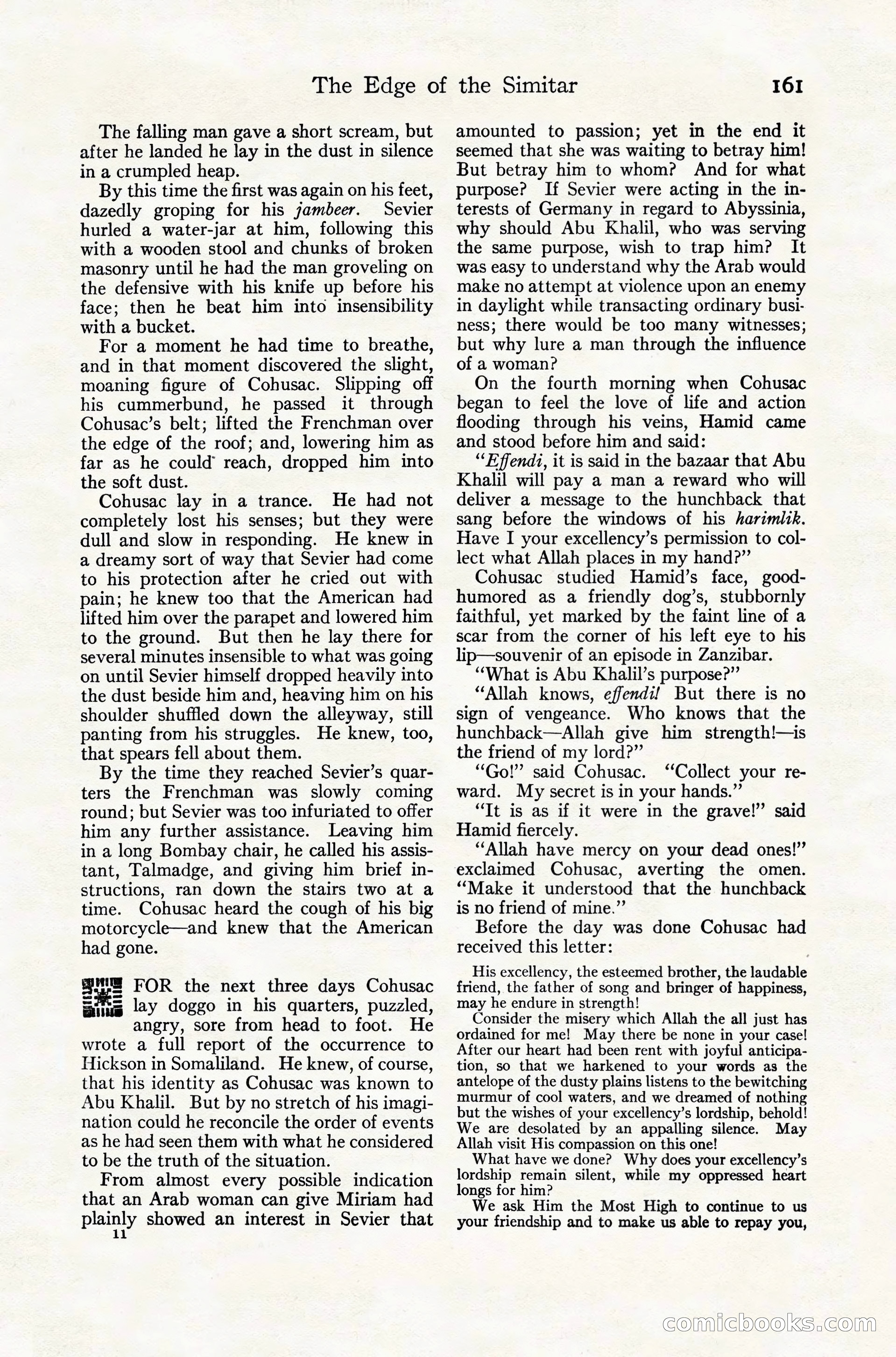
A restored page from Pulp Fiction, 1924. Page through the whole issue in the reader above.
📄 Transcribed text from this page (OCR, searchable)
Machine-transcribed from the original scan — historical spelling and the odd misread are preserved.
The Edge of the Simitar The falling man gave a short scream, but after he landed he lay in the dust in silence in a crumpled heap. By this time the first was again on his feet, dazedly groping for his jambeer. Sevier hurled a water-jar at him, following this with a wooden stool and chunks of broken masonry until he had the man groveling on the defensive with his knife up before his face; then he beat him into insensibility with a bucket. For a moment he had time to breathe, and in that moment discovered the slight, moaning figure of Cohusac. Slipping off his cummerbund, he passed it through Cohusac’s belt; lifted the Frenchman over the edge of the roof; and, lowering him as far as he could reach, dropped him into the soft dust. Cohusac lay in a trance. He had not completely lost his senses; but they were dull and slow in responding. He knew in a dreamy sort of way that Sevier had come to his protection after he cried out with pain; he knew too that the American had lifted him over the parapet and lowered him to the ground. But then he lay there for several minutes insensible to what was going on until Sevier himself dropped heavily into the dust beside him and, heaving him on his shoulder shuffled down the alleyway, still panting from his struggles. He knew, too, that spears fell about them. By the time they reached Sevier’s quar- ters the Frenchman was slowly coming round; but Sevier was too infuriated to offer him any further assistance. Leaving him in a long Bombay chair, he called his assis- tant, Talmadge, and giving him brief in- structions, ran down the stairs two at a time. Cohusac heard the cough of his big motorcycle—and knew that the American had gone. egim= FOR the next three days Cohusac =e lay doggo in his quarters, puzzled, angry, sore from head to foot. He wrote a full report of the occurrence to Hickson in Somaliland. He knew, of course, that his identity as Cohusac was known to Abu Khalil. But by no stretch of his imagi- nation could he reconcile the order of events as he had seen them with what he considered to be the truth of the situation. From almost every possible indication that an Arab woman can give Miriam had plainly showed an interest in Sevier that 161 amounted to passion; yet in the end it seemed that she was waiting to betray him! But betray him to whom? And for what purpose? If Sevier were acting in the in- terests of Germany in regard to Abyssinia, why should Abu Khalil, who was serving the same purpose, wish to trap him? It was easy to understand why the Arab would make no attempt at violence upon an enemy in daylight while transacting ordinary busi- ness; there would be too many witnesses; but why lure a man through the influence of a woman? On the fourth morning when Cohusac began to feel the love of life and action flooding through his veins, Hamid came and stood before him and said: “Effendi, it is said in the bazaar that Abu Khalil will pay a man a reward who will deliver a message to the hunchback that sang before the windows of his harimizk. Have I your excellency’s permission to col- lect what Allah places in my hand?” Cohusac studied Hamid’s face, good- humored as a friendly dog’s, stubbornly faithful, yet marked by the faint line of a scar from the corner of his left eye to his lip—souvenir of an episode in Zanzibar. ‘“‘What is Abu Khalil’s purpose?” “Allah knows, effendi{! But there is no sign of vengeance. Who knows that the hunchback—Allah give him strength!—is the friend of my lord?” “Go!” said Cohusac. “Collect your re- ward. My secret is in your hands.”’ “It is as if it were in the grave!’ said Hamid fiercely. ‘“‘Allah have mercy on your dead ones!”’ exclaimed Cohusac, averting the omen. “‘Make it understood that the hunchback is no friend of mine.”’ Before the day was done Cohusac had received this letter: His excellency, the esteemed brother, the laudable friend, the father of song and bringer of happiness, may he endure in strength! Consider the misery which Allah the all just has ordained for me! May there be none in your case! After our heart had been rent with joyful anticipa- tion, so that we harkened to your words as the antelope of the dusty plains listens to the bewitching murmur of cool waters, and we dreamed of nothing but the wishes of your excellency’s lordship, behold! We are desolated by an appalling silence. May Allah visit His compassion on this one! What have we done? Why does your excellency’s lordship remain silent, while my oppressed heart longs for him? We ask Him the Most High to continue to us your friendship and to make us able to repay you, MICLOOOLK (C©