
Pulp Fiction, 1924 · page 165 of 204
Adventure Magazine Cover — page 165: what you’re looking at
A restored page from Pulp Fiction, 1924. Page through the whole issue in the reader above.
📄 Transcribed text from this page (OCR, searchable)
Machine-transcribed from the original scan — historical spelling and the odd misread are preserved.
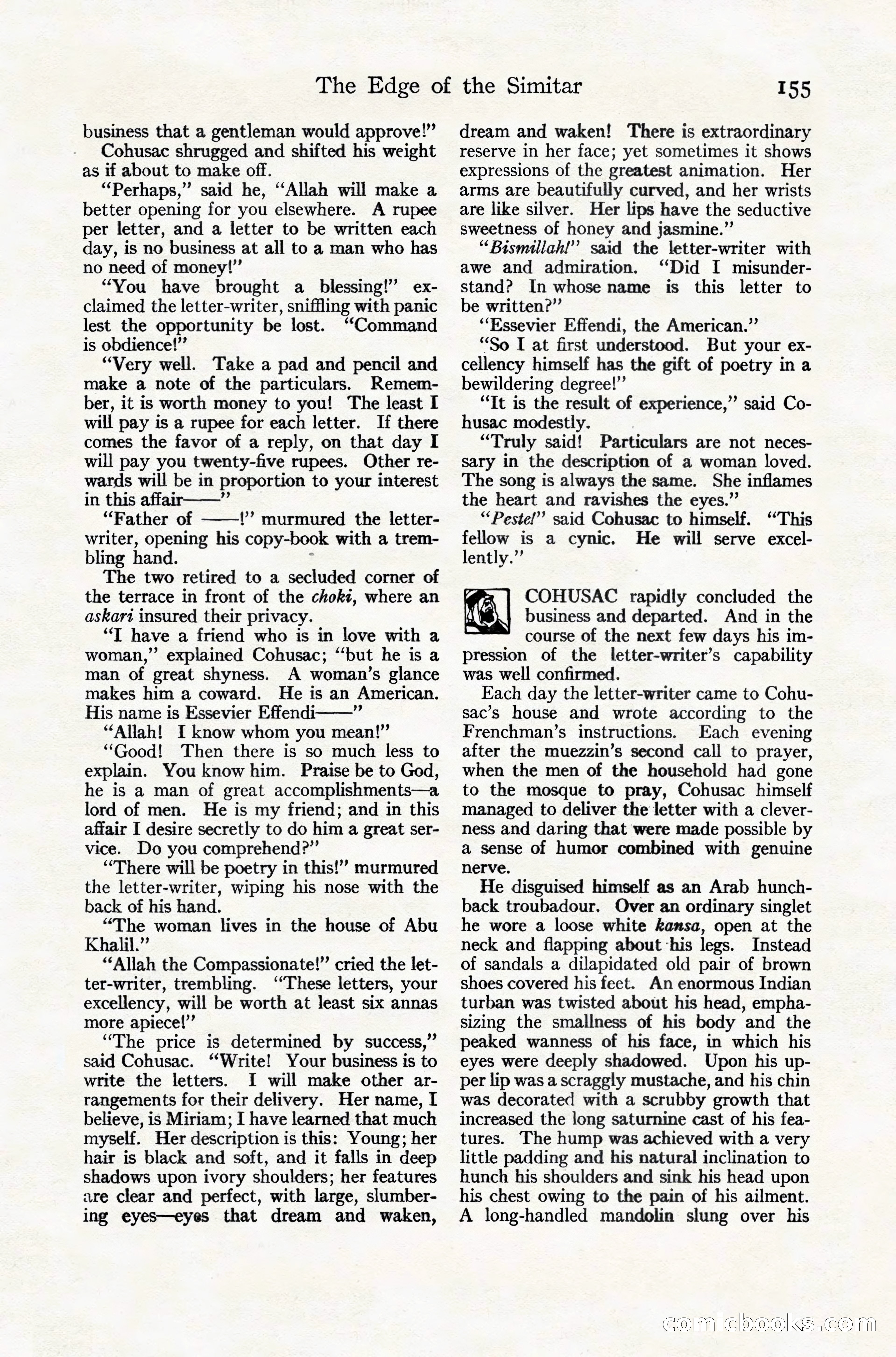
The Edge of the Simitar business that a gentleman would approve!” Cohusac shrugged and shifted his weight as if about to make off. “Perhaps,” said he, ‘Allah will make a better opening for you elsewhere. A rupee per letter, and a letter to be written each day, is no business at all to a man who has no need of money!’ “You have brought a blessing!” ex- claimed the letter-writer, sniffling with panic lest the opportunity be lost. “Command is obdience!”’ “Very well. Take a pad and pencil and make a note of the particulars. Remem- ber, it is worth money to you! The least I will pay is a rupee for each letter. If there comes the favor of a reply, on that day I will pay you twenty-five rupees. Other re- wards will be in proportion to your interest in this affair——”’ “Father of ——!’’ murmured the letter- writer, opening his copy-book with a trem- bling hand. ; The two retired to a secluded corner of the terrace in front of the chokz, where an askari insured their privacy. “T have a friend who is in love with a woman,” explained Cohusac; “but he is a man of great shyness. A woman’s glance makes him a coward. He is an American. His name is Essevier Effendi “Allah! I know whom you mean!” “Good! Then there is so much less to explain. You know him. Praise be to God, he is a man of great accomplishments—a lord of men. He is my friend; and in this affair I desire secretly to do him a great ser- vice. Do you comprehend?” ‘There will be poetry in this!’ murmured the letter-writer, wiping his nose with the back of his hand. “The woman lives in the house of Abu Khalil.” “‘Allah the Compassionate!”’ cried the let- ter-writer, trembling. “These letters, your excellency, will be worth at least six annas more apiece!” “The price is determined by success,” said Cohusac. “Write! Your business is to write the letters. I will make other ar- rangements for their delivery. Her name, I believe, is Miriam; I have learned that much myself. Her description is this: Young; her hair is black and soft, and it falls in deep shadows upon ivory shoulders; her features are clear and perfect, with large, slumber- ing eyes—eyes that dream and waken, 155 dream and waken! There is extraordinary reserve in her face; yet sometimes it shows expressions of the greatest animation. Her arms are beautifully curved, and her wrists are like silver. Her lips have the seductive sweetness of honey and jasmine.” “Bismillah!” said the letter-writer with awe and admiration. “Did I misunder- stand? In whose name is this letter to be written?” “‘Essevier Effendi, the American.”’ “So I at first understood. But your ex- cellency himself has the gift of poetry in a bewildering degree!”’ “It is the result of experience,” said Co- husac modestly. “Truly said! Particulars are not neces- sary in the description of a woman loved. The song is always the same. She inflames the heart and ravishes the eyes.” “Pestel”’ said Cohusac to himself. fellow is a cynic. “This He will serve excel- lently.” G | COHUSAC rapidly concluded the MON business and departed. And in the course of the next few days his im- pression of the letter-writer’s capability was well confirmed. Each day the letter-writer came to Cohu- sac’s house and wrote according to the Frenchman’s instructions. Each evening after the muezzin’s second call to prayer, when the men of the household had gone to the mosque to pray, Cohusac himself managed to deliver the letter with a clever- ness and daring that were made possible by a sense of humor combined with genuine nerve. He disguised himself as an Arab hunch- back troubadour. Over an ordinary singlet he wore a loose white kamsa, open at the neck and flapping about ‘his legs. Instead of sandals a dilapidated old pair of brown shoes covered his feet. An enormous Indian turban was twisted about his head, empha- sizing the smallness of his body and the peaked wanness of his face, in which his eyes were deeply shadowed. Upon his up- per lip was a scraggly mustache, and his chin was decorated with a scrubby growth that increased the long saturnine cast of his fea- tures. The hump was achieved with a very little padding and his natural inclination to hunch his shoulders and sink his head upon his chest owing to the pain of his ailment. A long-handled mandolin slung over his Go DOOLK 1 @)