
Pulp Fiction, 1924 · page 163 of 204
Adventure Magazine Cover — page 163: what you’re looking at
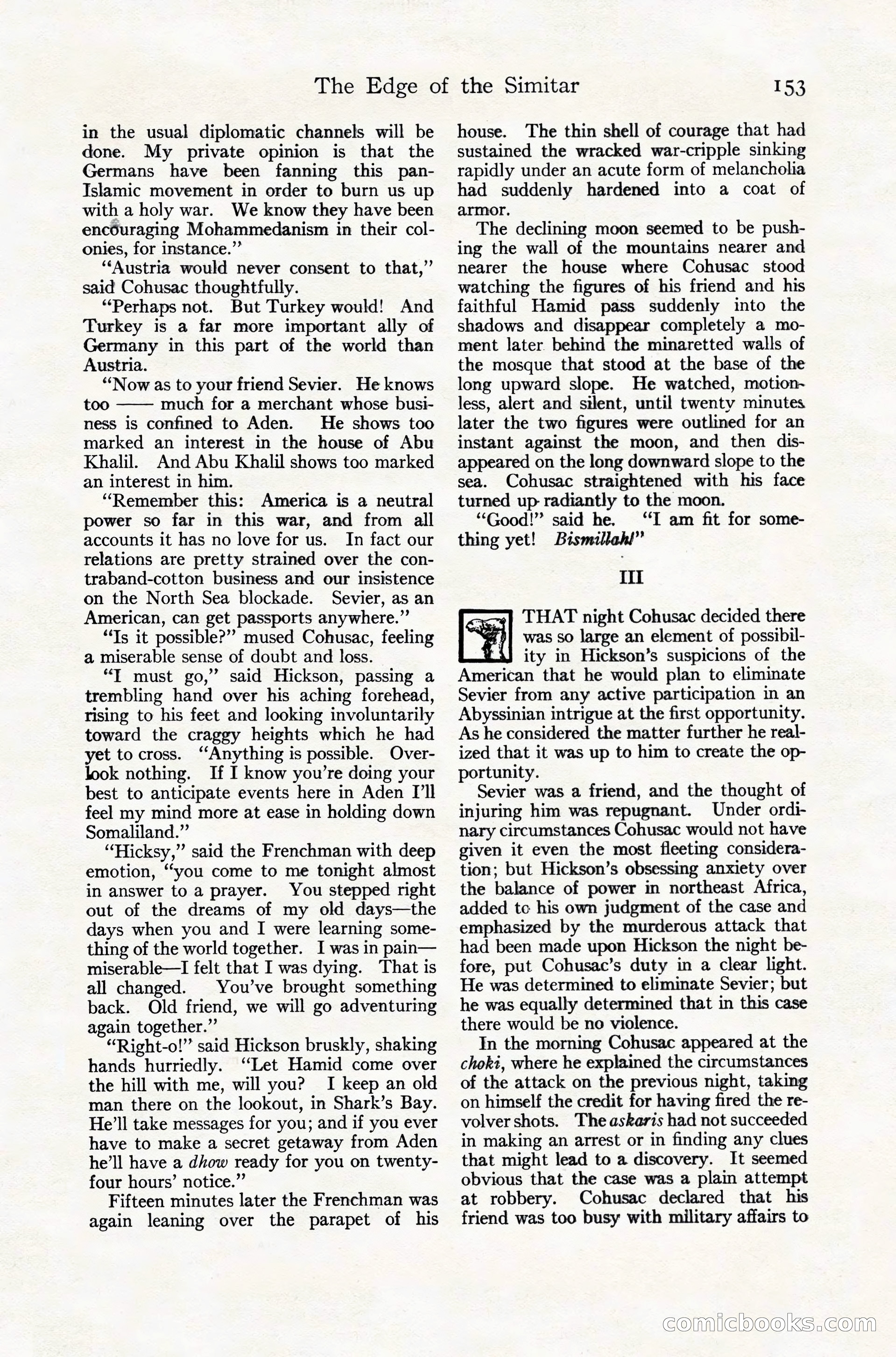
A restored page from Pulp Fiction, 1924. Page through the whole issue in the reader above.
📄 Transcribed text from this page (OCR, searchable)
Machine-transcribed from the original scan — historical spelling and the odd misread are preserved.
The Edge of the Simitar in the usual diplomatic channels will be done. My private opinion is that the Germans have been fanning this pan- Islamic movement in order to burn us up with a holy war. We know they have been encouraging Mohammedanism in their col- onies, for instance.” ‘‘Austria would never consent to that,” said Cohusac thoughtfully. “Perhaps not. But Turkey would! And Turkey is a far more important ally of Germany in this part of the world than Austria. ““Now as to your friend Sevier. He knows too much for a merchant whose busi- ness is confined to Aden. He shows too marked an interest in the house of Abu Khalil. And Abu Khalil shows too marked an interest in him. “Remember this: America is a neutral power so far in this war, and from all accounts it has no love for us. In fact our relations are pretty strained over the con- traband-cotton business and our insistence on the North Sea blockade. Sevier, as an American, can get passports anywhere.” “Is it possible?”? mused Cohusac, feeling a miserable sense of doubt and loss. “T must go,” said Hickson, passing a trembling hand over his aching forehead, rising to his feet and looking involuntarily toward the craggy heights which he had yet to cross. ‘‘Anything is possible. Over- look nothing. If I know you’re doing your best to anticipate events here in Aden I'll feel my mind more at ease in holding down Somaliland.” ‘“‘Hicksy,” said the Frenchman with deep emotion, “you come to me tonight almost in answer to a prayer. You stepped right out of the dreams of my old days—the days when you and I were learning some- thing of the world together. I was in pain— miserable—I felt that I was dying. That is all changed. You’ve brought something back. Old friend, we will go adventuring again together.”’ “Right-o!”” said Hickson bruskly, shaking hands hurriedly. ‘‘Let Hamid come over the hill with me, will you? I keep an old man there on the lookout, in Shark’s Bay. He’ll take messages for you; and if you ever have to make a secret getaway from Aden he’ll have a dhow ready for you on twenty- four hours’ notice.” Fifteen minutes later the Frenchman was again leaning over the parapet of his 153 house. The thin shell of courage that had sustained the wracked war-cripple sinking rapidly under an acute form of melancholia had suddenly hardened into a coat of armor. The declining moon seemed to be push- ing the wall of the mountains nearer and nearer the house where Cohusac stood watching the figures of his friend and his faithful Hamid pass suddenly into the shadows and disappear completely a mo- ment later behind the minaretted walls of the mosque that stood at the base of the long upward slope. He watched, motion~ less, alert and silent, until twenty minutes later the two figures were outlined for an instant against the moon, and then dis- appeared on the long downward slope to the sea. Cohusac straightened with his face turned up radiantly to the moon. “Good!” said he. “I am fit for some- thing yet! Bismillah!” Itt <4] 1 HAT night Cohusac decided there ¥| was so large an element of possibil- ity in Hickson’s suspicions of the American that he would plan to eliminate Sevier from any active participation in an Abyssinian intrigue at the first opportunity. As he considered the matter further he real- ized that it was up to him to create the op- portunity. Sevier was a friend, and the thought of injuring him was repugnant. Under ordi- nary circumstances Cohusac would not have given it even the most fleeting considera- tion; but Hickson’s obsessing anxiety over the balance of power in northeast Africa, added tc his own judgment of the case and emphasized by the murderous attack that had been made upon Hickson the night be- fore, put Cohusac’s duty in a clear light. He was determined to eliminate Sevier; but he was equally determined that in this case there would be no violence. In the morning Cohusac appeared at the choki, where he explained the circumstances of the attack on the previous night, taking on himself the credit for having fired the re- volver shots. The askaris had not succeeded in making an arrest or in finding any clues that might lead to a discovery. It seemed obvious that the case was a plain attempt at robbery. Cohusac declared that his friend was too busy with military affairs to Go DOOK 1@)