
Pulp Fiction, 1924 · page 159 of 204
Adventure Magazine Cover — page 159: what you’re looking at
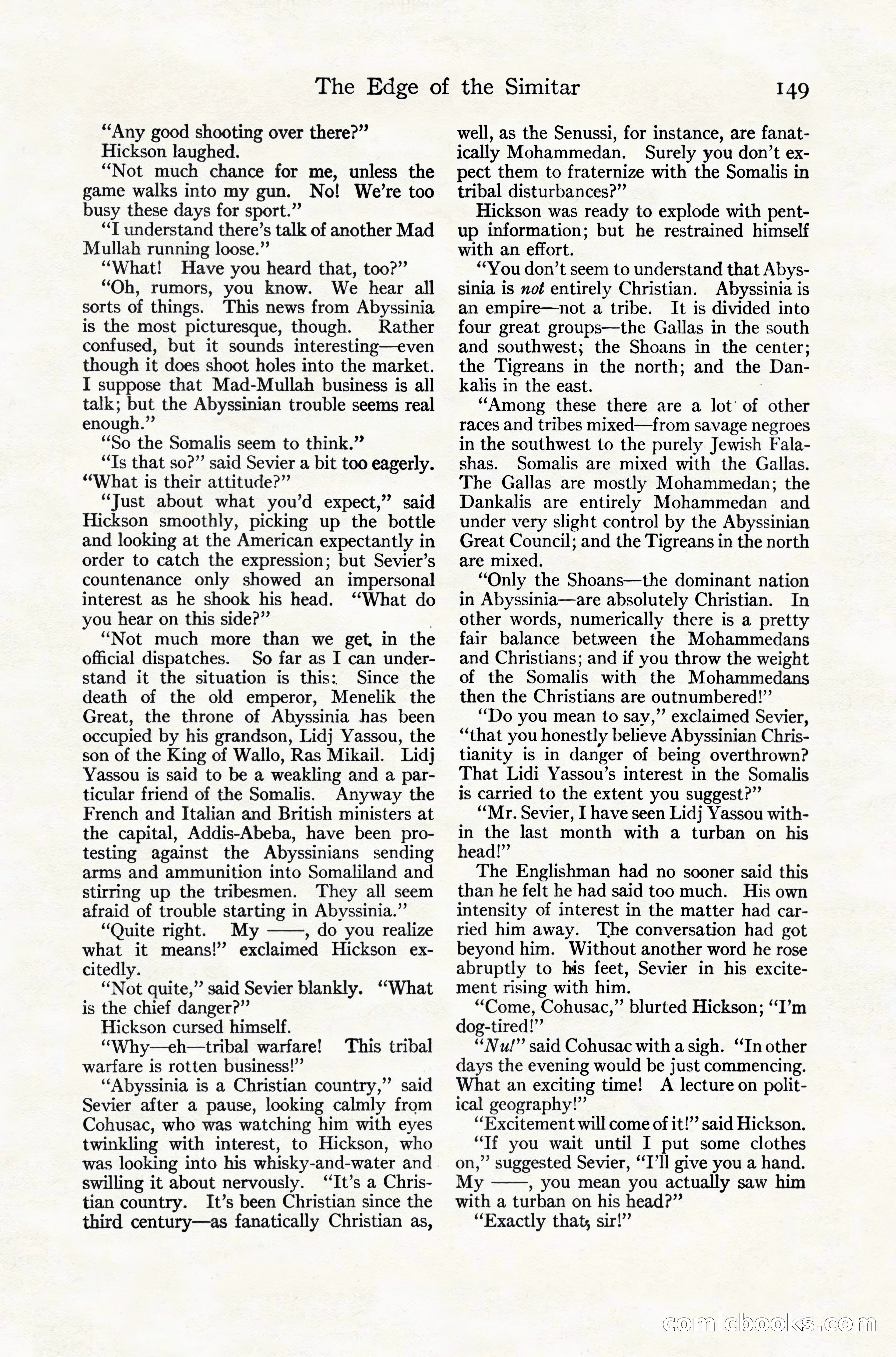
A restored page from Pulp Fiction, 1924. Page through the whole issue in the reader above.
📄 Transcribed text from this page (OCR, searchable)
Machine-transcribed from the original scan — historical spelling and the odd misread are preserved.
The Edge of the Simitar “Any good shooting over there?” Hickson laughed. “Not much chance for me, unless the game walks into my gun. No! We’re too busy these days for sport.” “T understand there’s talk of another Mad Mullah running loose.” “What! Have you heard that, too?” “Oh, rumors, you know. We hear all sorts of things. This news from Abyssinia is the most picturesque, though. Rather confused, but it sounds interesting—even though it does shoot holes into the market. I suppose that Mad-Mullah business is all talk; but the Abyssinian trouble seems real enough.” “So the Somalis seem to think.” “Ts that so?” said Sevier a bit too eagerly. “What is their attitude?” “Just about what you’d expect,’ said Hickson smoothly, picking up the bottle and looking at the American expectantly in order to catch the expression; but Sevier’s countenance only showed an impersonal interest as he shook his head. ‘‘What do you hear on this side?” “Not much more than we get, in the official dispatches. So far as I can under- stand it the situation is this: Since the death of the old emperor, Menelik the Great, the throne of Abyssinia has been occupied by his grandson, Lidj Yassou, the son of the King of Wallo, Ras Mikail. Lidj Yassou is said to be a weakling and a par- ticular friend of the Somalis. Anyway the French and Italian and British ministers at the capital, Addis-Abeba, have been pro- testing against the Abyssinians sending arms and ammunition into Somaliland and stirring up the tribesmen. ‘They all seem afraid of trouble starting in Abyssinia.”’ “Quite right. My , do you realize what it means!” exclaimed Hickson ex- citedly. “Not quite,” said Sevier blankly. “What is the chief danger?” Hickson cursed himself. “Why—eh—tribal warfare! This tribal warfare is rotten business!”’ ‘Abyssinia is a Christian country,” said Sevier after a pause, looking calmly from Cohusac, who was watching him with eyes twinkling with interest, to Hickson, who was looking into his whisky-and-water and swilling it about nervously. “It’s a Chris- tian country. It’s been Christian since the third century—as fanatically Christian as, 149 well, as the Senussi, for instance, are fanat- ically Mohammedan. Surely you don’t ex- pect them to fraternize with the Somalis in tribal disturbances?” Hickson was ready to explode with pent- up information; but he restrained himself with an effort. “You don’t seem to understand that Abys- sinia is not entirely Christian. Abyssinia is an empire—not a tribe. It is divided into four great groups—the Gallas in the south and southwest; the Shoans in the center; the Tigreans in the north; and the Dan- kalis in the east. ‘“‘Among these there are a lot’ of other races and tribes mixed—from savage negroes in the southwest to the purely Jewish Fala- shas. Somalis are mixed with the Gallas. The Gallas are mostly Mohammedan; the Dankalis are entirely Mohammedan and under very slight control by the Abyssinian Great Council; and the Tigreans in the north are mixed. “Only the Shoans—the dominant nation in Abyssinia—are absolutely Christian. In other words, numerically there is a pretty fair balance between the Mohammedans and Christians; and if you throw the weight of the Somalis with the Mohammedans then the Christians are outnumbered!” “Do you mean to say,” exclaimed Sevier, “that you honestly believe Abyssinian Chris- tianity is in danger of being overthrown? That Lidi Yassou’s interest in the Somalis is carried to the extent you suggest?” “Mr. Sevier, I have seen Lidj Yassou with- in the last month with a turban on his head!”’ The Englishman had no sooner said this than he felt he had said too much. His own intensity of interest in the matter had car- ried him away. The conversation had got beyond him. Without another word he rose abruptly to his feet, Sevier in his excite- ment rising with him. “Come, Cohusac,”’ blurted Hickson; “I’m dog-tired!”’ ‘“‘Nu!”’ said Cohusac with a sigh. “In other days the evening would be just commencing. What an exciting time! A lecture on polit- ical geography!” “Excitement will come of it!’ said Hickson. “Tf you wait until I put some clothes on,” suggested Sevier, “T’ll give you a hand. My ——., you mean you actually saw him with a turban on his head?” “Exactly that, sir!” Go NOOK 1 @)