
Pulp Fiction, 1924 · page 132 of 204
Adventure Magazine Cover — page 132: what you’re looking at
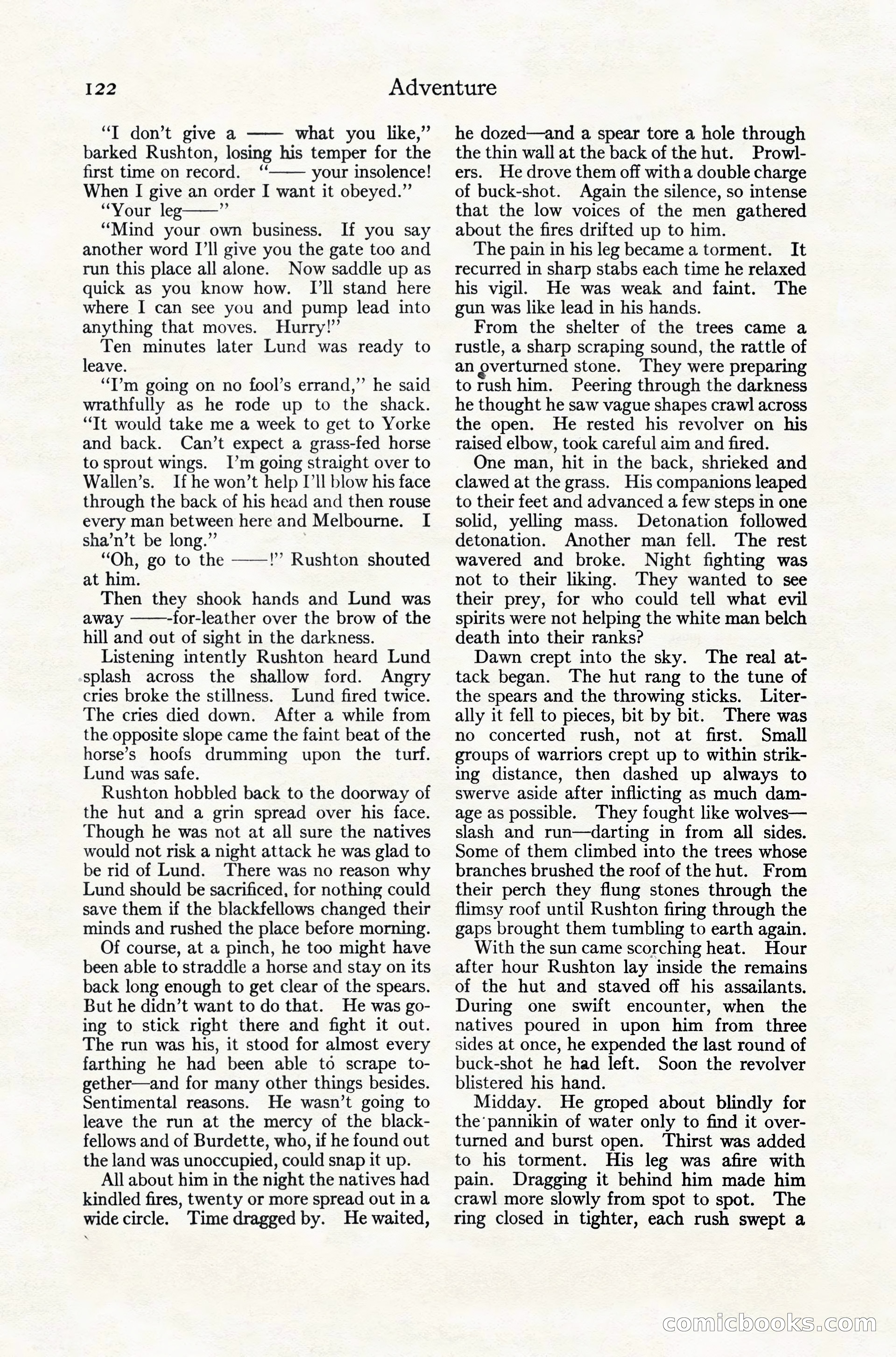
A restored page from Pulp Fiction, 1924. Page through the whole issue in the reader above.
📄 Transcribed text from this page (OCR, searchable)
Machine-transcribed from the original scan — historical spelling and the odd misread are preserved.
l22 “T don’t give a —— what you like,” barked Rushton, losing his temper for the first time on record. “ your insolence! When I give an order I want it obeyed.” “Your leg——”’ “Mind your own business. If you say another word I'll give you the gate too and run this place all alone. Now saddle up as quick as you know how. I'll stand here where I can see you and pump lead into anything that moves. Hurry!” Ten minutes later Lund was ready to leave. ‘“Y’m going on no fool’s errand,” he said wrathfully as he rode up to the shack. “It would take me a week to get to Yorke and back. Can’t expect a grass-fed horse to sprout wings. I’m going straight over to Wallen’s. If he won’t help I’ll blow his face through the back of his head and then rouse every man between here and Melbourne. I sha’n’t be long.” “Oh, go to the ——!”’ Rushton shouted at him. Then they shook hands and Lund was away -for-leather over the brow of the hill and out of sight in the darkness. Listening intently Rushton heard Lund splash across the shallow ford. Angry cries broke the stillness. Lund fired twice. The cries died down. After a while from the opposite slope came the faint beat of the horse’s hoofs drumming upon the turf. Lund was safe. Rushton hobbled back to the doorway of the hut and a grin spread over his face. Though he was not at all sure the natives would not risk a night attack he was glad to be rid of Lund. There was no reason why Lund should be sacrificed, for nothing could save them if the blackfellows changed their minds and rushed the place before morning. Of course, at a pinch, he too might have been able to straddle a horse and stay on its back long enough to get clear of the spears. But he didn’t want to do that. He was go- ing to stick right there and fight it out. The run was his, it stood for almost every farthing he had been able to scrape to- gether—and for many other things besides. Sentimental reasons. He wasn’t going to leave the run at the mercy of the black- fellows and of Burdette, who, if he found out the land was unoccupied, could snap it up. All about him in the night the natives had kindled fires, twenty or more spread out ina wide circle. Time dragged by. He waited, Adventure he dozed—and a spear tore a hole through the thin wall at the back of the hut. Prowl- ers. He drove them off witha double charge of buck-shot. Again the silence, so intense that the low voices of the men gathered about the fires drifted up to him. The pain in his leg became a torment. It recurred in sharp stabs each time he relaxed his vigil. He was weak and faint. The gun was like lead in his hands. From the shelter of the trees came a rustle, a sharp scraping sound, the rattle of an overturned stone. They were preparing torush him. Peering through the darkness he thought he saw vague shapes crawl across the open. He rested his revolver on his raised elbow, took careful aim and fired. One man, hit in the back, shrieked and clawed at the grass. His companions leaped to their feet and advanced a few steps in one solid, yelling mass. Detonation followed detonation. Another man fell. The rest wavered and broke. Night fighting was not to their liking. They wanted to see their prey, for who could tell what evil spirits were not helping the white man belch death into their ranks? Dawn crept into the sky. The real at- tack began. The hut rang to the tune of the spears and the throwing sticks. Liter- ally it fell to pieces, bit by bit. There was no concerted rush, not at first. Small groups of warriors crept up to within strik- ing distance, then dashed up always to swerve aside after inflicting as much dam- age as possible. They fought like wolves— slash and run—darting in from all sides. Some of them climbed into the trees whose branches brushed the roof of the hut. From their perch they flung stones through the flimsy roof until Rushton firing through the gaps brought them tumbling to earth again. With the sun came scorching heat. Hour after hour Rushton lay inside the remains of the hut and staved off his assailants. During one swift encounter, when the natives poured in upon him from three sides at once, he expended the last round of buck-shot he had left. Soon the revolver blistered his hand. Midday. He groped about blindly for the’ pannikin of water only to find it over- turned and burst open. Thirst was added to his torment. His leg was afire with pain. Dragging it behind him made him crawl more slowly from spot to spot. The ring closed in tighter, each rush swept a Conmiclbool 1O)