
Pulp Fiction, 1924 · page 127 of 204
Adventure Magazine Cover — page 127: what you’re looking at
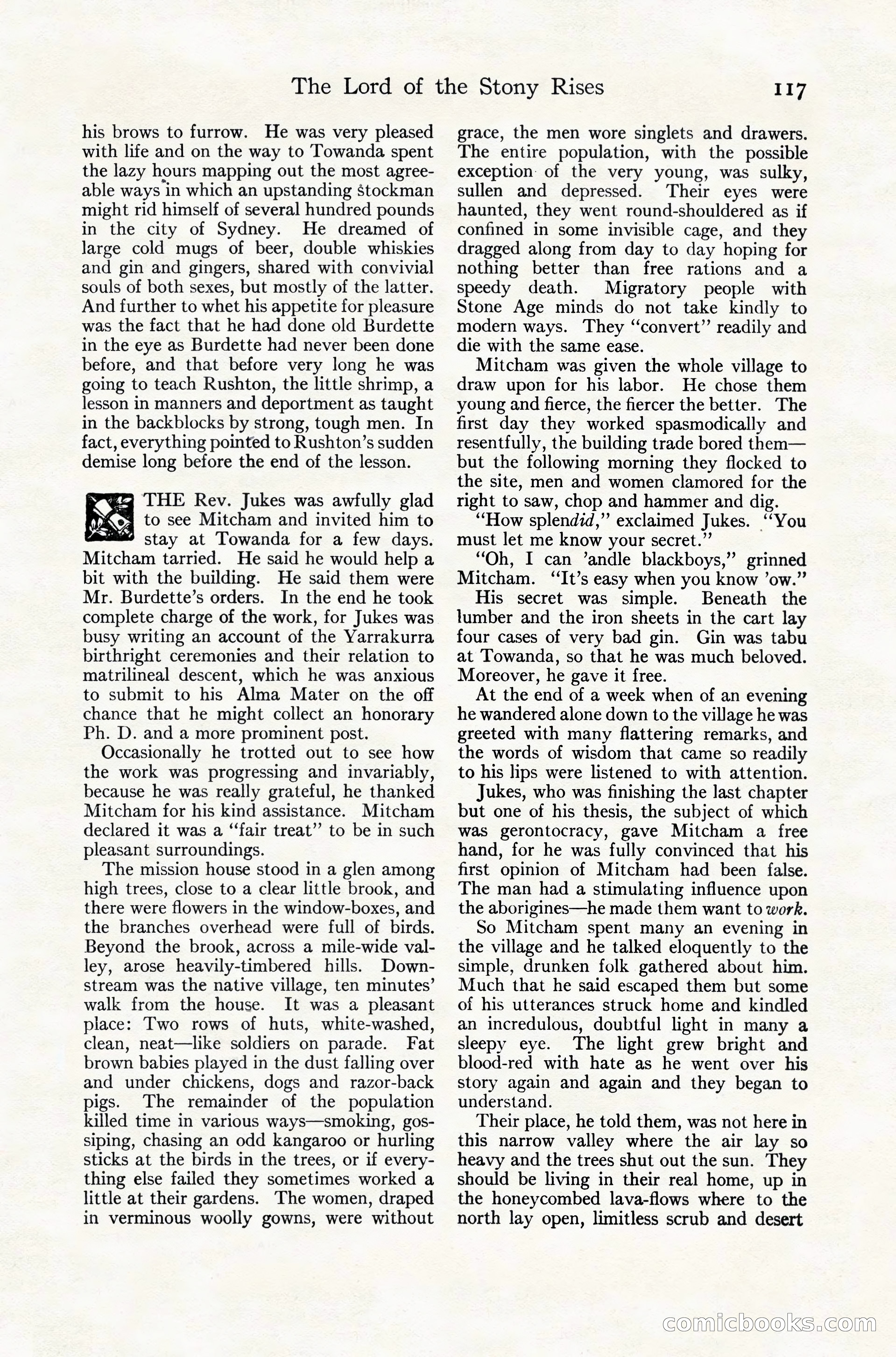
A restored page from Pulp Fiction, 1924. Page through the whole issue in the reader above.
📄 Transcribed text from this page (OCR, searchable)
Machine-transcribed from the original scan — historical spelling and the odd misread are preserved.
The Lord of the Stony Rises his brows to furrow. He was very pleased with life and on the way to Towanda spent the lazy hours mapping out the most agree- able ways in which an upstanding stockman might rid himself of several hundred pounds in the city of Sydney. He dreamed of large cold mugs of beer, double whiskies and gin and gingers, shared with convivial souls of both sexes, but mostly of the latter. And further to whet his appetite for pleasure was the fact that he had done old Burdette in the eye as Burdette had never been done before, and that before very long he was going to teach Rushton, the little shrimp, a lesson in manners and deportment as taught in the backblocks by strong, tough men. In fact, everything pointed to Rushton’s sudden demise long before the end of the lesson. THE Rev. Jukes was awfully glad to see Mitcham and invited him to stay at Towanda for a few days. Mitcham tarried. He said he would help a bit with the building. He said them were Mr. Burdette’s orders. In the end he took complete charge of the work, for Jukes was busy writing an account of the Yarrakurra birthright ceremonies and their relation to matrilineal descent, which he was anxious to submit to his Alma Mater on the off chance that he might collect an honorary Ph. D. and a more prominent post. Occasionally he trotted out to see how the work was progressing and invariably, because he was really grateful, he thanked Mitcham for his kind assistance. Mitcham declared it was a “fair treat” to be in such pleasant surroundings. The mission house stood in a glen among high trees, close to a clear little brook, and there were flowers in the window-boxes, and the branches overhead were full of birds. Beyond the brook, across a mile-wide val- ley, arose heavily-timbered hills. Down- stream was the native village, ten minutes’ walk from the house. It was a pleasant place: Two rows of huts, white-washed, clean, neat—like soldiers on parade. Fat brown babies played in the dust falling over and under chickens, dogs and razor-back pigs. The remainder of the population killed time in various ways—smoking, gos- siping, chasing an odd kangaroo or hurling sticks at the birds in the trees, or if every- thing else failed they sometimes worked a little at their gardens. The women, draped in verminous woolly gowns, were without 117 grace, the men wore singlets and drawers. The entire population, with the possible exception: of the very young, was sulky, sullen and depressed. Their eyes were haunted, they went round-shouldered as if confined in some invisible cage, and they dragged along from day to day hoping for nothing better than free rations and a speedy death. Migratory people with Stone Age minds do not take kindly to modern ways. They “convert” readily and die with the same ease. Mitcham was given the whole village to draw upon for his labor. He chose them young and fierce, the fiercer the better. The first day they worked spasmodically and resentfully, the building trade bored them— but the following morning they flocked to the site, men and women clamored for the right to saw, chop and hammer and dig. ‘‘How splendid,’’ exclaimed Jukes. ‘‘You must let me know your secret.”’ “Oh, I can ’andle blackboys,” grinned Mitcham. “It’s easy when you know ’ow.” His secret was simple. Beneath the lumber and the iron sheets in the cart lay four cases of very bad gin. Gin was tabu at Towanda, so that he was much beloved. Moreover, he gave it free. At the end of a week when of an evening he wandered alone down to the village he was greeted with many flattering remarks, and the words of wisdom that came so readily to his hps were listened to with attention. Jukes, who was finishing the last chapter but one of his thesis, the subject of which was gerontocracy, gave Mitcham a free hand, for he was fully convinced that his first opinion of Mitcham had been false. The man had a stimulating influence upon the aborigines—he made them want to work. So Mitcham spent many an evening in the village and he talked eloquently to the simple, drunken folk gathered about him. Much that he said escaped them but some of his utterances struck home and kindled an incredulous, doubtful light in many a sleepy eye. The light grew bright and blood-red with hate as he went over his story again and again and they began to understand. Their place, he told them, was not here in this narrow valley where the air lay so heavy and the trees shut out the sun. They should be living in their real home, up in the honeycombed lava-flows where to the north lay open, limitless scrub and desert Go NOOK 1 @)