
Pulp Fiction, 1924 · page 125 of 204
Adventure Magazine Cover — page 125: what you’re looking at
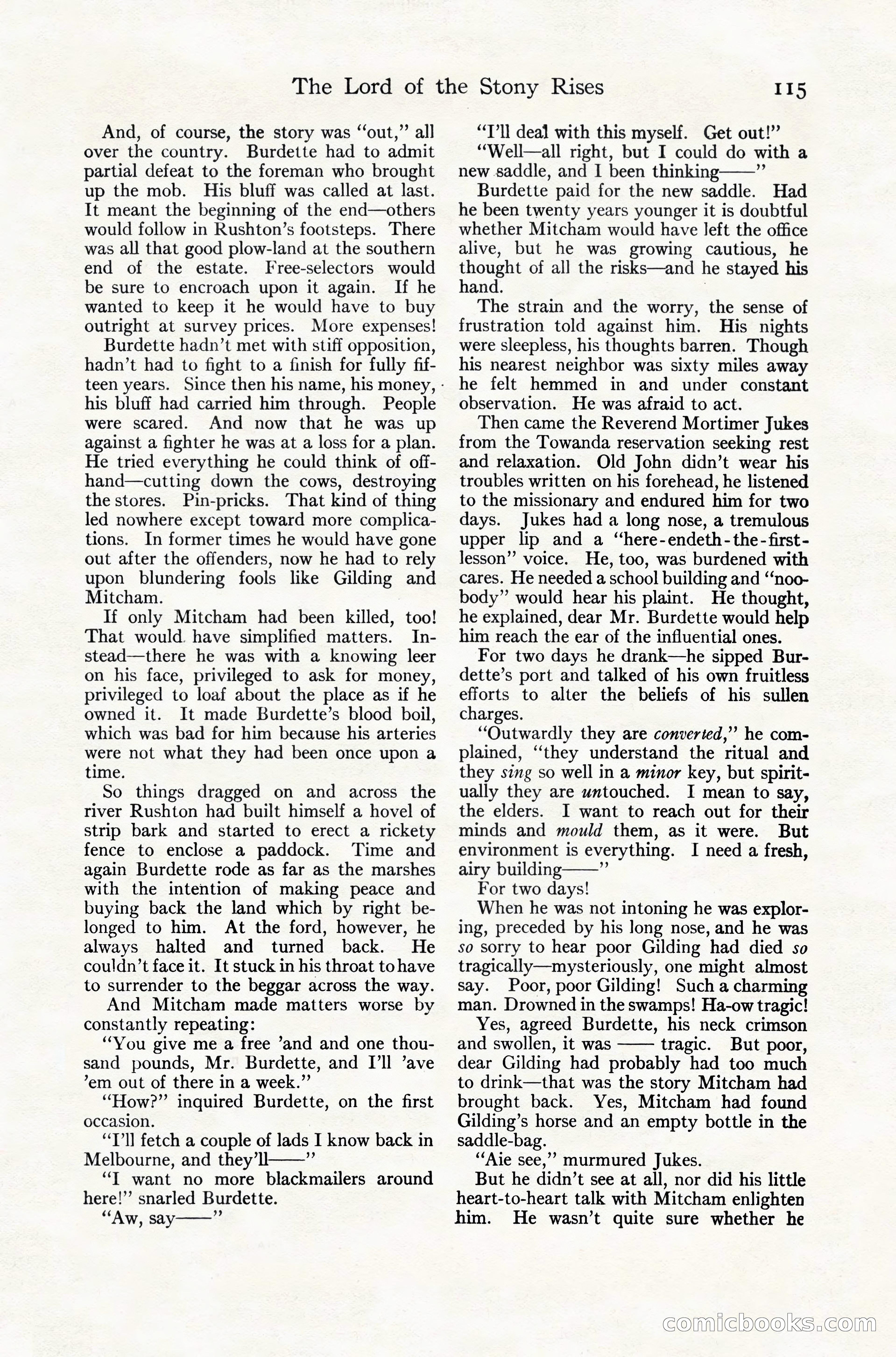
A restored page from Pulp Fiction, 1924. Page through the whole issue in the reader above.
📄 Transcribed text from this page (OCR, searchable)
Machine-transcribed from the original scan — historical spelling and the odd misread are preserved.
The Lord of the Stony Rises And, of course, the story was “‘out,” all over the country. Burdette had to admit partial defeat to the foreman who brought up the mob. His bluff was called at last. It meant the beginning of the end—others would follow in Rushton’s footsteps. There was all that good plow-land at the southern end of the estate. Free-selectors would be sure to encroach upon it again. If he wanted to keep it he would have to buy outright at survey prices. More expenses! Burdette hadn’t met with stiff opposition, hadn’t had to fight to a finish for fully fif- teen years. Since then his name, his money, - his bluff had carried him through. People were scared. And now that he was up against a fighter he was at a loss for a plan. He tried everything he could think of off- hand—cutting down the cows, destroying the stores. Pin-pricks. That kind of thing led nowhere except toward more complica- tions. In former times he would have gone out after the offenders, now he had to rely upon blundering fools like Gilding and Mitcham. If only Mitcham had been killed, too! That would. have simplified matters. In- stead—there he was with a knowing leer on his face, privileged to ask for money, privileged to loaf about the place as if he owned it. It made Burdette’s blood boil, which was bad for him because his arteries were not what they had been once upon a time. So things dragged on and across the river Rushton had built himself a hovel of strip bark and started to erect a rickety fence to enclose a paddock. ‘Time and again Burdette rode as far as the marshes with the intention of making peace and buying back the land which by right be- longed to him. At the ford, however, he always halted and turned back. He couldn’t face it. It stuck in his throat to have to surrender to the beggar across the way. And Mitcham made matters worse by constantly repeating: “You give me a free ’and and one thou- sand pounds, Mr. Burdette, and I'll ’ave 7em out of there in a week.” “How?” inquired Burdette, on the first occasion. “T?ll fetch a couple of lads I know back in Melbourne, and they’l1I——”’ “TJ want no more blackmailers around here!”’ snarled Burdette. “Aw, say——”’ 115 “T’ll deal with this myself. Get out!” “‘Well—all right, but I could do with a new saddle, and I been thinking——”’ Burdette paid for the new saddle. Had he been twenty years younger it is doubtful whether Mitcham would have left the office alive, but he was growing cautious, he thought of all the risks—and he stayed his hand. , The strain and the worry, the sense of frustration told against him. His nights were sleepless, his thoughts barren. Though his nearest neighbor was sixty miles away he felt hemmed in and under constant observation. He was afraid to act. Then came the Reverend Mortimer Jukes from the Towanda reservation seeking rest and relaxation. Old John didn’t wear his troubles written on his forehead, he listened to the missionary and endured him for two days. Jukes had a long nose, a tremulous upper lip and a “here-endeth-the-first- lesson” voice. He, too, was burdened with cares. He needed a school building and “‘noo- body” would hear his plaint. He thought, he explained, dear Mr. Burdette would help him reach the ear of the influential ones. For two days he drank—he sipped Bur- dette’s port and talked of his own fruitless efforts to alter the beliefs of his sullen charges. “Outwardly they are converted,’ he com- plained, “they understand the ritual and they sing so well in a minor key, but spirit- ually they are untouched. I mean to say, the elders. I want to reach out for their minds and mould them, as it were. But environment is everything. I need a fresh, airy building 4 For two days! When he was not intoning he was explor- ing, preceded by his long nose, and he was so sorry to hear poor Gilding had died so tragically—mysteriously, one might almost say. Poor, poor Gilding! Such a charming man. Drowned in the swamps! Ha-ow tragic! Yes, agreed Burdette, his neck crimson and swollen, it was tragic. But poor, dear Gilding had probably had too much to drink—that was the story Mitcham had brought back. Yes, Mitcham had found Gilding’s horse and an empty bottle in the saddle-bag. ‘“‘Aie see,’ murmured Jukes. But he didn’t see at all, nor did his little heart-to-heart talk with Mitcham enlighten him. He wasn’t quite sure whether he Go DOOLK 1 @)