
Pulp Fiction, 1924 · page 119 of 204
Adventure Magazine Cover — page 119: what you’re looking at
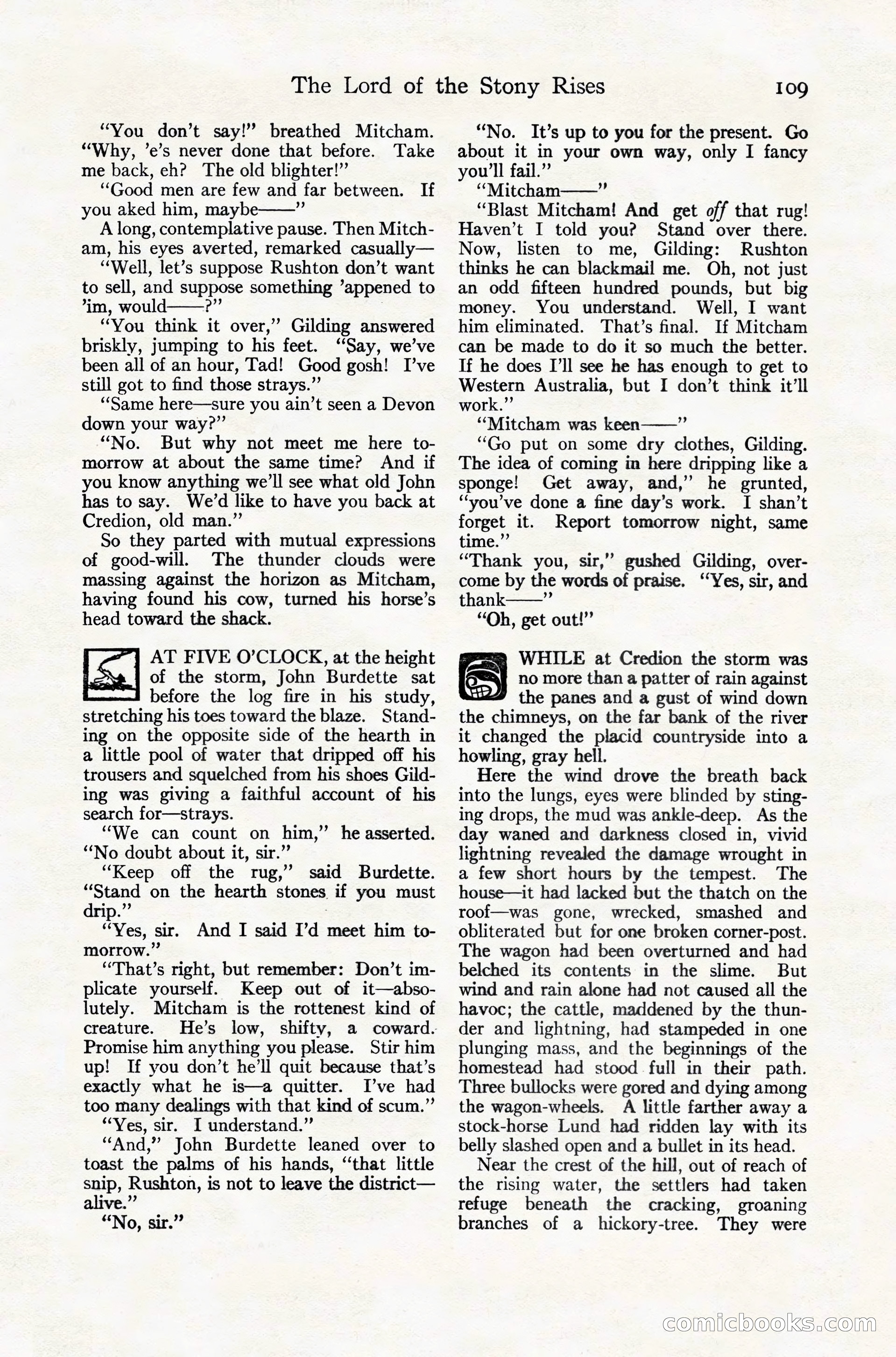
A restored page from Pulp Fiction, 1924. Page through the whole issue in the reader above.
📄 Transcribed text from this page (OCR, searchable)
Machine-transcribed from the original scan — historical spelling and the odd misread are preserved.
The Lord of the Stony Rises “You don’t say!” breathed Mitcham. ‘“‘Why, ’e’s never done that before. Take me back, eh? The old blighter!”’ ‘“Good men are few and far between. If you aked him, maybe——”’ A long, contemplative pause. Then Mitch- am, his eyes averted, remarked casually— ‘Well, let’s suppose Rushton don’t want to sell, and suppose something ’appened to "im, would——P”’ : “You think it over,’’ Gilding answered briskly, jumping to his feet. “Say, we’ve been all of an hour, Tad! Good gosh! I’ve still got to find those strays.”’ ‘“‘Same here—sure you ain’t seen a Devon down your way?”’ “No. But why not meet me here to- morrow at about the same time? And if you know anything we’ll see what old John has to say. We'd like to have you back at Credion, old man.” So they parted with mutual expressions of good-will. The thunder clouds were massing against the horizon as Mitcham, having found his cow, turned his horse’s head toward the shack. AT FIVE O’CLOCK, at the height of the storm, John Burdette sat eet before the log fire in his study, stretching his toes toward the blaze. Stand- ing on the opposite side of the hearth in a little pool of water that dripped off his trousers and squelched from his shoes Gild- ing was giving a faithful account of his search for—strays. “We can count on him,” he asserted. “No doubt about it, sir.”’ “Keep off the rug,” said Burdette. “Stand on the hearth stones if you must drip.”’ “Yes, sir. And I said I’d meet him to- morrow.” “That’s right, but remember: Don’t im- plicate yourself. Keep out of it—abso- lutely. Mitcham is the rottenest kind of creature. Promise him anything you please. Stir him up! If you don’t he’ll quit because that’s exactly what he is—a quitter. I’ve had too many dealings with that kind of scum.” “Yes, sir. I understand.” “And,” John Burdette leaned over to toast the palms of his hands, ‘‘that little snip, Rushton, is not to leave the district— alive.” 99 He’s low, shifty, a coward. 109 “No. It’s up to you for the present. Go about it in your own way, only I fancy you'll fail.” “Mitcham——’”’ “Blast Mitcham! And get off that rug! Haven’t I told you? Stand over there. Now, listen to me, Gilding: Rushton thinks he can blackmail me. Oh, not just an odd fifteen hundred pounds, but big money. You understand. Well, I want him eliminated. That’s final. If Mitcham can be made to do it so much the better. If he does I’ll see he has enough to get to Western Australia, but I don’t think it’ll work.” “Mitcham was keen——’ “Go put on some dry clothes, Gilding. The idea of coming in here dripping like a sponge! Get away, and,” he grunted, ‘“‘you’ve done a fine day’s work. I shan’t forget it. Report tomorrow night, same time.” “Thank you, sir,” gushed Gilding, over- come by the words of praise. ‘‘Yes, sir, and thank——”’ “Oh, get out!”’ gm WHILE at Credion the storm was Ox no more than a patter of rain against ié the panes and a gust of wind down the chimneys, on the far bank of the river it changed the placid countryside into a howling, gray hell. Here the wind drove the breath back into the lungs, eyes were blinded by sting- ing drops, the mud was ankle-deep. As the day waned and darkness closed in, vivid lightning revealed the damage wrought in a few short hours by the tempest. The house—it had lacked but the thatch on the roof—was gone, wrecked, smashed and obliterated but for one broken corner-post. The wagon had been overturned and had belched its contents in the slime. But wind and rain alone had not caused all the havoc; the cattle, maddened by the thun- der and lightning, had stampeded in one plunging mass, and the beginnings of the homestead had stood full in their path. Three bullocks were gored and dying among the wagon-wheels. A little farther away a stock-horse Lund had ridden lay with its belly slashed open and a bullet in its head. Near the crest of the hill, out of reach of the rising water, the settlers had taken refuge beneath the cracking, groaning branches of a hickory-tree. They were ’ Go DOOLK 1e@