
Pulp Fiction, 1924 · page 117 of 204
Adventure Magazine Cover — page 117: what you’re looking at
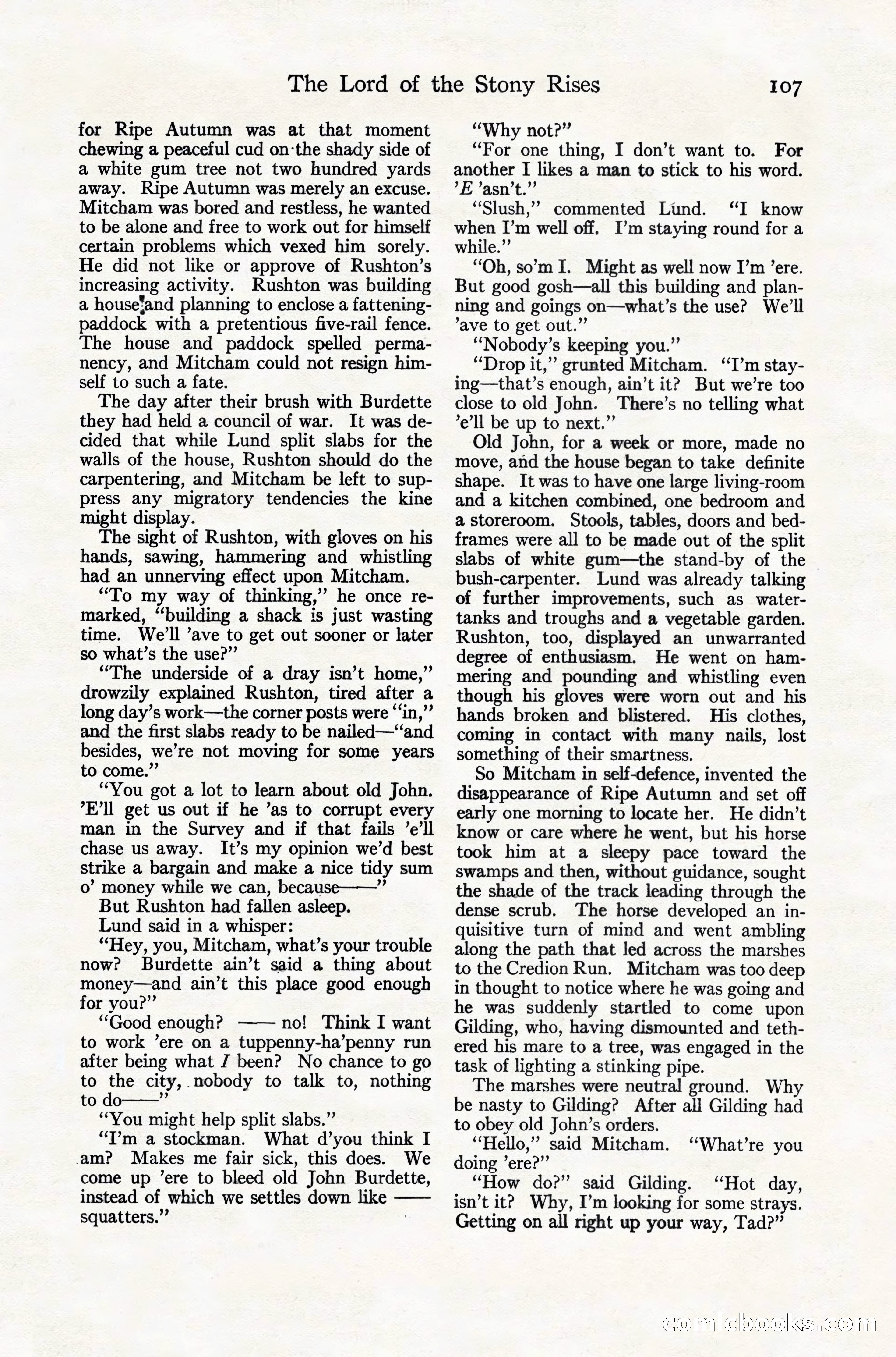
A restored page from Pulp Fiction, 1924. Page through the whole issue in the reader above.
📄 Transcribed text from this page (OCR, searchable)
Machine-transcribed from the original scan — historical spelling and the odd misread are preserved.
The Lord of the Stony Rises for Ripe Autumn was at that moment chewing a peaceful cud on-the shady side of a white gum tree not two hundred yards away. Ripe Autumn was merely an excuse. Mitcham was bored and restless, he wanted to be alone and free to work out for himself certain problems which vexed him sorely. He did not like or approve of Rushton’s Increasing activity. Rushton was building a housefand planning to enclose a fattening- paddock with a pretentious five-rail fence. The house and paddock spelled perma- nency, and Mitcham could not resign him- self to such a fate. The day after their brush with Burdette they had held a council of war. It was de- cided that while Lund split slabs for the walls of the house, Rushton should do the carpentering, and Mitcham be left to sup- press any migratory tendencies the kine might display. The sight of Rushton, with gloves on his hands, sawing, hammering and whistling had an unnerving effect upon Mitcham. “To my way of thinking,” he once re- marked, “building a shack is just wasting time. We'll ’ave to get out sooner or later so what’s the use?” “The underside of a dray isn’t home,” drowzily explained Rushton, tired after a long day’s work—the corner posts were “‘in,”’ and the first slabs ready to be nailed—‘‘and besides, we’re not moving for some years to come.” “You got a lot to learn about old John. ’E’ll get us out if he ’as to corrupt every man in the Survey and if that fails ’e’ll chase us away. It’s my opinion we’d best strike a bargain and make a nice tidy sum o’ money while we can, because——”’ But Rushton had fallen asleep. Lund said in a whisper: “Hey, you, Mitcham, what’s your trouble now? Burdette ain’t said a thing about money—and ain’t this place good enough for you?” “Good enough? ——no! Think I want to work ’ere on a tuppenny-ha’penny run after being what J been? No chance to go to the city,. nobody to talk to, nothing to do——”’ “You might help split slabs.” “Y’m a stockman. What d’you think I ame Makes me fair sick, this does. We come up ’ere to bleed old John Burdette, instead of which we settles down like —— squatters.” ) 107 “Why not?” “For one thing, I don’t want to. For another I likes a man to stick to his word. "FE ’asn’t.” “Slush,”’ commented Lund. “I know when I’m well off. I’m staying round for a while.” “Oh, so’m I. Might as well now I’m ’ere. But good gosh—all this building and plan- ning and goings on—what’s the use? We'll ’ave to get out.” “‘Nobody’s keeping you.”’ “Drop it,” grunted Mitcham. ‘I’m stay- ing—that’s enough, ain’t it? But we’re too close to old John. There’s no telling what ’e’ll be up to next.”’ Old John, for a week or more, made no move, and the house began to take definite shape. It was to have one large living-room and a kitchen combined, one bedroom and a storeroom. Stools, tables, doors and bed- frames were all to be made out of the split slabs of white gum—the stand-by of the bush-carpenter. Lund was already talking of further improvements, such as water- tanks and troughs and a vegetable garden. Rushton, too, displayed an unwarranted degree of enthusiasm. He went on ham- mering and pounding and whistling even though his gloves were worn out and his hands broken and blistered. His clothes, coming in contact with many nails, lost something of their smartness. So Mitcham in self-defence, invented the disappearance of Ripe Autumn and set off early one morning to locate her. He didn’t know or care where he went, but his horse took him at a sleepy pace toward the swamps and then, without guidance, sought the shade of the track leading through the dense scrub. The horse developed an in- quisitive turn of mind and went ambling along the path that led across the marshes to the Credion Run. Mitcham was too deep in thought to notice where he was going and he was suddenly startled to come upon Gilding, who, having dismounted and teth- ered his mare to a tree, was engaged in the task of lighting a stinking pipe. The marshes were neutral ground. Why be nasty to Gilding? After all Gilding had to obey old John’s orders. “Hello,” said Mitcham. ‘‘What’re you doing ’ere?”’ “How do?” said Gilding. ‘Hot day, isn’t it? Why, I’m looking for some strays. Getting on all right up your way, Tad?” Go DOOK 1 @)