
Pulp Fiction, 1924 · page 95 of 196
Adventure Magazine, April 10, 1924 — page 95: what you’re looking at
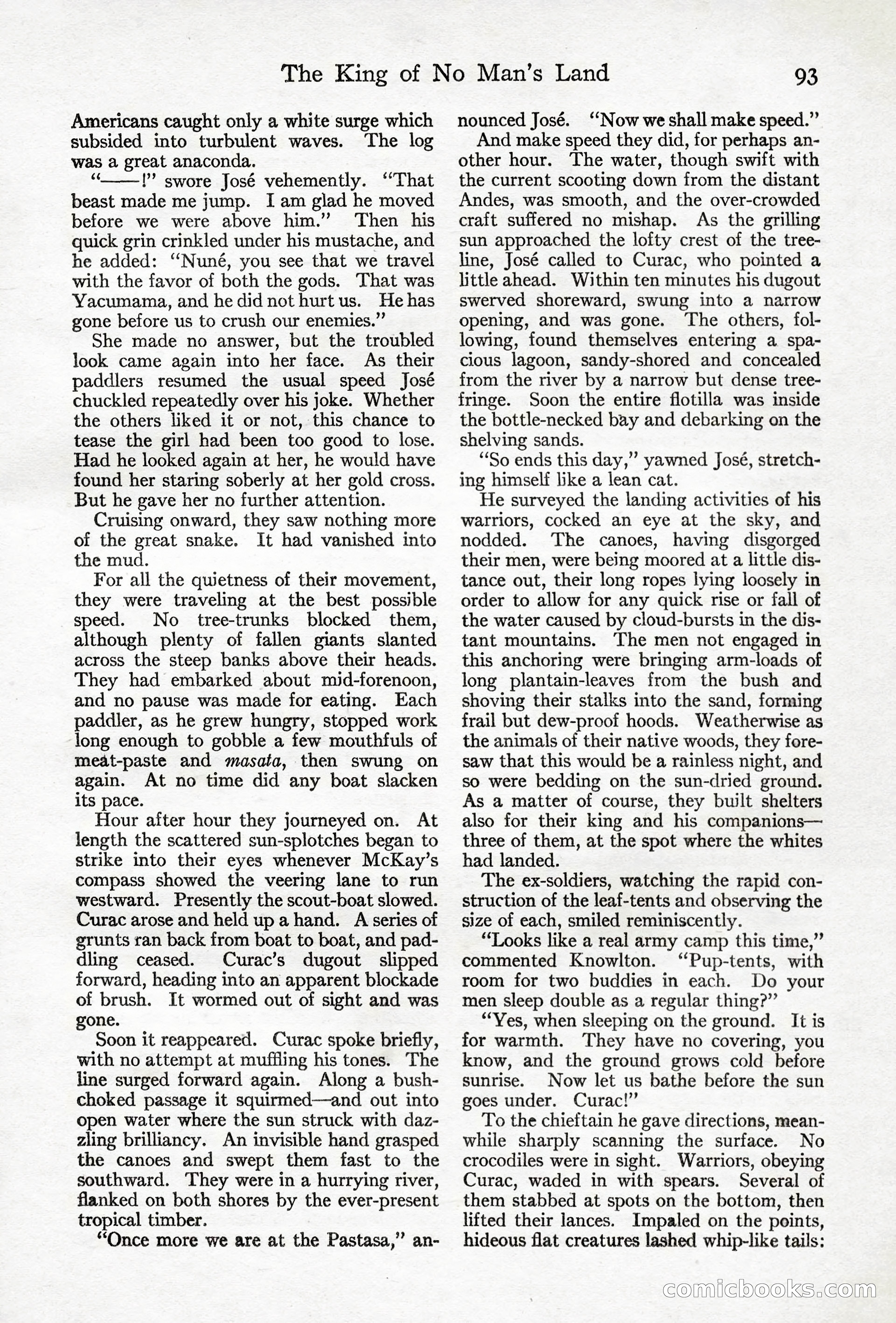
A restored page from Pulp Fiction, 1924. Page through the whole issue in the reader above.
📄 Transcribed text from this page (OCR, searchable)
Machine-transcribed from the original scan — historical spelling and the odd misread are preserved.
The King of No Man’s Land 93 Americans caught only a white surge which subsided into turbulent waves. The log was a great anaconda. “‘____|”” swore José vehemently. “That beast made me jump. I am glad he moved before we were above him.” Then his quick grin crinkled under his mustache, and he added: ‘‘Nuné, you see that we travel with the favor of both the gods. That was Yacumama, and he did not hurt us. Hehas gone before us to crush our enemies.” She made no answer, but the troubled look came again into her face. As their paddlers resumed the usual speed José chuckled repeatedly over his joke. Whether the others liked it or not, this chance to tease the girl had been too good to lose. Had he looked again at her, he would have found her staring soberly at her gold cross. But he gave her no further attention. Cruising onward, they saw nothing more of the great snake. It had vanished into the mud. For all the quietness of their movement, they were traveling at the best possible speed. No tree-trunks blocked them, although plenty of fallen giants slanted across the steep banks above their heads. They had embarked about mid-forenoon, and no pause was made for eating. Each paddler, as he grew hungry, stopped work long enough to gobble a few mouthfuls of meat-paste and masata, then swung on again. At no time did any boat slacken its pace. Hour after hour they journeyed on. At length the scattered sun-splotches began to strike into their eyes whenever McKay’s compass showed the veering lane to run westward. Presently the scout-boat slowed. Curac arose and held up a hand. A series of grunts ran back from boat to boat, and pad- dling ceased. Curac’s dugout slipped forward, heading into an apparent blockade of brush. It wormed out of sight and was gone. Soon it reappeared. Curac spoke briefly, with no attempt at muffling his tones. The line surged forward again. Along a bush- choked passage it squirmed—and out into open water where the sun struck with daz- zling brilliancy. An invisible hand grasped the canoes and swept them fast to the southward. They were in a hurrying river, flanked on both shores by the ever-present tropical timber. “Once more we are at the Pastasa,” an- nounced José. ‘Now we shall make speed.” And make speed they did, for perhaps an- other hour. The water, though swift with the current scooting down from the distant Andes, was smooth, and the over-crowded craft suffered no mishap. As the grilling sun approached the lofty crest of the tree- line, José called to Curac, who pointed a little ahead. Within ten minutes his dugout swerved shoreward, swung into a narrow opening, and was gone. ‘The others, fol- lowing, found themselves entering a spa- cious lagoon, sandy-shored and concealed from the river by a narrow but dense tree- fringe. Soon the entire flotilla was inside the bottle-necked bay and debarking on the shelving sands. “So ends this day,” yawned José, stretch- ing himself like a lean cat. He surveyed the landing activities of his warriors, cocked an eye at the sky, and nodded. The canoes, having disgorged their men, were being moored at a little dis- tance out, their long ropes lying loosely in order to allow for any quick rise or fall of the water caused by cloud-bursts in the dis- tant mountains. The men not engaged in this anchoring were bringing arm-loads of long plantain-leaves from the bush and shoving their stalks into the sand, forming frail but dew-proof hoods. Weatherwise as the animals of their native woods, they fore- saw that this would be a rainless night, and so were bedding on the sun-dried ground. As a matter of course, they built shelters also for their king and his companions— three of them, at the spot where the whites had landed. The ex-soldiers, watching the rapid con- struction of the leaf-tents and observing the size of each, smiled reminiscently. “Looks like a real army camp this time,” commented Knowlton. “Pup-tents, with room for two buddies in each. Do your men sleep double as a regular thing?” “Yes, when sleeping on the ground. It is for warmth. They have no covering, you know, and the ground grows cold before sunrise. Now let us bathe before the sun goes under. Curac!” To the chieftain he gave directions, mean- while sharply scanning the surface. No crocodiles were in sight. Warriors, obeying Curac, waded in with spears. Several of them stabbed at spots on the bottom, then lifted their lances. Impaled on the points, hideous flat creatures lashed whip-like tails: COmiclboookkSs.G© |