
Pulp Fiction, 1924 · page 79 of 196
Adventure Magazine, April 10, 1924 — page 79: what you’re looking at
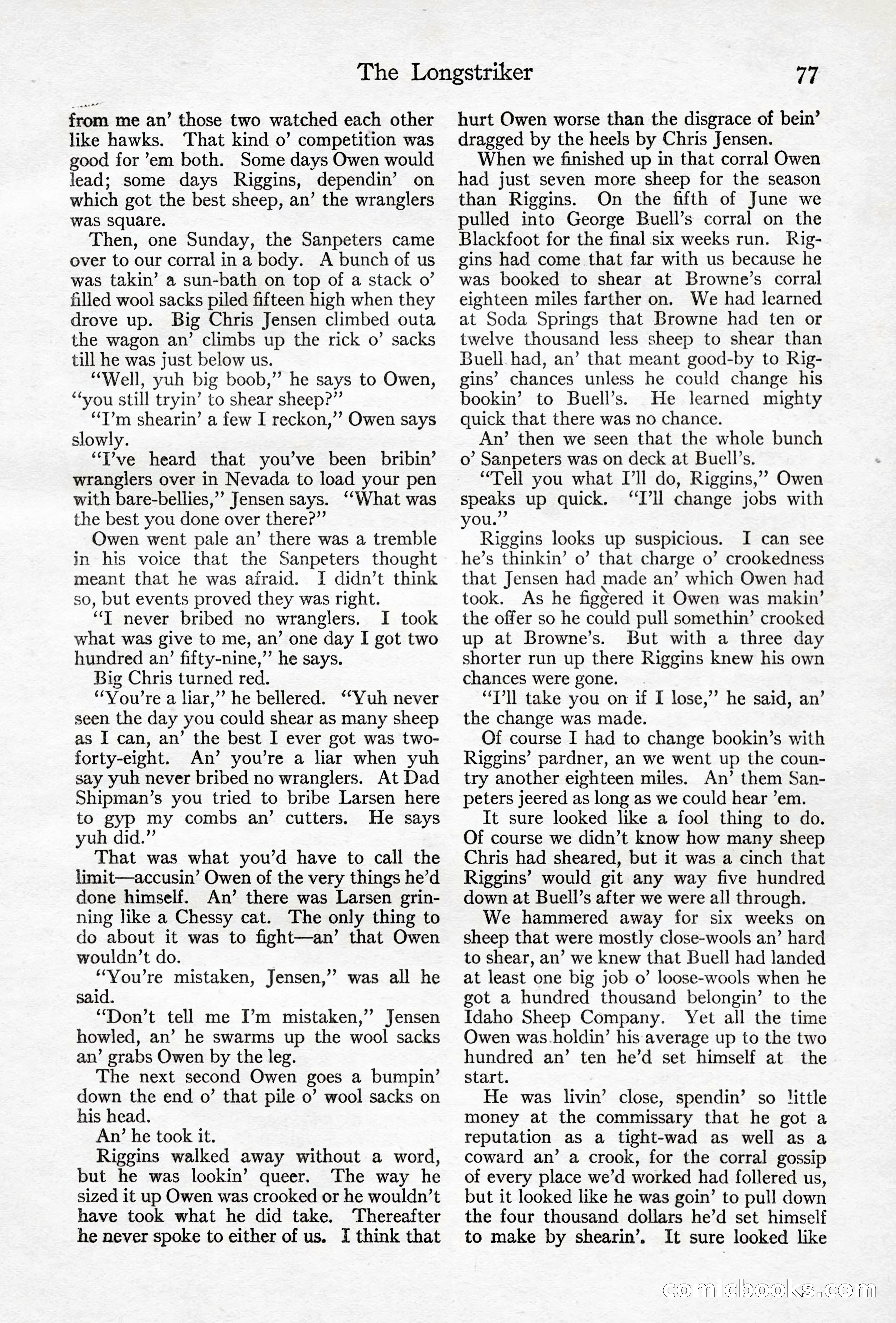
A restored page from Pulp Fiction, 1924. Page through the whole issue in the reader above.
📄 Transcribed text from this page (OCR, searchable)
Machine-transcribed from the original scan — historical spelling and the odd misread are preserved.
The Longstriker 77 from me an’ those two watched each other like hawks. That kind o’ competition was good for ’em both. Some days Owen would lead; some days Riggins, dependin’ on which got the best sheep, an’ the wranglers was square. Then, one Sunday, the Sanpeters came over to our corral ina body. A bunch of us was takin’ a sun-bath on top of a stack o’ filled wool sacks piled fifteen high when they drove up. Big Chris Jensen climbed outa the wagon an’ climbs up the rick o’ sacks till he was just below us. ‘Well, yuh big boob,” he says to Owen, ‘fyou still tryin’ to shear sheep?”’ “I’m shearin’ a few I reckon,’”’ Owen says slowly. “Yve heard that you’ve been bribin’ wranglers over in Nevada to load your pen with bare-bellies,”’ Jensen says. ‘‘What was the best you done over there?” Owen went pale an’ there was a tremble in his voice that the Sanpeters thought meant that he was airaid. I didn’t think so, but events proved they was right. “T never bribed no wranglers. I took what was give to me, an’ one day I got two hundred an’ fifty-nine,”’ he says. Big Chris turned red. ‘““You’re a liar,” he bellered. “‘Yuh never seen the day you could shear as many sheep as I can, an’ the best I ever got was two- forty-eight. An’ you’re a liar when yuh say yuh never bribed no wranglers. At Dad Shipman’s you tried to bribe Larsen here to gyp my combs an’ cutters. He says yuh did.” That was what you’d have to call the limit—accusin’ Owen of the very things he’d done himself. An’ there was Larsen grin- ning like a Chessy cat. The only thing to do about it was to fight—an’ that Owen wouldn’t do. ‘You’re mistaken, Jensen,” was all he said. “Don’t tell me I’m mistaken,” Jensen howled, an’ he swarms up the wool sacks an’ grabs Owen by the leg. The next second Owen goes a bumpin’ down the end o’ that pile o’ wool sacks on his head. An’ he took it. Riggins walked away without a word, but he was lookin’ queer. The way he sized it up Owen was crooked or he wouldn’t have took what he did take. ‘Thereafter he never spoke to either of us. I think that hurt Owen worse than the disgrace of bein’ dragged by the heels by Chris Jensen. When we finished up in that corral Owen had just seven more sheep for the season than Riggins. On the fifth of June we pulled into George Buell’s corral on the Blackfoot for the final six weeks run. Rig- gins had come that far with us because he was booked to shear at Browne’s corral eighteen miles farther on. We had learned at Soda Springs that Browne had ten or twelve thousand less sheep to shear than Buell had, an’ that meant good-by to Rig- gins’ chances unless he could change his bookin’ to Buell’s. He learned mighty quick that there was no chance. An’ then we seen that the whole bunch o’ Sanpeters was on deck at Buell’s. “Tell you what I’ll do, Riggins,’”’ Owen speaks up quick. “T’ll change jobs with you.” Riggins looks up suspicious. I can see he’s thinkin’ o’ that charge o’ crookedness that Jensen had made an’ which Owen had took. As he figgered it Owen was makin’ the offer so he could pull somethin’ crooked up at Browne’s. But with a three day shorter run up there Riggins knew his own chances were gone. . “T’ll take you on if I lose,”’ he said, an’ the change was made. Of course I had to change bookin’s with Riggins’ pardner, an we went up the coun- try another eighteen miles. An’ them San- peters jeered as long as we could hear ’em. It sure looked like a fool thing to do. Of course we didn’t know how many sheep Chris had sheared, but it was a cinch that Riggins’ would git any way five hundred down at Buell’s after we were all through. We hammered away for six weeks on sheep that were mostly close-wools an’ hard to shear, an’ we knew that Buell had landed at least one big job o’ loose-wools when he got a hundred thousand belongin’ to the Idaho Sheep Company. Yet all the time Owen was.holdin’ his average up to the two hundred an’ ten he’d set himself at the start. He was livin’ close, spendin’ so little money at the commissary that he got a reputation as a tight-wad as well as a coward an’ a crook, for the corral gossip of every place we’d worked had follered us, but it looked like he was goin’ to pull down the four thousand dollars he’d set himself to make by shearin’. It sure looked like COMiICLOoOCkkS. GO 5}