
Pulp Fiction, 1924 · page 39 of 196
Adventure Magazine, April 10, 1924 — page 39: what you’re looking at
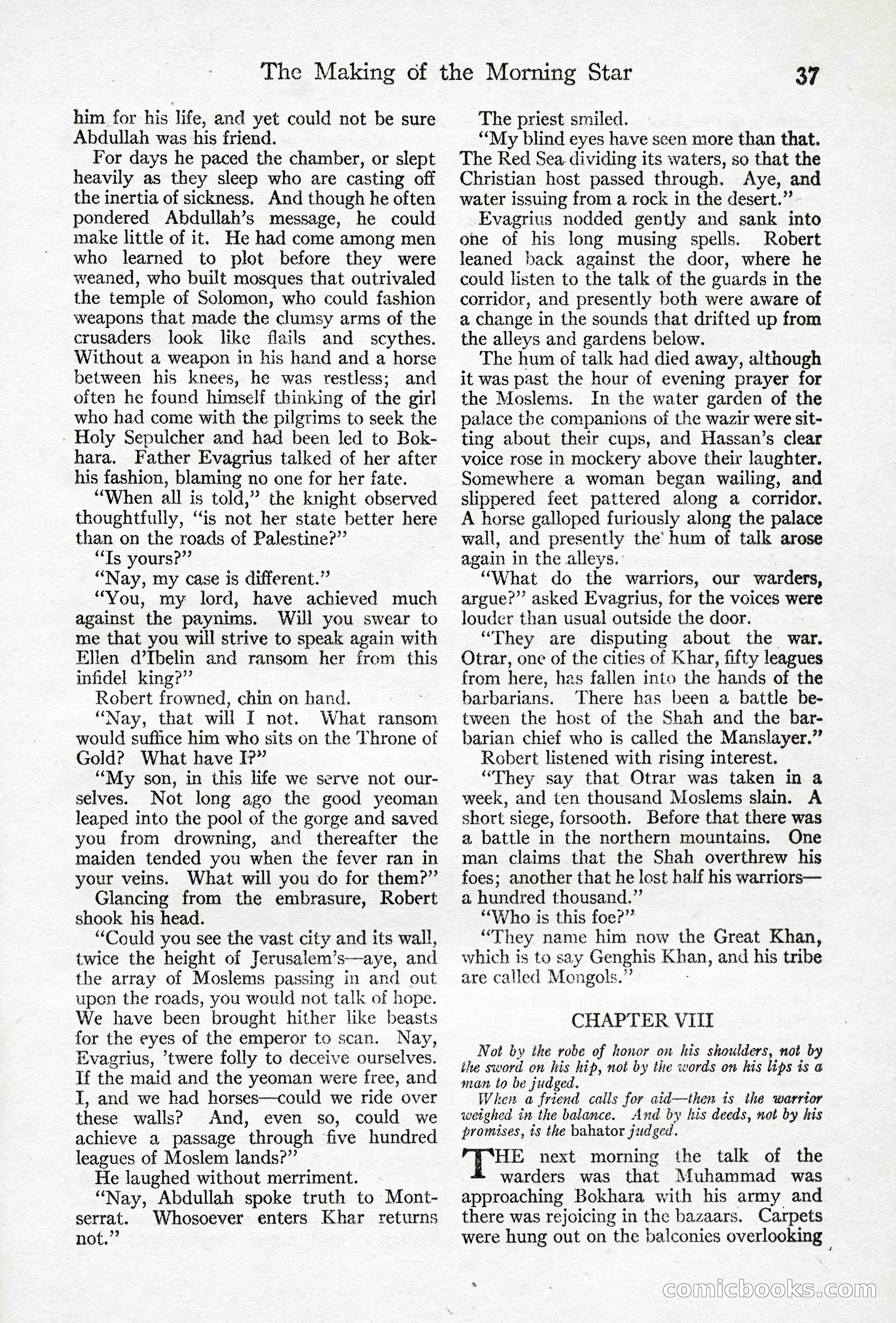
A restored page from Pulp Fiction, 1924. Page through the whole issue in the reader above.
📄 Transcribed text from this page (OCR, searchable)
Machine-transcribed from the original scan — historical spelling and the odd misread are preserved.
The Making of the Morning Star 37 him for his life, and yet could not be sure Abdullah was his friend. For days he paced the chamber, or slept heavily as they sleep who are casting off the inertia of sickness. And though he often pondered Abdullah’s message, he could make little of it. He had come among men who learned to plot before they were weaned, who built mosques that outrivaled the temple of Solomon, who could fashion weapons that made the clumsy arms of the crusaders look like flails and_ scythes. Without a weapon in his hand and a horse between his knees, he was restless; and often he found himself thinking of the girl who had come with the pilgrims to seek the Holy Sepulcher and had been led to Bok- hara. Father Evagrius talked of her after his fashion, blaming no one for her fate. “When all is told,” the knight observed thoughtfully, “is not her state better here than on the roads of Palestine?” “Is yours?” “Nay, my case is different.” “You, my lord, have achieved much against the paynims. Will you swear to me that you will strive to speak again with Klien d’Ibelin and ransom her from this infidel king?” Robert frowned, chin on hand. “Nay, that will I not. What ransom would suffice him who sits on the Throne of Gold? What have I?” ‘““My son, in this life we serve not our- selves. Not long ago the good yeoman leaped into the pool of the gorge and saved you from drowning, and thereafter the maiden tended you when the fever ran in your veins. What will you do for them?” Glancing from the embrasure, Robert shook his head. “Could you see the vast city and its wall, twice the height of Jerusalem’s—aye, and the array of Moslems passing in and out upon the roads, you would not talk of hope. We have been brought hither like beasts for the eyes of the emperor to scan. Nay, Evagrius, ’twere folly to deceive ourselves. If the maid and the yeoman were free, and I, and we had horses—could we ride over these walls? And, even so, could we achieve a passage through five hundred leagues of Moslem lands?” He laughed without merriment. “Nay, Abdullah spoke truth to Mont- serrat. Whosoever enters Khar returns not.” The priest smiled. “My blind eyes have seen more than that. The Red Sea dividing its waters, so that the Christian host passed through, Aye, and water issuing from a rock in the desert.” Evagrius nodded gently and sank into one of his long musing spells. Robert leaned back against the door, where he could listen to the talk of the guards in the corridor, and presently both were aware of a change in the sounds that drifted up from the alleys and gardens below. The hum of talk had died away, although it was past the hour of evening prayer for the Moslems. In the water garden of the palace the companions of the wazir were sit- ting about their cups, and Hassan’s clear voice rose in mockery above their laughter. Somewhere a woman began wailing, and slippered feet pattered along a corridor. A horse galloped furiously along the palace wall, and presently the’ hum of talk arose again in the alleys. “What do the warriors, our warders, argue?” asked Evagrius, for the voices were louder than usual outside the door. “They are disputing about the war. Otrar, one of the cities of Khar, fifty leagues from here, has fallen into the hands of the barbarians. There has been a battle be- tween the host of the Shah and the bar- barian chief who is called the Manslayer.” Robert listened with rising interest. “They say that Otrar was taken in a week, and ten thousand Moslems slain. A short siege, forsooth. Before that there was a battle in the northern mountains. One man claims that the Shah overthrew his foes; another that he lost half his warriors— a hundred thousand.” “Who is this foe?” “They name him now the Great Khan, which is to say Genghis Khan, and his tribe are called Mengols.’ CHAPTER VIII Not by the robe of honor on his shoulders, not by the sword on his hip, not by the words on his lips is a man to be judged. When a friend calls fer aid—then is the warrtor wetghed in the balance. And by his deeds, not by his promises, is the bahator judged. HE next morning the talk of the warders was that Muhammad was approaching Bokhara with his army and there was rejoicing in the bazaars. Carpets were hung out on the balconies overlooking ; COnmiclboooks (C@