
Pulp Fiction, 1924 · page 191 of 196
Adventure Magazine, April 10, 1924 — page 191: what you’re looking at
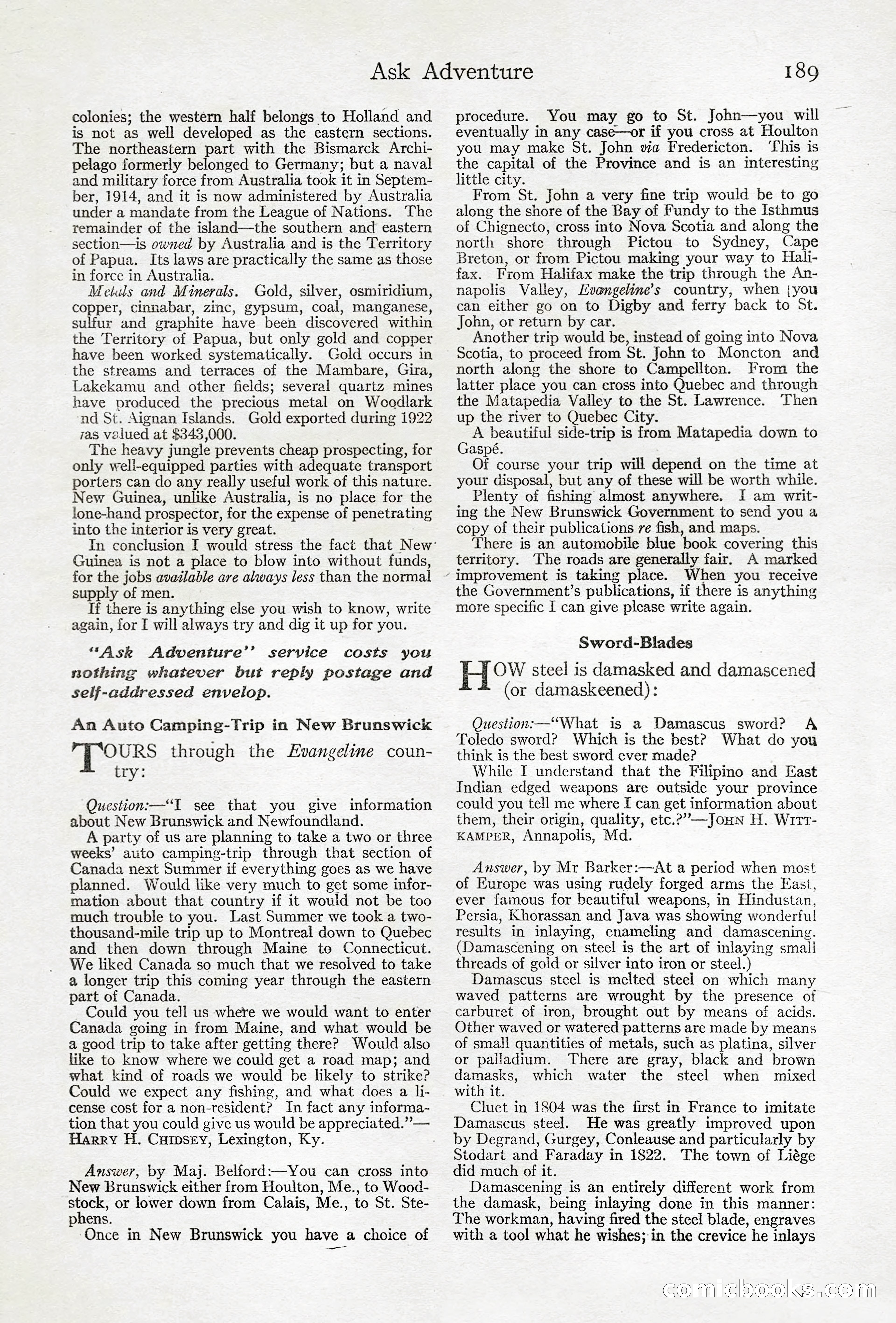
A restored page from Pulp Fiction, 1924. Page through the whole issue in the reader above.
📄 Transcribed text from this page (OCR, searchable)
Machine-transcribed from the original scan — historical spelling and the odd misread are preserved.
Ask Adventure colonies; the western half belongs to Holland and is not as well developed as the eastern sections. The northeastern part with the Bismarck Archi- pelago formerly belonged to Germany; but a naval and military force from Australia took it in Septem- ber, 1914, and it is now administered by Australia under a mandate from the League of Nations. The remainder of the island—the southern and eastern section—is owned by Australia and is the Territory of Papua. Its laws are practically the same as those in force in Australia. Metuls and Minerals. Gold, silver, osmiridium, copper, cinnabar, zinc, gypsum, coal, manganese, sulfur and graphite have been discovered within the Territory of Papua, but only gold and copper have been worked systematically. Gold occurs in the streams and terraces of the Mambare, Gira, Lakekamu and other fields; several quartz mines have produced the precious metal on Weodlark nd St. Aignan Islands. Gold exported during 1922 zas valued at $343,000. The heavy jungle prevents cheap prospecting, for only well-equipped parties with adequate transport porters can do any really useful work of this nature. New Guinea, unlike Australia, is no place for the lone-hand prospector, for the expense of penetrating into the interior is very great. In conclusion I would stress the fact that New’ Guinea is not a place to blow into without funds, for the jobs available are always less than the normal supply of men. Tf there is anything else you wish to know, write again, ior I will always try and dig it up for you. “Ask Adventure’’ service costs you nothing whatever but reply postage and self-addressed envelop. An Auto Camping-Trip in New Brunswick "TOURS through the Evangeline coun- try: Question:—‘I see that you give information about New Brunswick and Newfoundland. A party of us are planning to take a two or three weeks’ auto camping-trip through that section of Canada next Summer if everything goes as we have planned. Would like very much to get some infor- mation about that country if it would not be too much trouble to you. Last Summer we took a two- thousand-mile trip up to Montreal down to Quebec and then down through Maine to Connecticut. We liked Canada so much that we resolved to take a longer trip this coming year through the eastern part of Canada. Could you tell us where we would want to enter Canada going in from Maine, and what would be a good trip to take after getting there? Would also like to know where we could get a road map; and what kind of roads we would be likely to strike? Could we expect any fishing, and what does a li- cense cost for a non-resident? In fact any informa- tion that you could give us would be appreciated.” — Harry H. Cuipsey, Lexington, Ky. Answer, by Maj. Belford:—You can cross into New Brunswick either from Houlton, Me., to Wood- stock, or lower down from Calais, Me., to St. Ste- phens. Once in New Brunswick you have a choice of ‘improvement is taking place. 189 procedure. You may go to St. John—you will eventually in any case—or if you cross at Houlton you may make St. John wia Fredericton. This is the capital of the Province and is an interesting little city. From St. John a very fine trip would be to go along the shore of the Bay of Fundy to the Isthmus of Chignecto, cross into Nova Scotia and along the north shore through Pictou to Sydney, Cape Breton, or from Pictou making your way to Hali- fax. From Halifax make the trip through the An- napolis Valley, Evaengeline’s country, when jyou can either go on to Digby and ferry back to St. John, or return by car. Another trip would be, instead of going into Nova Scotia, to proceed from St. John to Moncton and north along the shore to Campellton. Trom the latter place you can cross into Quebec and through the Matapedia Valley to the St. Lawrence. Then up the river to Quebec City. A beautiful side-trip is from Matapedia down to Gaspé. Of course your trip will depend on the time at your disposal, but any of these will be worth while. Plenty of fishing almost anywhere. I am writ- ing the New Brunswick Government to send you a copy of their publications ve fish, and maps. There is an automobile blue book covering this territory. ‘The roads are generally fair. A marked When you receive the Government’s publications, if there is anything more specific I can give please write again. Sword-Blades OW steel is damasked and damascened (or damaskeened): Question: —“What is a Damascus sword? A Toledo sword? Which is the best? What do you think is the best sword ever made? While I understand that the Filipino and East Indian edged weapons are outside your province could you tell me where [ can get information about them, their origin, quality, etc.2”—JoHn H. Wirr- KAMPER, Annapolis, Md. Answer, by Mr Barker:—At a period when most of Europe was using rudely forged arms the East, ever famous for beautiful weapons, in Hindustan, Persia, Khorassan and Java was showing wonderful! results in inlaying, enameling and damascening. (Damascening on steel is the art of inlaying small threads of gold or silver into iron or steel.) Damascus steel is melted steel on which many waved patterns are wrought by the presence of carburet of iron, brought out by means of acids. Other waved or watered patterns are made by means of small quantities of metals, such as platina, silver or palladium. There are gray, black and brown damasks, which water the steel when mixed with it. Cluet in 1804 was the first in France to imitate Damascus steel. He was greatly improved upon by Degrand, Gurgey, Conleause and particularly by Stodart and Faraday in 1822. The town of Liége did much of it. Damascening is an entirely different work from the damask, being inlaying done in this manner: The workman, having fired the steel blade, engraves with a tool what he wishes; in the crevice he inlays COnmiclbooks G (©