
Pulp Fiction, 1924 · page 189 of 196
Adventure Magazine, April 10, 1924 — page 189: what you’re looking at
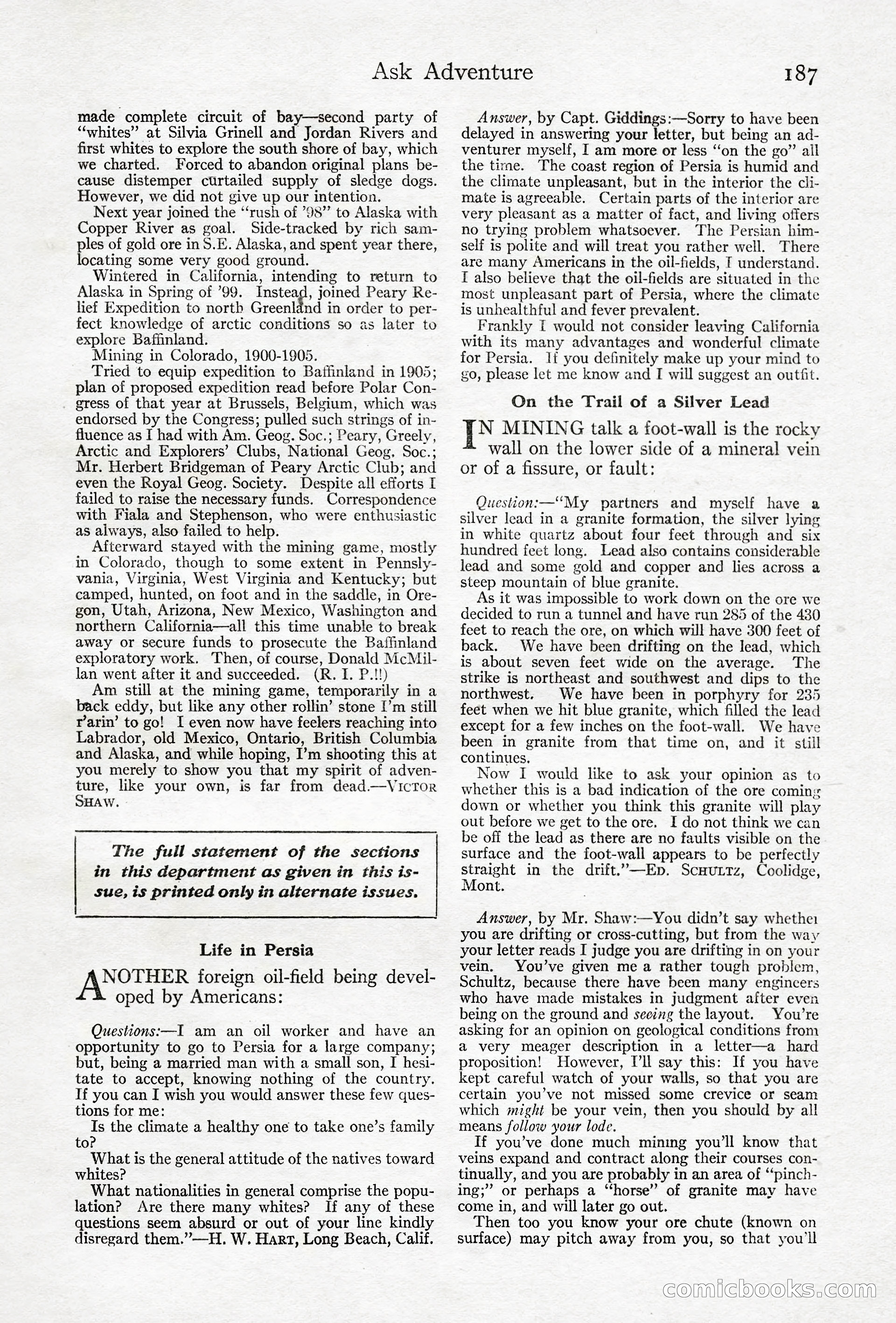
A restored page from Pulp Fiction, 1924. Page through the whole issue in the reader above.
📄 Transcribed text from this page (OCR, searchable)
Machine-transcribed from the original scan — historical spelling and the odd misread are preserved.
Ask Adventure made complete circuit of bay—second party of “whites” at Silvia Grinell and Jordan Rivers and first whites to explore the south shore of bay, which we charted. Forced to abandon original plans be- cause distemper curtailed supply of sledge dogs. However, we did not give up our intention. Next year joined the “‘rush of 98” to Alaska with Copper River as goal. Side-tracked by rich sam- ples of gold ore inS.E. Alaska, and spent year there, locating some very good ground. Wintered in California, intending to return to Alaska in Spring of 799. Instead, joined Peary Re- lief Expedition to north Greenland in order to per- fect knowledge of arctic conditions so as later to explore Baffinland. Mining in Colorado, 1900-1905. Tried to equip expedition to Baffinland in 1905; plan of proposed expedition read before Polar Con- gress of that year at Brussels, Belgium, which was endorsed by the Congress; pulled such strings of in- fluence as I had with Am. Geog. Soc.; Peary, Greely, Arctic and Explorers’ Clubs, National Geog, Soc.; Mr. Herbert Bridgeman of Peary Arctic Club; and even the Royal Geog. Society. Despite all efforts I failed to raise the necessary funds. Correspondence with Fiala and Stephenson, who were enthusiastic as always, also failed to help. Afterward stayed with the mining game, mostly in Colorado, though to some extent in Pennsly- vania, Virginia, West Virginia and Kentucky; but camped, hunted, on foot and in the saddle, in Ore- gon, Utah, Arizona, New Mexico, Washington and northern California—all this time unable to break away or secure funds to prosecute the Baffinland exploratory work. Then, of course, Donald McMil- lan went after it and succeeded. (R. I. P.!!) Am still at the mining game, temporarily in a back eddy, but like any other rollin’ stone I’m still r’arin’ to go! I even now have feelers reaching into Labrador, old Mexico, Ontario, British Columbia and Alaska, and while hoping, I’m shooting this at you merely to show you that my spirit of adven- ture, like your own, is far from dead.—VicToRr SHAW. The full statement of the sections in this department as given in this is- sue, is printed only in alternate issues. Life in Persia A OTHER foreign oil-field being devel- oped by Americans: Questions:—I am an oil worker and have an opportunity to go to Persia for a large company; but, being a married man with a small son, I hesi- tate to accept, knowing nothing of the country. If you can I wish you would answer these few ques- tions for me: Is the climate a healthy one to take one’s family to? What is the general attitude of the natives toward whites? What nationalities in general comprise the popu- lation? Are there many whites? If any of these questions seem absurd or out of your line kindly disregard them.”—H. W. Hart, Long Beach, Calif. 187 Answer, by Capt. Giddings:—Sorry to have been delayed in answering your letter, but being an ad- venturer myself, I am more or less ‘‘on the go” all the time. The coast region of Persia is humid and the climate unpleasant, but in the interior the cli- mate is agreeable. Certain parts of the interior are very pleasant as a matter of fact, and living offers no trying problem whatsoever. The Persian him- self is polite and will treat you rather well. There are many Americans in the oil-fields, I understand. I also believe that the oil-fields are situated in the most unpleasant part of Persia, where the climate is unhealthful and fever prevalent. Frankly [ would not consider leaving California with its many advantages and wonderful climate for Persia. 1l{ you definitely make up your mind to go, please let me know and I will suggest an outfit. On the Trail of a Silver Lead N MINING talk a foot-wall is the rocky wall on the lower side of a mineral vein or of a fissure, or fault: Question:—“My partners and myself have a silver lead in a granite formation, the silver lying in white quartz about four feet through and six hundred feet long. Lead also contains considerable lead and some gold and copper and lies across a steep mountain of blue granite. As it was impossible to work down on the ore we decided to run a tunnel and have run 285 of the 430 feet to reach the ore, on which will have 300 feet of back. We have been drifting on the lead, which is about seven feet wide on the average. The strike is northeast and southwest and dips to the northwest. We have been in porphyry for 235 feet when we hit blue granite, which filled the lead except for a few inches on the foot-wall. We have been in granite from that time on, and it still continues. Now I would like to ask your opinion as to whether this is a bad indication of the ore coming down or whether you think this granite will play out before we get to the ore. I do not think we can be off the lead as there are no faults visible on the surface and the foot-wall appears to be perfectly straight in the drift.”"—Ep. Scuurtz, Coolidge, Mont. Answer, by Mr. Shaw:—You didn’t say whethe you are drifting or cross-cutting, but from the way your letter reads I judge you are drifting in on your vein. You’ve given me a rather tough problem, Schultz, because there have been many engincers who have made mistakes in judgment after even being on the ground and seeing the layout. You’re asking for an opinion on geological conditions from a very meager description in a letter—a hard proposition! However, Ill say this: If you have kept careful watch of your walls, so that you are certain you’ve not missed some crevice or seam which might be your vein, then you should by all means follow your lode. If you’ve done much mining you’ll know that veins expand and contract along their courses con- tinually, and you are probably in an area of “‘pinch- ing;” or perhaps a “horse” of granite may have come in, and will later go out. Then too you know your ore chute (known on surface) may pitch away from you, so that you'll COnmicboooks (C@