
Pulp Fiction, 1924 · page 141 of 196
Adventure Magazine, April 10, 1924 — page 141: what you’re looking at
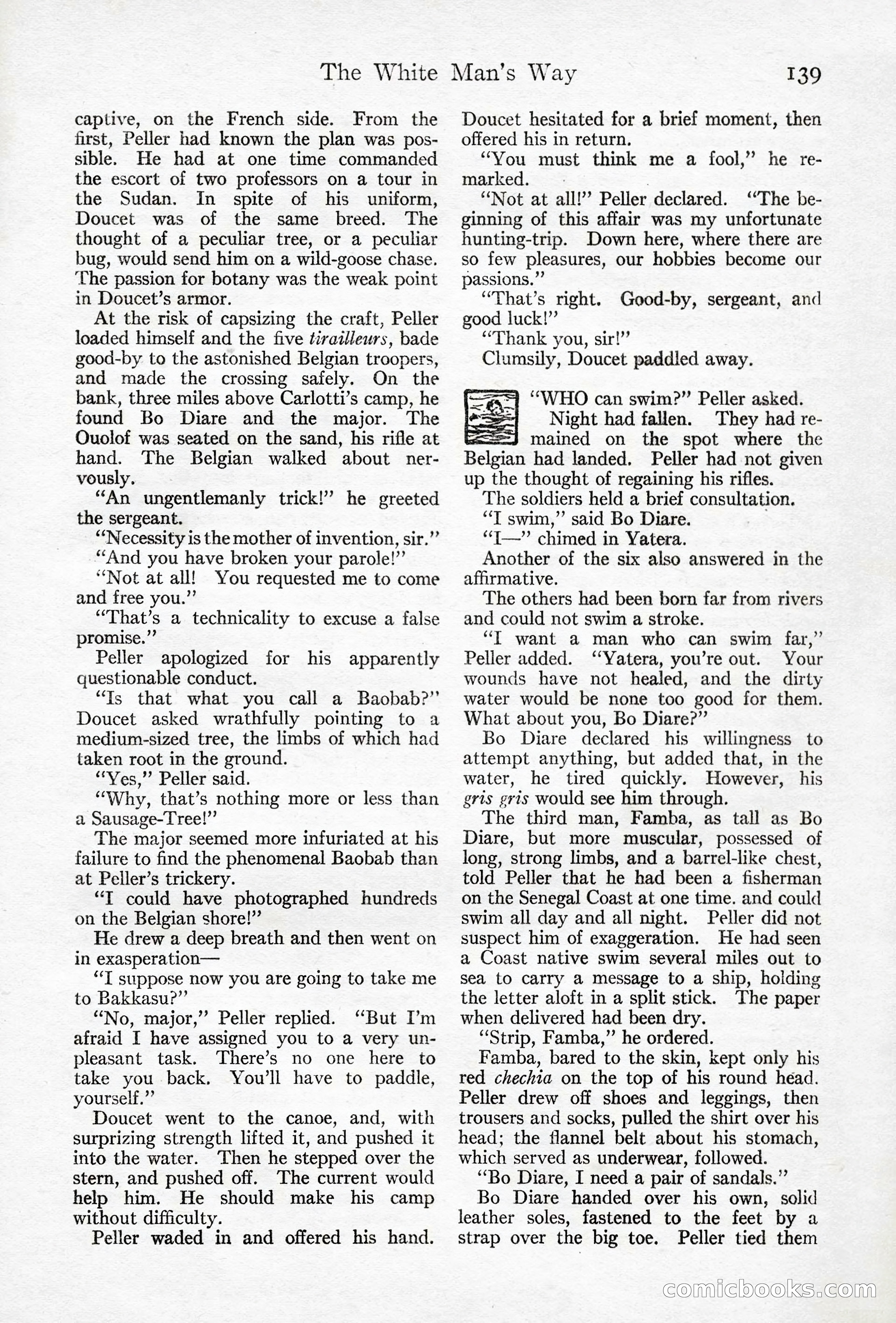
A restored page from Pulp Fiction, 1924. Page through the whole issue in the reader above.
📄 Transcribed text from this page (OCR, searchable)
Machine-transcribed from the original scan — historical spelling and the odd misread are preserved.
The White captive, on the French side. From the first, Peller had known the plan was pos- sible. He had at one time commanded the escort of two professors on a tour in the Sudan. In spite of his uniform, Doucet was of the same breed. The thought of a peculiar tree, or a peculiar bug, would send him on a wild-goose chase. The passion for botany was the weak point in Doucet’s armor. At the risk of capsizing the craft, Peller loaded himself and the five tirailleurs, bade good-by to the astonished Belgian troopers, and made the crossing safely. On the bank, three miles above Carlotti’s camp, he found Bo Diare and the major. The OQuolof was seated on the sand, his rifle at hand. The Belgian walked about ner- vously. “An ungentlemanly trick!” he greeted the sergeant. ‘Necessity is the mother of invention, sir.” ‘And you have broken your parole!”’ “Not at all! You requested me to come and free you.”’ ‘““That’s a technicality to excuse a false promise.” Peller apologized for his apparently questionable conduct. “Ts that what you call a Baobab?”’ Doucet asked wrathfully pointing to a medium-sized tree, the limbs of which had taken root in the ground. “Yes,” Peller said. “Why, that’s nothing more or less than a Sausage-Tree!”’ The major seemed more infuriated at his failure to find the phenomenal Baobab than at Peller’s trickery. “T could have photographed hundreds on the Belgian shore!” He drew a deep breath and then went on in exasperation— “IT suppose now you are going to take me to Bakkasu?”’ “No, major,” Peller replied. “But I’m afraid I have assigned you to a very un- pleasant task. There’s no one here to take you back. You'll have to paddle, yourself.”’ Doucet went to the canoe, and, with surprizing strength lifted it, and pushed it into the water. Then he stepped over the stern, and pushed off. The current would help him. He should make his camp without difficulty. Peller waded in and offered his hand. Man’s Way 139 Doucet hesitated for a brief moment, then offered his in return. “You must think me a fool,” he re- marked. } “Not at all!’’ Peller declared. ‘The be- ginning of this affair was my unfortunate hunting-trip. Down here, where there are so few pleasures, our hobbies become our passions,”’ “That’s right. good luck!” “Thank you, sir!’ Clumsily, Doucet paddled away. Good-by, sergeant, and —e “WHO can swim?” Peller asked. es~| Night had fallen. They had re- “—=-J mained on the spot where the Belgian had landed. Peller had not given up the thought of regaining his rifles. The soldiers held a brief consultation. “T swim,” said Bo Diare. “T—” chimed in Yatera. Another of the six also answered in the afhrmative. The others had been born far from rivers and could not swim a stroke. “T want a man who can swim far,” Peller added. ‘“Yatera, you’re out. Your wounds have not healed, and the dirty water would be none too good for them. What about you, Bo Diare?” Bo Diare declared his willingness to attempt anything, but added that, in the water, he tired quickly. However, his gris gris would see him through. The third man, Famba, as tall as Bo Diare, but more muscular, possessed of long, strong limbs, and a barrel-like chest, told Peller that he had been a fisherman on the Senegal Coast at one time. and could swim all day and all night. Peller did not suspect him of exaggeration. He had seen a Coast native swim several miles out to sea to carry a message to a ship, holding the letter aloft in a split stick. The paper when delivered had been dry. “Strip, Famba,” he ordered. Famba, bared to the skin, kept only his red chechia on the top of his round head. Peller drew off shoes and leggings, then trousers and socks, pulled the shirt over his head; the flannel belt about his stomach, which served as underwear, followed. “Bo Diare, I need a pair of sandals.” Bo Diare handed over his own, solid leather soles, fastened to the feet by a strap over the big toe. Peller tied them 3 COMmMiclboooks G (C@ S|