
Pulp Fiction, 1924 · page 131 of 196
Adventure Magazine, April 10, 1924 — page 131: what you’re looking at
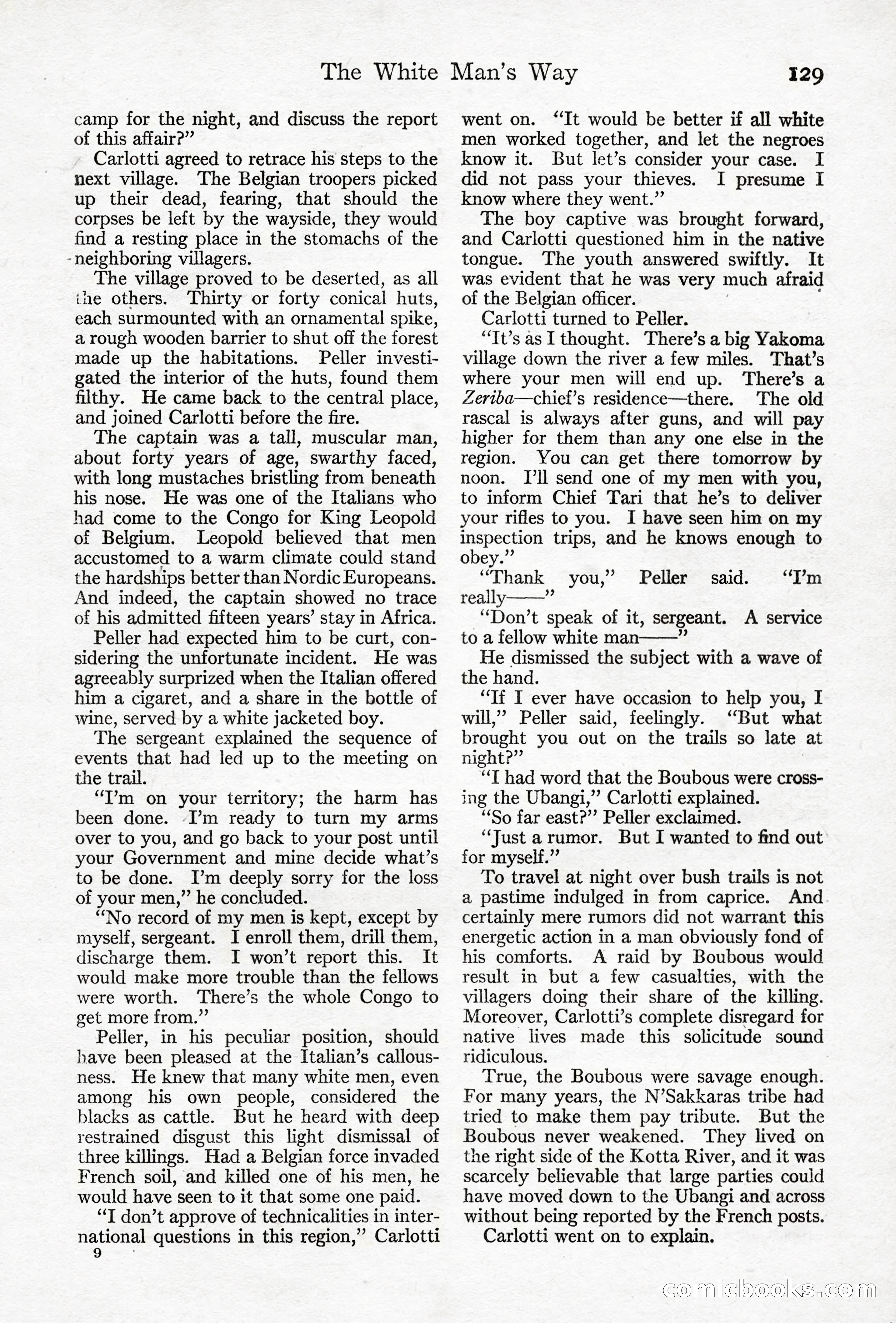
A restored page from Pulp Fiction, 1924. Page through the whole issue in the reader above.
📄 Transcribed text from this page (OCR, searchable)
Machine-transcribed from the original scan — historical spelling and the odd misread are preserved.
The White camp for the night, and discuss the report of this affair?” Carlotti agreed to retrace his steps to the next village. The Belgian troopers picked up their dead, fearing, that should the corpses be left by the wayside, they would find a resting place in the stomachs of the -neighboring villagers. The village proved to be deserted, as all ine others. Thirty or forty conical huts, each surmounted with an ornamental spike, a rough wooden barrier to shut off the forest made up the habitations. Peller investi- gated the interior of the huts, found them filthy. He came back to the central place, and joined Carlotti before the fire. The captain was a tall, muscular man, about forty years of age, swarthy faced, with long mustaches bristling from beneath his nose. He was one of the Italians who had come to the Congo for King Leopold of Belgium. Leopold believed that men accustomed to a warm climate could stand the hardships better than Nordic Europeans. And indeed, the captain showed no trace of his admitted fifteen years’ stay in Africa. Peller had expected him to be curt, con- sidering the unfortunate incident. He was agreeably surprized when the Italian offered him a cigaret, and a share in the bottle of wine, served by a white jacketed boy. The sergeant explained the sequence of events that had led up to the meeting on the trail. “T’m on your territory; the harm has been done. I’m ready to turn my arms over to you, and go back to your post until your Government and mine decide what’s to be done. I’m deeply sorry for the loss of your men,” he concluded. “No record of my men is kept, except by myself, sergeant. I enroll them, drill them, discharge them. I won’t report this. It would make more trouble than the fellows were worth. There’s the whole Congo to get more from.”’ Peller, in his peculiar position, should have been pleased at the Italian’s callous- ness. He knew that many white men, even among his own people, considered the blacks as cattle. But he heard with deep restrained disgust this light dismissal of three killings. Had a Belgian force invaded French soil, and killed one of his men, he would have seen to it that some one paid. “T don’t approve of technicalities in inter- peu questions in this region,” Carlotti Man’s Way 129 went on. “It would be better if all white men worked together, and let the negroes know it. But let’s consider your case. I did not pass your thieves. I presume I know where they went.” The boy captive was brought forward, and Carlotti questioned him in the native tongue. The youth answered swiftly. It was evident that he was very much afraid of the Belgian officer. Carlotti turned to Peller. “It’s as [ thought. There’s a big Yakoma village down the river a few miles. That’s where your men will end up. There’s a Zertba—chiet’s residence—there. ‘The old rascal is always after guns, and will pay higher for them than any one else in the region. You can get there tomorrow by noon. I'll send one of my men with you, to inform Chief Tari that he’s to deliver your rifles to you. I have seen him on my inspection trips, and he knows enough to obey.” “Thank Peller “T’m you,” said. d9 “Don’t speak of it, sergeant. A service to a fellow white man——” He dismissed the subject with a wave of the hand. “Tf I ever have occasion to help you, I will,” Peller said, feelingly. “But what brought you out on the trails so late at night?” “T had word that the Boubous were cross- ing the Ubangi,” Carlotti explained. “So far east?”’ Peller exclaimed. “Just arumor. But I wanted to find out for myself.” To travel at night over bush trails is not a pastime indulged in from caprice. And certainly mere rumors did not warrant this energetic action in a man obviously fond of his comforts. A raid by Boubous would result in but a few casualties, with the villagers doing their share of the killing. Moreover, Carlotti’s complete disregard for native lives made this solicitude sound ridiculous. True, the Boubous were savage enough. For many years, the N’Sakkaras tribe had tried to make them pay tribute. But the Boubous never weakened. ‘They lived on the right side of the Kotta River, and it was scarcely believable that large parties could have moved down to the Ubangi and across without being reported by the French posts. Carlotti went on to explain. COnmiclbooks (©