
Pulp Fiction, 1924 · page 129 of 196
Adventure Magazine, April 10, 1924 — page 129: what you’re looking at
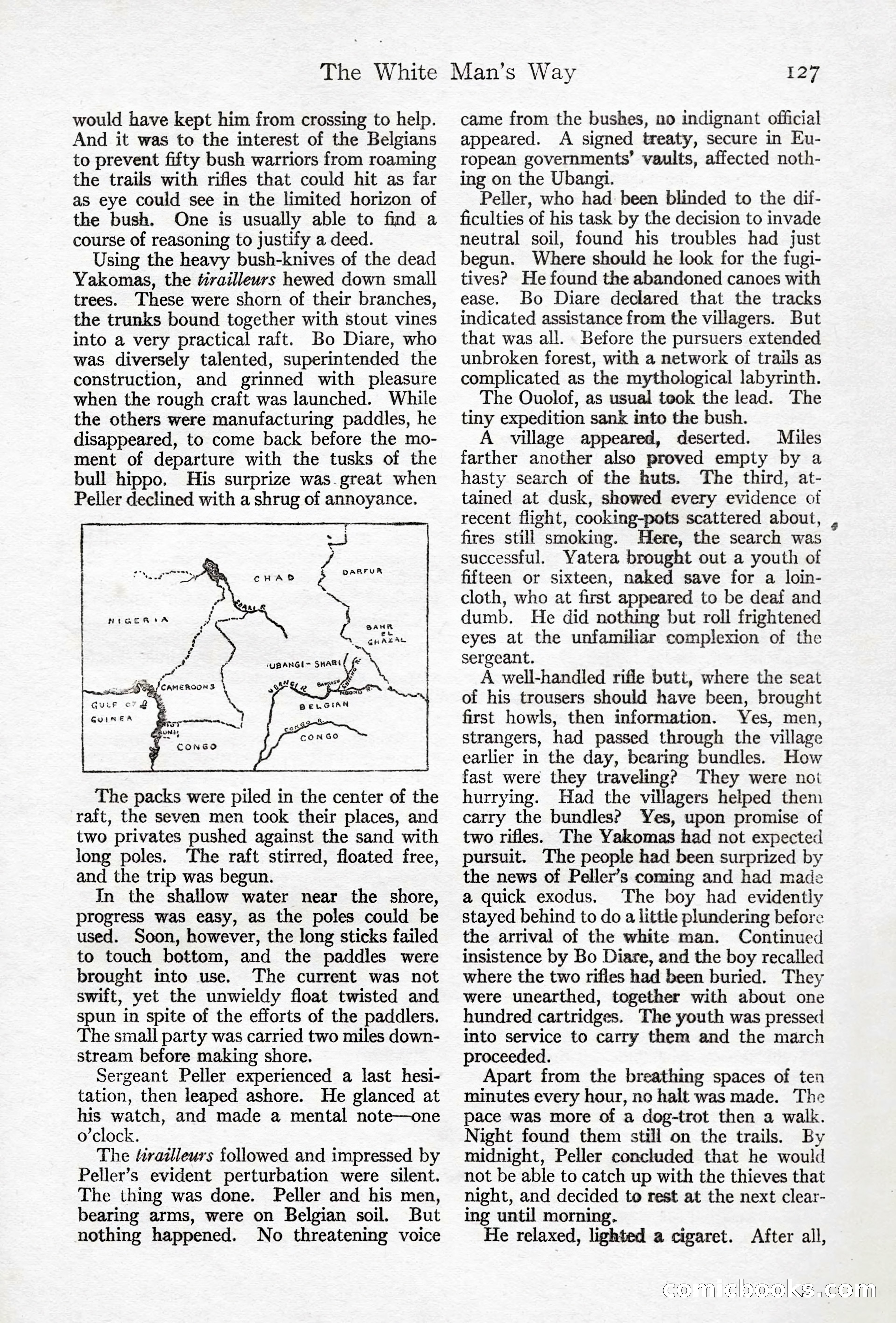
A restored page from Pulp Fiction, 1924. Page through the whole issue in the reader above.
📄 Transcribed text from this page (OCR, searchable)
Machine-transcribed from the original scan — historical spelling and the odd misread are preserved.
The White would have kept him from crossing to help. And it was to the interest of the Belgians to prevent fifty bush warriors from roaming the trails with rifles that could hit as far as eye could see in the limited horizon of the bush. One is usually able to find a course of reasoning to justify a deed. Using the heavy bush-knives of the dead Yakomas, the trailleurs hewed down small trees. These were shorn of their branches, the trunks bound together with stout vines into a very practical raft. Bo Diare, who was diversely talented, superintended the construction, and grinned with pleasure when the rough craft was launched. While the others were manufacturing paddles, he disappeared, to come back before the mo- ment of departure with the tusks of the bull hippo. His surprize was.great when Peller declined with a shrug of annoyance. <3 *. / OARFUR = ee eet SAHA eu GHAZAL GUINEA The packs were piled in the center of the raft, the seven men took their places, and two privates pushed against the sand with long poles. The raft stirred, floated free, and the trip was begun. In the shallow water near the shore, progress was easy, as the poles could be used. Soon, however, the long sticks failed to touch bottom, and the paddles were brought into use. The current was not swift, yet the unwieldy float twisted and spun in spite of the efforts of the paddlers. The small party was carried two miles down- stream before making shore. Sergeant Peller experienced a last hesi- tation, then leaped ashore. He glanced at his watch, and made a mental note—one o’clock. The tarailleurs followed and impressed by Peller’s evident perturbation were silent. The thing was done. Peller and his men, bearing arms, were on Belgian soil. But nothing happened. No threatening voice Man’s Way 127 came from the bushes, no indignant official appeared. A signed treaty, secure in Eu- ropean governments’ vaults, affected noth- ing on the Ubangi. Peller, who had been blinded to the dif- ficulties of his task by the decision to invade neutral soil, found his troubles had just begun. Where should he look for the fugi- tives? He found the abandoned canoes with ease. Bo Diare declared that the tracks indicated assistance from the villagers. But that was all. Before the pursuers extended unbroken forest, with a network of trails as complicated as the mythological labyrinth. The Ouolof, as usual took the lead. The tiny expedition sank into the bush. A village appeared, deserted. Miles farther another also proved empty by a hasty search of the huts. The third, at- tained at dusk, showed every evidence oi recent flight, cooking-pots scattered about, fires still smoking. Here, the search was successful. Yatera brought out a youth of fifteen or sixteen, naked save for a loin- cloth, who at first appeared to be deaf and dumb. He did nothing but roll frightened eyes at the unfamiliar complexion of the sergeant. A well-handled rifle butt, where the seat of his trousers should have been, brought first howls, then information. Yes, men, strangers, had passed through the village earlier in the day, bearing bundles. How fast were they traveling? They were not hurrying. Had the villagers helped them carry the bundles? Yes, upon promise of two rifles. The Yakomas had not expected pursuit. The people had been surprized by the news of Peller’s coming and had made a quick exodus. ‘The boy had evidently stayed behind to do a little plundering before the arrival of the white man. Continued insistence by Bo Diare, and the boy recalled where the two rifles had been buried. They were unearthed, together with about one hundred cartridges. The youth was pressed into service to carry them and the march proceeded. Apart from the breathing spaces of ten minutes every hour, no halt was made. The pace was more of a dog-trot then a walk. Night found them still on the trails. By midnight, Peller concluded that he would not be able to catch up with the thieves that night, and decided to rest at the next clear- ing until morning. He relaxed, lighted a cigaret. After all, GO JOO AMG S ) (C@ S|