
Pulp Fiction, 1924 · page 121 of 196
Adventure Magazine, April 10, 1924 — page 121: what you’re looking at
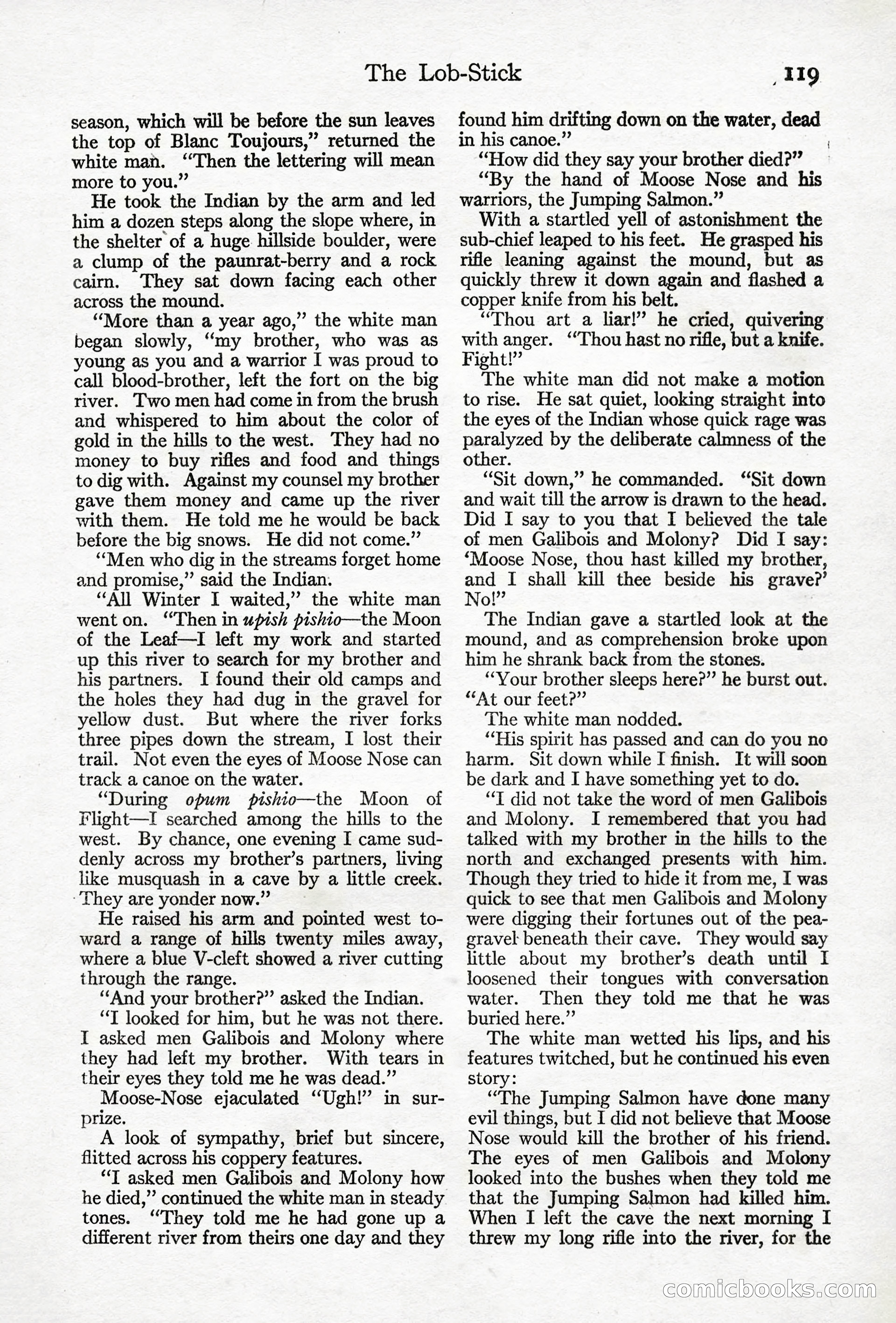
A restored page from Pulp Fiction, 1924. Page through the whole issue in the reader above.
📄 Transcribed text from this page (OCR, searchable)
Machine-transcribed from the original scan — historical spelling and the odd misread are preserved.
The Lob-Stick season, which will be before the sun leaves the top of Blanc Toujours,” returned the white man. “Then the lettering will mean more to you.” He took the Indian by the arm and led him a dozen steps along the slope where, in the shelter of a huge hillside boulder, were a clump of the paunrat-berry and a rock cairn. They sat down facing each other across the mound. “More than a year ago,” the white man began slowly, “my brother, who was as young as you and a warrior I was proud to call blood-brother, left the fort on the big river. Two men had come in from the brush and whispered to him about the color of gold in the hills to the west. They had no money to buy rifles and food and things to dig with. Against my counsel my brother gave them money and came up the river with them. He told me he would be back before the big snows. He did not come.” “(Men who dig in the streams forget home and promise,” said the Indian. “All Winter I waited,” the white man wenton. “Then in upish pishio—the Moon of the Leaf—I left my work and started up this river to search for my brother and his partners. I found their old camps and the holes they had dug in the gravel for yellow dust. But where the river forks three pipes down the stream, I lost their trail. Not even the eyes of Moose Nose can track a canoe on the water. “During opum pishio—the Moon of Flight—I searched among the hills to the west. By chance, one evening I came sud- denly across my brother’s partners, living like musquash in a cave by a little creek. ‘They are yonder now.” He raised his arm and pointed west to- ward a range of hills twenty miles away, where a blue V-cleft showed a river cutting through the range. ‘And your brother?” asked the Indian. “T looked for him, but he was not there. I asked men Galibois and Molony where they had left my brother. With tears in their eyes they told me he was dead.” Moose-Nose ejaculated “Ugh!” in sur- prize. A look of sympathy, brief but sincere, flitted across his coppery features. “I asked men Galibois and Molony how he died,”’ continued the white man in steady tones. ‘They told me he had gone up a different river from theirs one day and they lg found him drifting down on the water, dead in his canoe.” “How did they say your brother died?” “By the hand of Moose Nose and his warriors, the Jumping Salmon.” With a startled yell of astonishment the sub-chief leaped to his feet. He grasped his rifle leaning against the mound, but as quickly threw it down again and flashed a copper knife from his belt. “Thou art a lar!” he cried, quivering with anger. “Thou hast no rifle, but a knife. Fight!” The white man did not make a motion to rise. He sat quiet, looking straight into the eyes of the Indian whose quick rage was paralyzed by the deliberate calmness of the other. “Sit down,” he commanded. “Sit down and wait till the arrow is drawn to the head. Did I say to you that I believed the tale of men Galibois and Molony? Did I say: ‘Moose Nose, thou hast killed my brother, and I shall kill thee beside his grave?’ No!” The Indian gave a startled look at the mound, and as comprehension broke upon him he shrank back from the stones. “Your brother sleeps here?” he burst out. ““At our feet?” The white man nodded. ““His spirit has passed and can do you no harm. Sit down while I finish. It will soon be dark and I have something yet to do. “T did not take the word of men Galibois and Molony. I remembered that you had talked with my brother in the hills to the north and exchanged presents with him. Though they tried to hide it from me, I was quick to see that men Galibois and Molony were digging their fortunes out of the pea- gravel beneath their cave. They would say little about my brother’s death until I loosened their tongues with conversation water. Then they told me that he was buried here.”’ The white man wetted his lips, and his features twitched, but he continued his even story: “The Jumping Salmon have done many evil things, but I did not believe that Moose Nose would kill the brother of his friend. The eyes of men Galibois and Molony looked into the bushes when they told me that the Jumping Salmon had killed him. When I left the cave the next morning I threw my long rifle into the river, for the GomiGcidooksEeo