
Pulp Fiction, 1924 · page 111 of 196
Adventure Magazine, April 10, 1924 — page 111: what you’re looking at
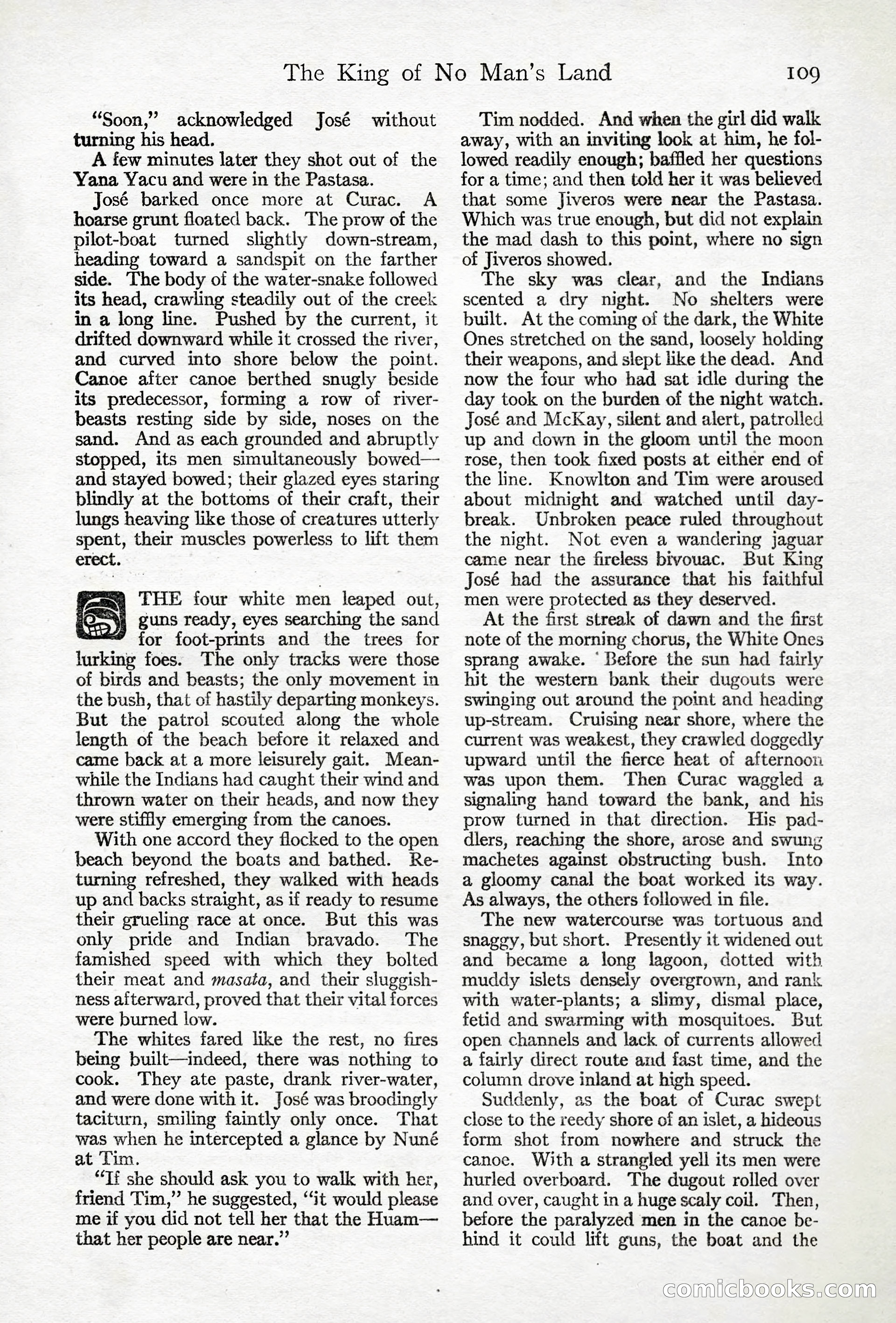
A restored page from Pulp Fiction, 1924. Page through the whole issue in the reader above.
📄 Transcribed text from this page (OCR, searchable)
Machine-transcribed from the original scan — historical spelling and the odd misread are preserved.
The King of No Man’s Land “Soon,” acknowledged José without turning his head. A few minutes later they shot out of the Yana Yacu and were in the Pastasa. José barked once more at Curac. A hoarse grunt floated back. The prow of the pilot-boat turned slightly down-stream, heading toward a sandspit on the farther side. The body of the water-snake followed its head, crawling steadily out of the creek in a long line. Pushed by the current, it drifted downward while it crossed the river, and curved into shore below the point. Canoe after canoe berthed snugly beside its predecessor, forming a row of river- beasts resting side by side, noses on the sand. And as each grounded and abruptly stopped, its men simultaneously bowed— and stayed bowed; their glazed eyes staring blindly at the bottoms of their craft, their lungs heaving like those of creatures utterly spent, their muscles powerless to lift them erect. ’ a er J THE four white men leaped out, guns ready, eyes searching the sand for foot-prints and the trees for lurking foes. The only tracks were those of birds and beasts; the only movement in the bush, that of hastily departing monkeys. But the patrol scouted along the whole length of the beach before it relaxed and came back at a more leisurely gait. Mean- while the Indians had caught their wind and thrown water on their heads, and now they were stiffly emerging from the canoes. With one accord they flocked to the open beach beyond the boats and bathed. Re- turning refreshed, they walked with heads up and backs straight, as if ready to resume their grueling race at once. But this was only pride and Indian bravado. The famished speed with which they bolted their meat and masata, and their sluggish- ness aiterward, proved that their vital forces were burned low. The whites fared like the rest, no fires being built—indeed, there was nothing to cook. They ate paste, drank river-water, and were done with it. José was broodingly taciturn, smiling faintly only once. That was when he intercepted a glance by Nuné at Tim. “Tf she should ask you to walk with her, friend Tim,” he suggested, “it would please me if you did not tell her that the Huam— that her people are near.”’ 109 Tim nodded. And when the girl did walk away, with an inviting look at him, he fol- lowed readily enough; baffled her questions for a time; and then told her it was believed that some Jiveros were near the Pastasa. Which was true enough, but did not explain the mad dash to this point, where no sign of Jiveros showed. The sky was clear, and the Indians scented a dry night. No shelters were built. At the coming of the dark, the White Ones stretched on the sand, loosely holding their weapons, and slept like the dead. And now the four who had sat idle during the day took on the burden of the night watch. José and McKay, silent and alert, patrolled up and down in the gloom until the moon rose, then took fixed posts at either end of the line. Knowlton and Tim were aroused about midnight and watched until day- break. Unbroken peace ruled throughout the night. Not even a wandering jaguar came near the fireless btvouac. But King José had the assurance that his faithful men were protected as they deserved. At the first streak of dawn and the first note of the morning chorus, the White Ones sprang awake. ‘ Before the sun had fairly hit the western bank their dugouts were Swinging out around the point and heading up-stream. Cruising near shore, where the current was weakest, they crawled doggedly upward until the fierce heat of afternoot was upon them. Then Curac waggled a signaling hand toward the bank, and his prow turned in that direction. His pad- dlers, reaching the shore, arose and swung machetes against obstructing bush. Into a gloomy canal the boat worked its way. As always, the others followed in file. The new watercourse was tortuous and snagey, but short. Presently it widened out and became a long lagoon, dotted with muddy islets densely overgrown, and rank with water-plants; a slimy, dismal place, fetid and swarming with mosquitoes. But open channels and lack of currents allowed a fairly direct route and fast time, and the column drove inland at high speed. Suddenly, as the boat of Curac swept close to the reedy shore of an islet, a hideous form shot from nowhere and struck the canoe. With a strangled yell its men were hurled overboard. The dugout rolled over and over, caught in a huge scaly coil. Then, before the paralyzed men in the canoe be- hind it could litt guns, the boat and the CORnICLOO C S (C@