
Pulp Fiction, 1924 · page 11 of 196
Adventure Magazine, April 10, 1924 — page 11: what you’re looking at
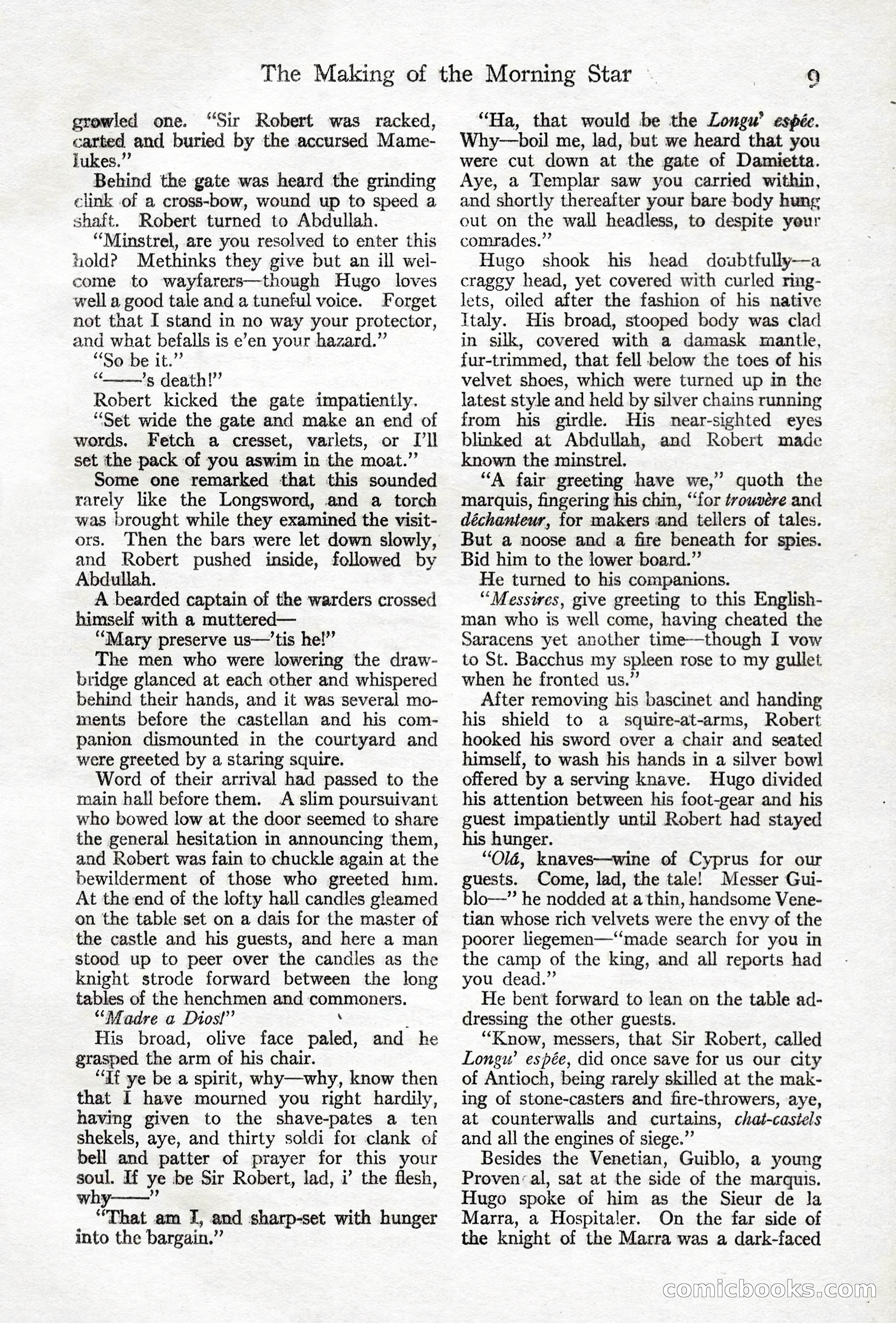
A restored page from Pulp Fiction, 1924. Page through the whole issue in the reader above.
📄 Transcribed text from this page (OCR, searchable)
Machine-transcribed from the original scan — historical spelling and the odd misread are preserved.
The Making of the Morning Star — growled one. “Sir Robert was racked, carted and buried by the accursed Mame- jukes.”’ Behind the gate was heard the grinding clink of a cross-bow, wound up to speed a shaft. Robert turned to Abdullah. “Minstrel, are you resolved to enter this hold? Methinks they give but an ill wei- come to wayfarers—though Hugo loves well a good tale and a tuneful voice. Forget not that I stand in no way your protector, and what befalls is e’en your hazard.” “So be it.” 3 ’s death!” Robert kicked the gate impatiently. “Set wide the gate and make an end of words. Fetch a cresset, varlets, or I’ll set the pack of you aswim in the moat.” Some one remarked that this sounded rarely like the Longsword, and a torch was brought while they examined the visit- ors. Then the bars were let down slowly, and Robert pushed inside, followed by Abdullah. A bearded captain of the warders crossed himself with a muttered— ‘““Mary preserve us—’tis he!” The men who were lowering the draw- bridge glanced at each other and whispered behind their hands, and it was several mo- ments before the castellan and his com- panion dismounted in the courtyard and were greeted by a staring squire. Word of their arrival had passed to the main hall before them. A slim poursuivant who bowed low at the door seemed to share the general hesitation in announcing them, and Robert was fain to chuckle again at the bewilderment of those who greeted him. At the end of the lofty hall candles gleamed on the table set on a dais for the master of the castle and his guests, and here a man stood up to peer over the candies as the knight strode forward between the long tables of the henchmen and commoners. “Madre a Dios!” His broad, olive face ala and he grasped the arm of his chair. “Tf ye be a spirit, why—why, know then that I have mourned you right hardily, having given to the shave-pates a ten shekels, aye, and thirty soldi for clank of bell and patter of prayer for this your soul. If ye be Sir Robert, lad, i’ the flesh, why——”’ “That am I, and sharp-set with hunger into the bargain. z Q “Ha, that would be the Longu’ espéc. Why—boil me, lad, but we heard that you were cut down at the gate of Damietta. Aye, a Templar saw you carried within, and shortly thereafter your bare body hung out on the wall headless, to despite yeur comrades.” Hugo shook his head doubtfully—a craggy head, yet covered with curled ring- lets, oiled after the fashion of his native Italy. His broad, stooped body was clad in silk, covered with a damask mantle, fur-trimmed, that fell below the toes of his velvet shoes, which were turned up in the latest style and held by silver chains running from his girdle. His near-sighted eyes blinked at Abdullah, and Robert made known the minstrel. “A fair greeting have we,’ quoth the marquis, fingering his chin, ‘‘for trouvére and déchanteur, for makers and tellers of tales. But a noose and a fire beneath for spies. Bid him to the lower board.” He turned to his companions. “Messires, give greeting to this English- man who is well come, having cheated the Saracens yet another time—though I vow to St. Bacchus my spleen rose to my gullet when he fronted us,” After removing his bascinet and handing his shield to a squire-at-arms, Robert hooked his sword over a chair and seated himself, to wash his hands in a silver bowl offered by a serving knave. Hugo divided his attention between his foot-gear and his guest impatiently until Robert had stayed his hunger. “Olé, knaves—wine of Cyprus for our guests. Come, lad, the tale! Messer Gui- blo—” he nodded at a thin, handsome Vene- tian whose rich velvets were the envy of the poorer liegemen—‘‘made search for you in the camp of the king, and all reports had you dead.” He bent forward to lean on the table ad- dressing the other guests. “Know, messers, that Sir Robert, called Longu’ espée, did once save for us our city of Antioch, being rarely skilled at the mak- ing of stone-casters and fire-throwers, aye, at counterwalls and curtains, chat-casiels and all the engines of siege.”’ Besides the Venetian, Guiblo, a young Proven al, sat at the side of the marquis. Hugo spoke of him as the Sieur de la Marra, a Hospitaler. On the far side of the knight of the Marra was a dark-faced COMIGHOO C S (C© 5