
Pulp Fiction, 1924 · page 107 of 196
Adventure Magazine, April 10, 1924 — page 107: what you’re looking at
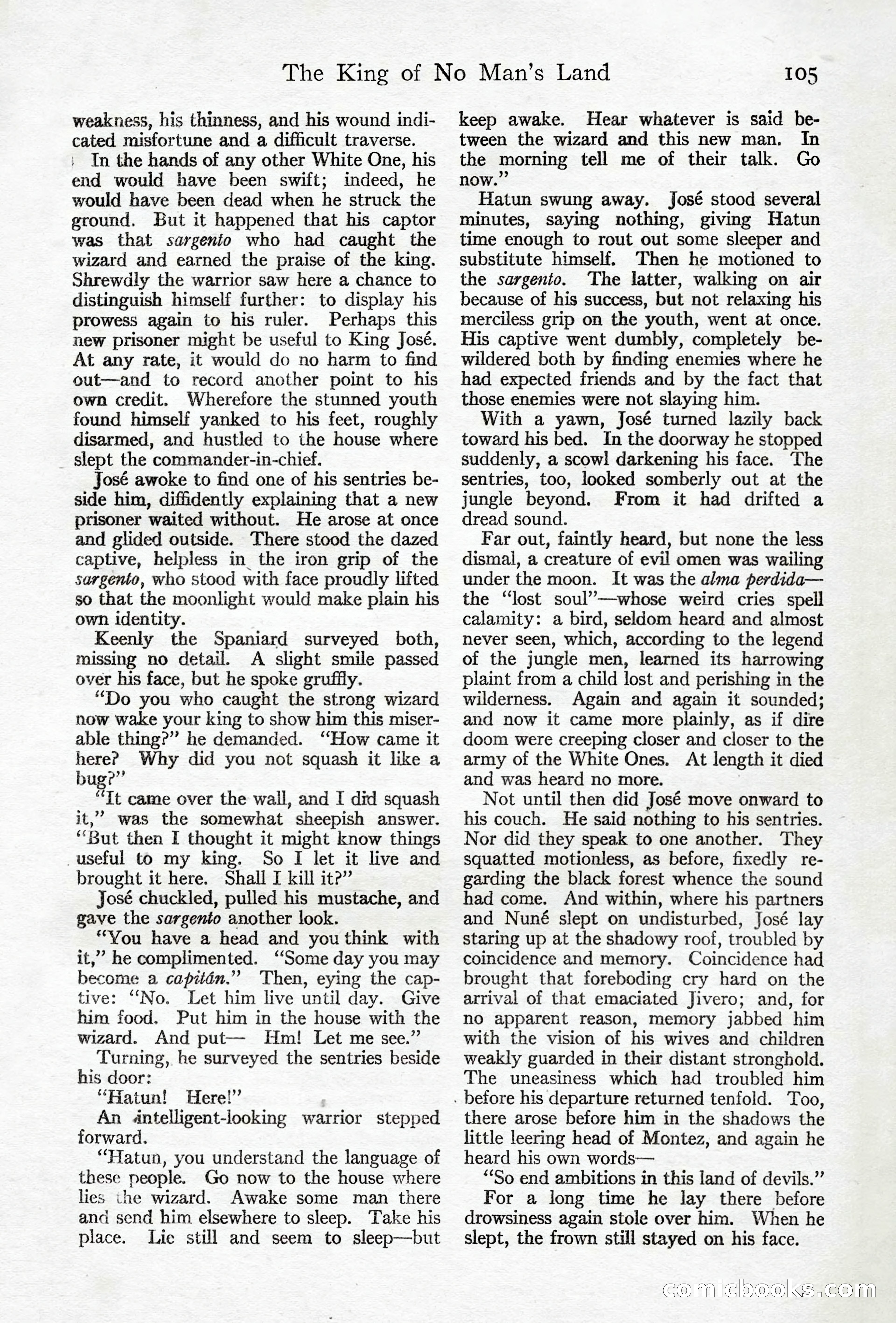
A restored page from Pulp Fiction, 1924. Page through the whole issue in the reader above.
📄 Transcribed text from this page (OCR, searchable)
Machine-transcribed from the original scan — historical spelling and the odd misread are preserved.
The King of No Man’s Land weakness, his thinness, and his wound indi- cated misfortune and a difficult traverse. | In the hands of any other White One, his end would have been swift; indeed, he would have been dead when he struck the ground. But it happened that his captor was that sargenio who had caught the wizard and earned the praise of the king. Shrewdly the warrior saw here a chance to distinguish himself further: to display his prowess again to his ruler. Perhaps this new prisoner might be useful to King José. At any rate, it would do no harm to find out—and to record another point to his own credit. Wherefore the stunned youth found himself yanked to his feet, roughly disarmed, and hustled to the house where _ slept the commander-in-chief. José awoke to find one of his sentries be- side him, diffidently explaining that a new prisoner waited without. He arose at once and glided outside. There stood the dazed captive, helpless in_ the iron grip of the sargento, who stood with face proudly lifted so that the moonlight would make plain his own identity. Keenly the Spaniard surveyed both, missing no detail. A slight smile passed over his face, but he spoke gruffly. “Do you who caught the strong wizard now wake your king to show him this miser- able thing?” he demanded. ‘How came it here? Why did you not squash it like a bug?”’ “It came over the wall, and I did squash it,’ was the somewhat sheepish answer. “But then [ thought it might know things useful to my king. So I let it live and brought it here. Shall I kill ite” José chuckled, pulled his mustache, and gave the sargento another look. “You have a head and youthink with it,” he complimented. ‘Some day you may become a capiidn.”’ Then, eying the cap- tive: “‘No. Let him live until day. Give him food. Put him in the house with the wizard. And put— Hm! Let me see.” Turning, he surveyed the sentries beside his door: ‘“Hatun! Here An dntelligent-looking warrior stepped forward. “Hatun, you understand the language of these people. Go now to the house where lies the wizard. Awake some man there and send him elsewhere to sleep. Take his place. Lie still and seem to sleep—but 1)? 105 keep awake. Hear whatever is said be- tween the wizard and this new man. In the morning tell me of their talk. Go now.” Hatun swung away. José stood several minutes, saying nothing, giving Hatun time enough to rout out some sleeper and substitute himself. Then he motioned to the sargento. ‘The latter, walking on air because of his success, but not relaxing his merciless grip on the youth, went at once. His captive went dumbly, completely be- wildered both by finding enemies where he had expected friends and by the fact that those enemies were not slaying him. With a yawn, José turned lazily back toward his bed. In the doorway he stopped suddenly, a scowl darkening his face. The sentries, too, looked somberly out at the jungle beyond. From it had drifted a dread sound. Far out, faintly heard, but none the less dismal, a creature of evil omen was wailing under the moon. It was the alma perdida— the “lost soul”—whose weird cries spell calamity: a bird, seldom heard and almost never seen, which, according to the legend of the jungle men, learned its harrowing plaint from a child lost and perishing in the wilderness. Again and again it sounded; and now it came more plainly, as if dire doom were creeping closer and closer to the army of the White Ones. At length it died and was heard no more. Not until then did José move onward to his couch. He said nothing to his sentries. Nor did they speak to one another. They squatted motionless, as before, fixedly re- garding the black forest whence the sound had come. And within, where his partners and Nuné slept on undisturbed, José lay staring up at the shadowy roof, troubled by coincidence and memory. Coincidence had brought that foreboding cry hard on the arrival of that emaciated Jivero; and, for no apparent reason, memory jabbed him with the vision of his wives and children weakly guarded in their distant stronghold. The uneasiness which had troubled him . before his departure returned tenfold. Too, there arose before him in the shadows the little leering head of Montez, and again he heard his own words— **So end ambitions in this land of devils.” For a long time he lay there before drowsiness again stole over him. When he slept, the frown still stayed on his face. CGoOmiGcdookseeco