
Pulp Fiction, 1924 · page 98 of 200
Adventure Magazine Cover — page 98: what you’re looking at
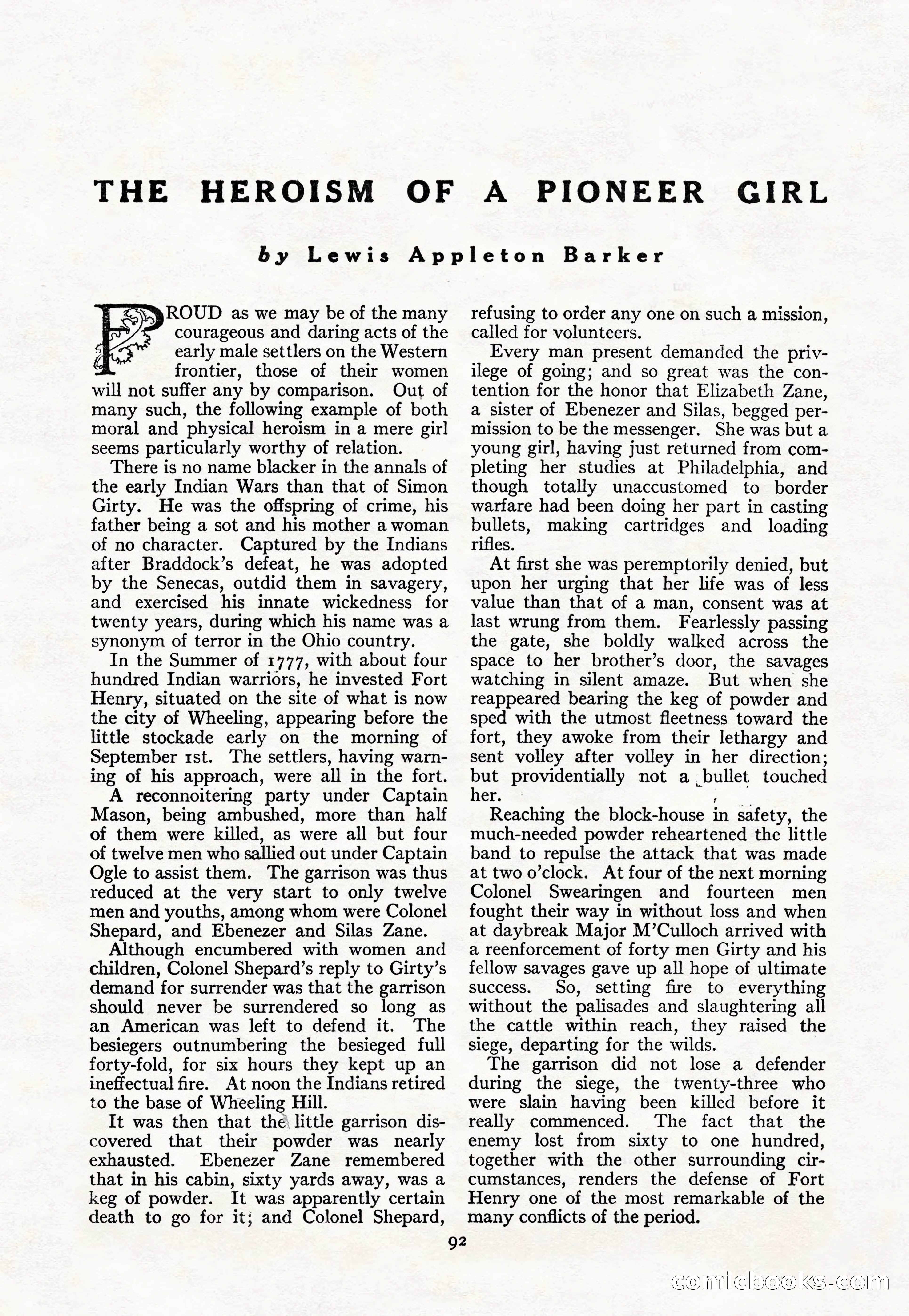
A restored page from Pulp Fiction, 1924. Page through the whole issue in the reader above.
📄 Transcribed text from this page (OCR, searchable)
Machine-transcribed from the original scan — historical spelling and the odd misread are preserved.
THE HEROISM OF A PIONEER GIRL by Lewis Appleton Barker ROUD as we may be of the many courageous and daring acts of the early male settlers on the Western frontier, those of their women will not suffer any by comparison. Out of many such, the following example of both moral and physical heroism in a mere girl seems particularly worthy of relation. There is no name blacker in the annals of the early Indian Wars than that of Simon Girty. He was the offspring of crime, his father being a sot and his mother a woman of no character. Captured by the Indians after Braddock’s defeat, he was adopted by the Senecas, outdid them in savagery, and exercised his innate wickedness for twenty years, during which his name was a synonym of terror in the Ohio country. In the Summer of 1777, with about four hundred Indian warriors, he invested Fort Henry, situated on the site of what is now the city of Wheeling, appearing before the little stockade early on the morning of September 1st. The settlers, having warn- ing of his approach, were all in the fort. A reconnoitering party under Captain Mason, being ambushed, more than half of them were killed, as were all but four of twelve men who sallied out under Captain Ogle to assist them. The garrison was thus reduced at the very start to only twelve men and youths, among whom were Colonel Shepard, and Ebenezer and Silas Zane. Although encumbered with women and children, Colonel Shepard’s reply to Girty’s demand for surrender was that the garrison should never be surrendered so long as an American was left to defend it. The besiegers outnumbering the besieged full forty-fold, for six hours they kept up an ineffectual fire. At noon the Indians retired to the base of Wheeling Hill. It was then that thé little garrison dis- covered that their powder was nearly exhausted. Ebenezer Zane remembered that in his cabin, sixty yards away, was a keg of powder. It was apparently certain death to go for it; and Colonel Shepard, Q2 refusing to order any one on such a mission, called for volunteers. Every man present demanded the priv- ilege of going; and so great was the con- tention for the honor that Elizabeth Zane, a sister of Ebenezer and Silas, begged per- mission to be the messenger. She was but a young girl, having just returned from com- pleting her studies at Philadelphia, and though totally unaccustomed to border wartare had been doing her part in casting bullets, making cartridges and loading rifles. At first she was peremptorily denied, but upon her urging that her life was of less value than that of a man, consent was at last wrung from them. Fearlessly passing the gate, she boldly walked across the space to her brother’s door, the savages watching in silent amaze. But when she reappeared bearing the keg of powder and sped with the utmost fleetness toward the fort, they awoke from their lethargy and sent volley after volley in her direction; but providentially not a,bullet touched her. ; Reaching the block-house in safety, the much-needed powder reheartened the little band to repulse the attack that was made at two o’clock. At four of the next morning Colonel Swearingen and fourteen men fought their way in without loss and when at daybreak Major M’Culloch arrived with a reenforcement of forty men Girty and his fellow savages gave up all hope of ultimate success. So, setting fire to everything without the palisades and slaughtering all the cattle within reach, they raised the siege, departing for the wilds. The garrison did not lose a defender during the siege, the twenty-three who were slain having been killed before it really commenced. The fact that the enemy lost from sixty to one hundred, together with the other surrounding cir- cumstances, renders the defense of Fort Henry one of the most remarkable of the many conflicts of the period. EO lDNOOLK CO