
Pulp Fiction, 1924 · page 47 of 200
Adventure Magazine Cover — page 47: what you’re looking at
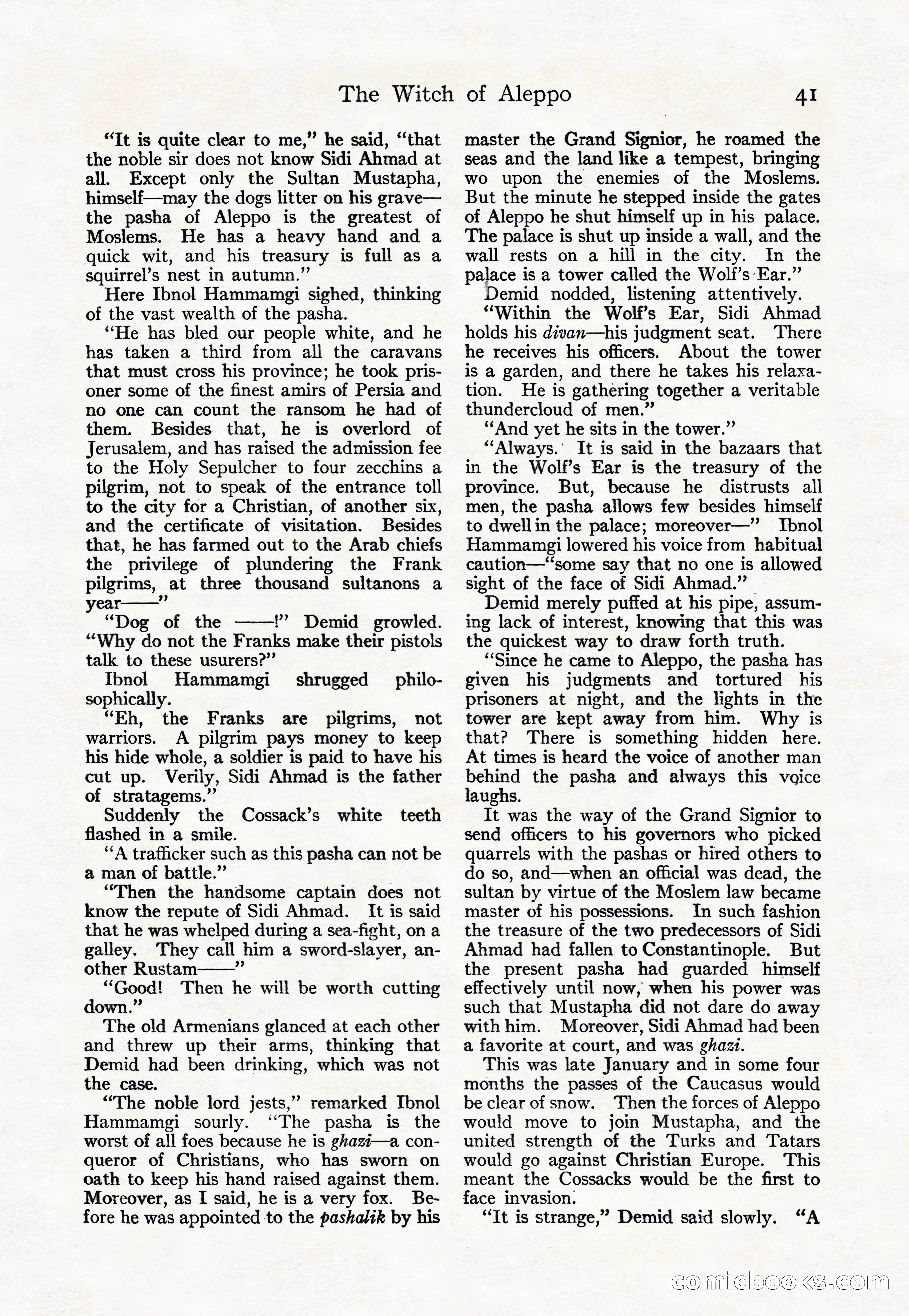
A restored page from Pulp Fiction, 1924. Page through the whole issue in the reader above.
📄 Transcribed text from this page (OCR, searchable)
Machine-transcribed from the original scan — historical spelling and the odd misread are preserved.
The Witch of Aleppo “Tt is quite clear to me,” he said, “that the noble sir does not know Sidi Ahmad at all. Except only the Sultan Mustapha, himself—may the dogs litter on his grave— the pasha of Aleppo is the greatest of Moslems. He has a heavy hand and a quick wit, and his treasury is full as a squirrel’s nest in autumn.” Here Ibnol Hammamgi sighed, thinking of the vast wealth of the pasha. ‘‘He has bled our people white, and he has taken a third from all the caravans that must cross his province; he took pris- oner some of the finest amirs of Persia and no one can count the ransom he had of them. Besides that, he is overlord of Jerusalem, and has raised the admission fee to the Holy Sepulcher to four zecchins a pilgrim, not to speak of the entrance toll to the city for a Christian, of another six, and the certificate of visitation. Besides that, he has farmed out to the Arab chiefs the privilege of plundering the Frank pilgrims, at three thousand sultanons a year 9) “Dog of the Demid growled. “Why do not the Franks make their pistols talk to these usurers?”’ Ibnol Hammamgi _ shrugged sophically. “Eh, the Franks are pilgrims, not warriors. A pilgrim pays money to keep his hide whole, a soldier is paid to have his cut up. Verily, Sidi Ahmad is the father of stratagems.”’ Suddenly the flashed in a smile. ‘‘A trafficker such as this pasha can not be a man of battle.” “Then the handsome captain does not know the repute of Sidi Ahmad. It is said that he was whelped during a sea-fight, on a galley. They call him a sword-slayer, an- other Rustam “Good! Then he will be worth cutting down.” The old Armenians glanced at each other and threw up their arms, thinking that Demid had been drinking, which was not the case. “The noble lord jests,” remarked Ibnol Hammamgi sourly. “‘The pasha is the worst of all foes because he is ghazi—a con- queror of Christians, who has sworn on oath to keep his hand raised against them. Moreover, as I said, he is a very fox. Be- fore he was appointed to the pashaltk by his 17? philo- Cossack’s white teeth AI master the Grand Signior, he roamed the seas and the land like a tempest, bringing wo upon the enemies of the Moslems. But the minute he stepped inside the gates of Aleppo he shut himself up in his palace. The palace is shut up inside a wall, and the wall rests on a hill in the city. In the palace is a tower called the Wolf’s Ear.” Demid nodded, listening attentively. “Within the Wolf’s Ear, Sidi Ahmad holds his divan—his judgment seat. There he receives his officers. About the tower is a garden, and there he takes his relaxa- tion. He is gathering together a veritable thundercloud of men.” “And yet he sits in the tower.” “Always. It is said in the bazaars that in the Wolf’s Ear is the treasury of the province. But, because he distrusts all men, the pasha allows few besides himself to dwellin the palace; moreover—” Ibnol Hammamegi lowered his voice from habitual caution—“some say that no one is allowed sight of the face of Sidi Ahmad.” Demid merely puffed at his pipe, assum- ing lack of interest, knowing that this was the quickest way to draw forth truth. “‘Since he came to Aleppo, the pasha has given his judgments and tortured his prisoners at night, and the lights in the tower are kept away from him. Why is that? There is something hidden here. At times is heard the voice of another man behind the pasha and always this voice laughs. It was the way of the Grand Signior to send officers to his governors who picked quarrels with the pashas or hired others to do so, and—when an official was dead, the sultan by virtue of the Moslem law became master of his possessions. In such fashion the treasure of the two predecessors of Sidi Ahmad had fallen to Constantinople. But the present pasha had guarded himself effectively until now, when his power was such that Mustapha did not dare do away with him. Moreover, Sidi Ahmad had been a favorite at court, and was ghazt. This was late January and in some four months the passes of the Caucasus would be clear of snow. Then the forces of Aleppo would move to join Mustapha, and the united strength of the Turks and Tatars would go against Christian Europe. This meant the Cossacks would be the first to face invasion. “It is strange,” Demid said slowly. “A comicbooks.com