
Pulp Fiction, 1924 · page 35 of 200
Adventure Magazine Cover — page 35: what you’re looking at
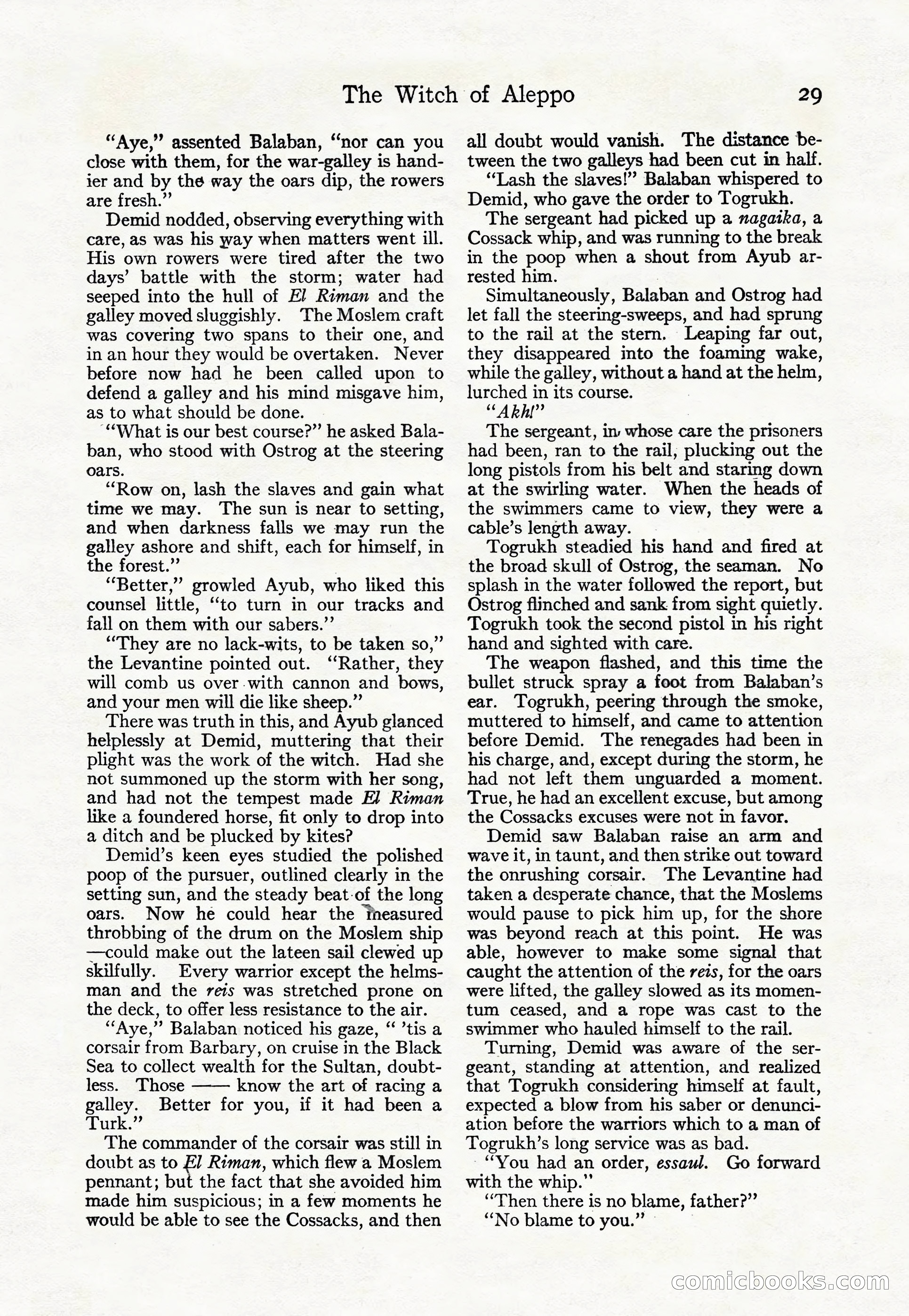
A restored page from Pulp Fiction, 1924. Page through the whole issue in the reader above.
📄 Transcribed text from this page (OCR, searchable)
Machine-transcribed from the original scan — historical spelling and the odd misread are preserved.
The Witch of Aleppo “Aye,” assented Balaban, “nor can you close with them, for the war-galley is hand- ier and by the way the oars dip, the rowers are fresh.” Demid nodded, observing everything with care, as was his way when matters went ill. His own rowers were tired after the two days’ battle with the storm; water had seeped into the hull of El Riman and the galley moved sluggishly. The Moslem craft was covering two spans to their one, and in an hour they would be overtaken. Never before now had he been called upon to defend a galley and his mind misgave him, as to what should be done. “What is our best course?”’ he asked Bala- ban, who stood with Ostrog at the steering oars. “Row on, lash the slaves and gain what time we may. The sun is near to setting, and when darkness falls we may run the galley ashore and shift, each for himself, in the forest.” | “Better,” growled Ayub, who liked this counsel little, “to turn in our tracks and fall on them with our sabers.”’ ““They are no lack-wits, to be taken so,” the Levantine pointed out. ‘“‘Rather, they will comb us over-with cannon and bows, and your men will die like sheep.” There was truth in this, and Ayub glanced helplessly at Demid, muttering that their plight was the work of the witch. Had she not summoned up the storm with her song, and had not the tempest made El Riman like a foundered horse, fit only to drop into a ditch and be plucked by kites? Demid’s keen eyes studied the polished poop of the pursuer, outlined clearly in the setting sun, and the steady beat-of the long oars. Now he could hear the theasured throbbing of the drum on the Moslem ship —could make out the lateen sail clewed up skilfully. Every warrior except the helms- man and the reis was stretched prone on the deck, to offer less resistance to the air. “Aye,” Balaban noticed his gaze, “ ’tis a corsair from Barbary, on cruise in the Black Sea to collect wealth for the Sultan, doubt- less. Those know the art of racing a galley. Better for you, if it had been a Turk.” The commander of the corsair was still in doubt as to El Raman, which flew a Moslem pennant; but the fact that she avoided him made him suspicious; in a few moments he would be able to see the Cossacks, and then 29 all doubt would vanish. The distance be- tween the two galleys had been cut in half. “Lash the slaves!”’ Balaban whispered to Demid, who gave the order to Togrukh. The sergeant had picked up a nagatka, a Cossack whip, and was running to the break in the poop when a shout from Ayub ar- eine him. Simultaneously, Balaban and Ostrog had let fall the steering-sweeps, and had sprung to the rail at the stern. Leaping far out, they disappeared into the foaming wake, while the galley, without a hand at the helm, lurched in its course. 9 A kh!’ The sergeant, in whose care the prisoners had been, ran to the rail, plucking out the long pistols from his belt and staring down at the swirling water. When the heads of the swimmers came to view, they were a cable’s length away. Togrukh steadied his hand and fired at the broad skull of Ostrog, the seaman. No splash in the water followed the report, but Ostrog flinched and sank from sight quietly. Togrukh took the second pistol in his right hand and sighted with care. The weapon flashed, and this time the bullet struck spray a foot from Balaban’s ear. Togrukh, peering through the smoke, muttered to himself, and came to attention before Demid. The renegades had been in his charge, and, except during the storm, he had not left them unguarded a moment. True, he had an excellent excuse, but among the Cossacks excuses were not in favor. Demid saw Balaban raise an arm and wave it, in taunt, and then strike out toward the onrushing corsair. The Levantine had taken a desperate chance, that the Moslems would pause to pick him up, for the shore was beyond reach at this point. He was able, however to make some signal that caught the attention of the rezs, for the oars were lifted, the galley slowed as its momen- tum ceased, and a rope was cast to the swimmer who hauled himself to the rail. Turning, Demid was aware of the ser- geant, standing at attention, and realized that Togrukh considering himself at fault, expected a blow from his saber or denunci- ation before the warriors which to a man of Togrukh’s long service was as bad. ~“Vou had an order, essaul. Go forward with the whip.”’ “Then there is no blame, father?” “No blame to you.’ COmiclbook (©