
Pulp Fiction, 1924 · page 30 of 200
Adventure Magazine Cover — page 30: what you’re looking at
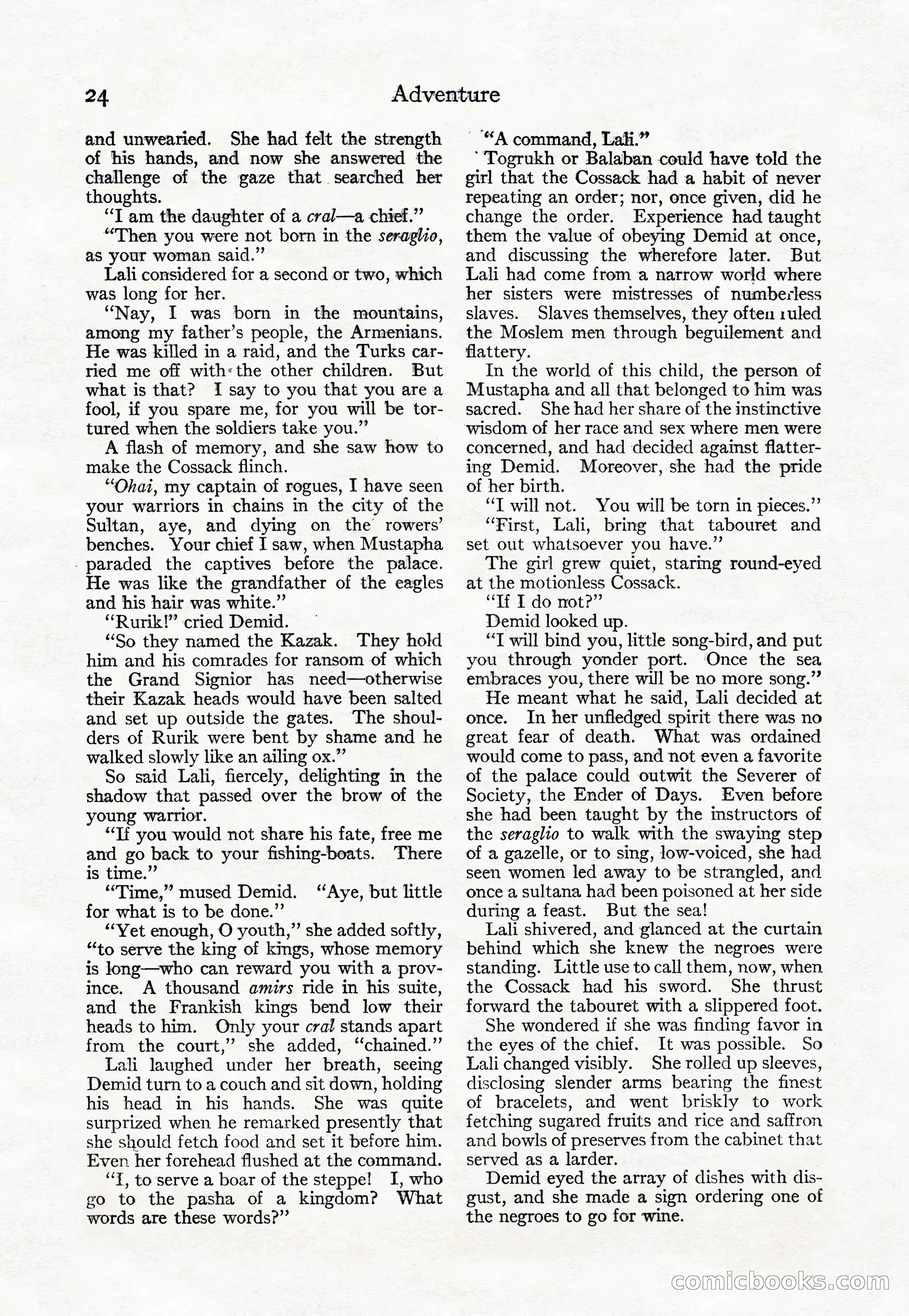
A restored page from Pulp Fiction, 1924. Page through the whole issue in the reader above.
📄 Transcribed text from this page (OCR, searchable)
Machine-transcribed from the original scan — historical spelling and the odd misread are preserved.
24 and unwearied. She had felt the strength of his hands, and now she answered the challenge of the gaze that searched her thoughts. “T am the daughter of a cral—a chief.” “Then you were not born in the seraglio, as your woman said.” Lali considered for a second or two, which was long for her. “Nay, I was born in the mountains, among my father’s people, the Armenians. He was killed in a raid, and the Turks car- ried me off with:the other children. But what is that? I say to you that you area fool, if you spare me, for you will be tor- tured when the soldiers take you.” A flash of memory, and she saw how to make the Cossack flinch. “Ohai, my captain of rogues, I have seen your warriors in chains in the city of the Sultan, aye, and dying on the rowers’ benches. Your chief I saw, when Mustapha - paraded the captives before the palace. He was like the grandfather of the eagles and his hair was white.” “Rurik!” cried Demid. “So they named the Kazak. They hold him and his comrades for ransom of which the Grand Signior has need—otherwise their Kazak heads would have been salted and set up outside the gates. The shoul- ders of Rurik were bent by shame and he walked slowly like an ailing ox.” So said Lali, fiercely, delighting in the shadow that passed over the brow of the young warrior. “Tf you would not share his fate, free me and go back to your fishing-boats. There is time.” “Time,” mused Demid. “Aye, but little for what is to be done.” “Yet enough, O youth,” she added softly, “to serve the king of kmgs, whose memory is long—who can reward you with a prov- ince. A thousand amirs ride in his suite, and the Frankish kings bend low their heads to him. Only your cral stands apart from the court,” she added, ‘‘chained.”’ Lali laughed under her breath, seeing Demid turn to a couch and sit down, holding his head in his hands. She was quite surprized when he remarked presently that she should fetch food and set it before him. Even her forehead flushed at the command. “¥, to serve a boar of the steppe! I, who go to the pasha of a kingdom? What words are these words?” Adventure “A command, Lah.” ‘Togrukh or Balaban could have told the girl that the Cossack had a habit of never repeating an order; nor, once given, did he change the order. Experience had taught them the value of obeying Demid at once, and discussing the wherefore later. But Lali had come from a narrow world where her sisters were mistresses of numberless slaves. Slaves themselves, they often 1uled the Moslem men through beguilement and flattery. In the world of this child, the person of Mustapha and all that belonged to him was sacred. She had her share of the instinctive wisdom of her race and sex where men were concerned, and had decided against flatter- ing Demid. Moreover, she had the pride of her birth. “T will not. You will be torn in pieces.” “First, Lah, bring that tabouret and set out whatsoever you have.” The girl grew quiet, staring round-eyed at the motionless Cossack. “Tf I do not?” Demid looked up. “T will bind you, little song-bird, and put you through yonder port. Once the sea embraces you, there will be no more song.” He meant what he said, Lali decided at once. In her unfledged spirit there was no great fear of death. What was ordained would come to pass, and not even a favorite of the palace could outwit the Severer of Society, the Ender of Days. Even before she had been taught by the mstructors of the seraglio to walk with the swaying step of a gazelle, or to sing, low-voiced, she had seen women led away to be strangled, and once a sultana had been poisoned at her side during a feast. But the sea! Lali shivered, and glanced at the curtain behind which she knew the negroes were standing. Little use to call them, now, when the Cossack had his sword. She thrust forward the tabouret with a slippered foot. She wondered if she was finding favor in the eyes of the chief. It was possible. So Lali changed visibly. She rolled up sleeves, disclosing slender arms bearing the finest of bracelets, and went briskly to work fetching sugared fruits and rice and saffron and bowls of preserves from the cabinet that served as a larder. Demid eyed the array of dishes with dis- gust, and she made a sign ordering one of the negroes to go for wine. COmiclboook CO