
Pulp Fiction, 1924 · page 20 of 200
Adventure Magazine Cover — page 20: what you’re looking at
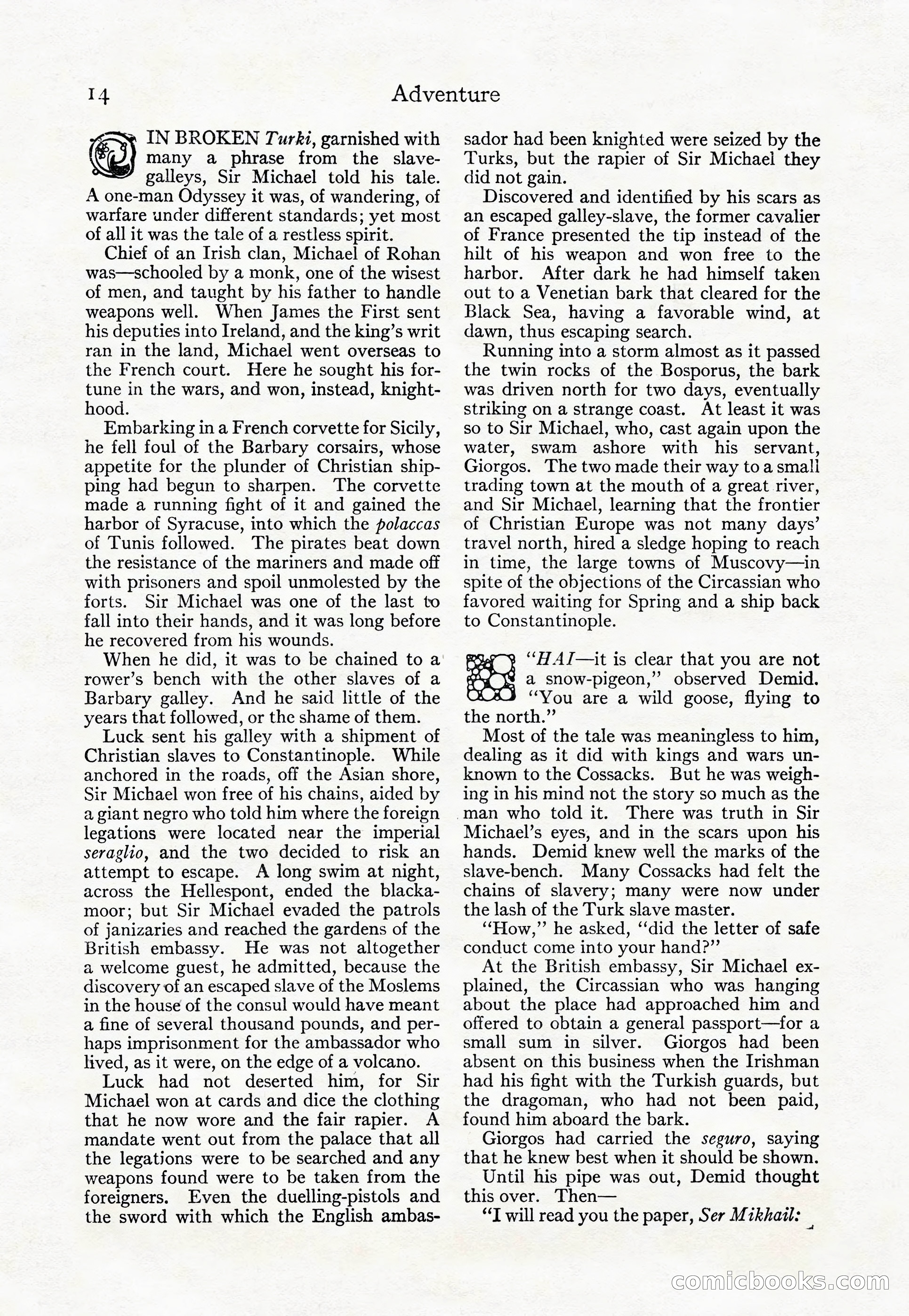
A restored page from Pulp Fiction, 1924. Page through the whole issue in the reader above.
📄 Transcribed text from this page (OCR, searchable)
Machine-transcribed from the original scan — historical spelling and the odd misread are preserved.
14 ~ IN BROKEN Turki, garnished with (@) many a phrase from the slave- galleys, Sir Michael told his tale. A one-man Odyssey it was, of wandering, of warfare under different standards; yet most of all it was the tale of a restless spirit. Chief of an Irish clan, Michael of Rohan was—schooled by a monk, one of the wisest of men, and taught by his father to handle weapons well. When James the First sent his deputies into Ireland, and the king’s writ ran in the land, Michael went overseas to the French court. Here he sought his for- tune in the wars, and won, instead, knight- hood. Embarking in a French corvette for Sicily, he fell foul of the Barbary corsairs, whose appetite for the plunder of Christian ship- ping had begun to sharpen. The corvette made a running fight of it and gained the harbor of Syracuse, into which the polaccas of Tunis followed. The pirates beat down the resistance of the mariners and made off with prisoners and spoil unmolested by the forts. Sir Michael was one of the last to fall into their hands, and it was long before he recovered from his wounds. When he did, it was to be chained to a rower’s bench with the other slaves of a Barbary galley. And he said little of the years that followed, or the shame of them. Luck sent his galley with a shipment of Christian slaves to Constantinople. While anchored in the roads, off the Asian shore, Sir Michael won free of his chains, aided by a giant negro who told him where the foreign legations were located near the imperial seraglio, and the two decided to risk an attempt to escape. A long swim at night, across the Hellespont, ended the blacka- moor; but Sir Michael evaded the patrols of janizaries and reached the gardens of the British embassy. He was not altogether a welcome guest, he admitted, because the discovery of an escaped slave of the Moslems in the house of the consul would have meant a fine of several thousand pounds, and per- haps imprisonment for the ambassador who lived, as it were, on the edge of a volcano. Luck had not deserted him, for Sir Michael won at cards and dice the clothing that he now wore and the fair rapier. A mandate went out from the palace that all the legations were to be searched and any weapons found were to be taken from the foreigners. Even the duelling-pistols and the sword with which the English ambas- -man who told it. Adventure sador had been knighted were seized by the Turks, but the rapier of Sir Michael they did not gain. Discovered and identified by his scars as an escaped galley-slave, the former cavalier of France presented the tip instead of the hilt of his weapon and won free to the harbor. After dark he had himself taken out to a Venetian bark that cleared for the Black Sea, having a favorable wind, at dawn, thus escaping search. Running into a storm almost as it passed the twin rocks of the Bosporus, the bark was driven north for two days, eventually striking on a strange coast. At least it was so to Sir Michael, who, cast again upon the water, swam ashore with his servant, Giorgos. The two made their way toa small trading town at the mouth of a great river, and Sir Michael, learning that the frontier of Christian Europe was not many days’ travel north, hired a sledge hoping to reach in time, the large towns of Muscovy—in spite of the objections of the Circassian who favored waiting for Spring and a ship back to Constantinople. ae a snow-pigeon,”’ observed Demid. “You are a wild goose, flying to the north.” Most of the tale was meaningless to him, dealing as it did with kings and wars un- known to the Cossacks. But he was weigh- ing in his mind not the story so much as the There was truth in Sir Michael’s eyes, and in the scars upon his hands. Demid knew well the marks of the slave-bench. Many Cossacks had felt the chains of slavery; many were now under the lash of the Turk slave master. “How,” he asked, “‘did the letter of safe conduct come into your hand?”’ At the British embassy, Sir Michael ex- plained, the Circassian who was hanging about the place had approached him and offered to obtain a general passport—for a small sum in silver. Giorgos had been absent on this business when the Irishman had his fight with the Turkish guards, but the dragoman, who had not been paid, found him aboard the bark. Giorgos had carried the seguro, saying that he knew best when it should be shown. Until his pipe was out, Demid thought this over. Then— “I will read you the paper, Ser Mikhail: “HAI—1t is clear that you are not COMGHOO Sj CO