
Pulp Fiction, 1924 · page 196 of 200
Adventure Magazine Cover — page 196: what you’re looking at
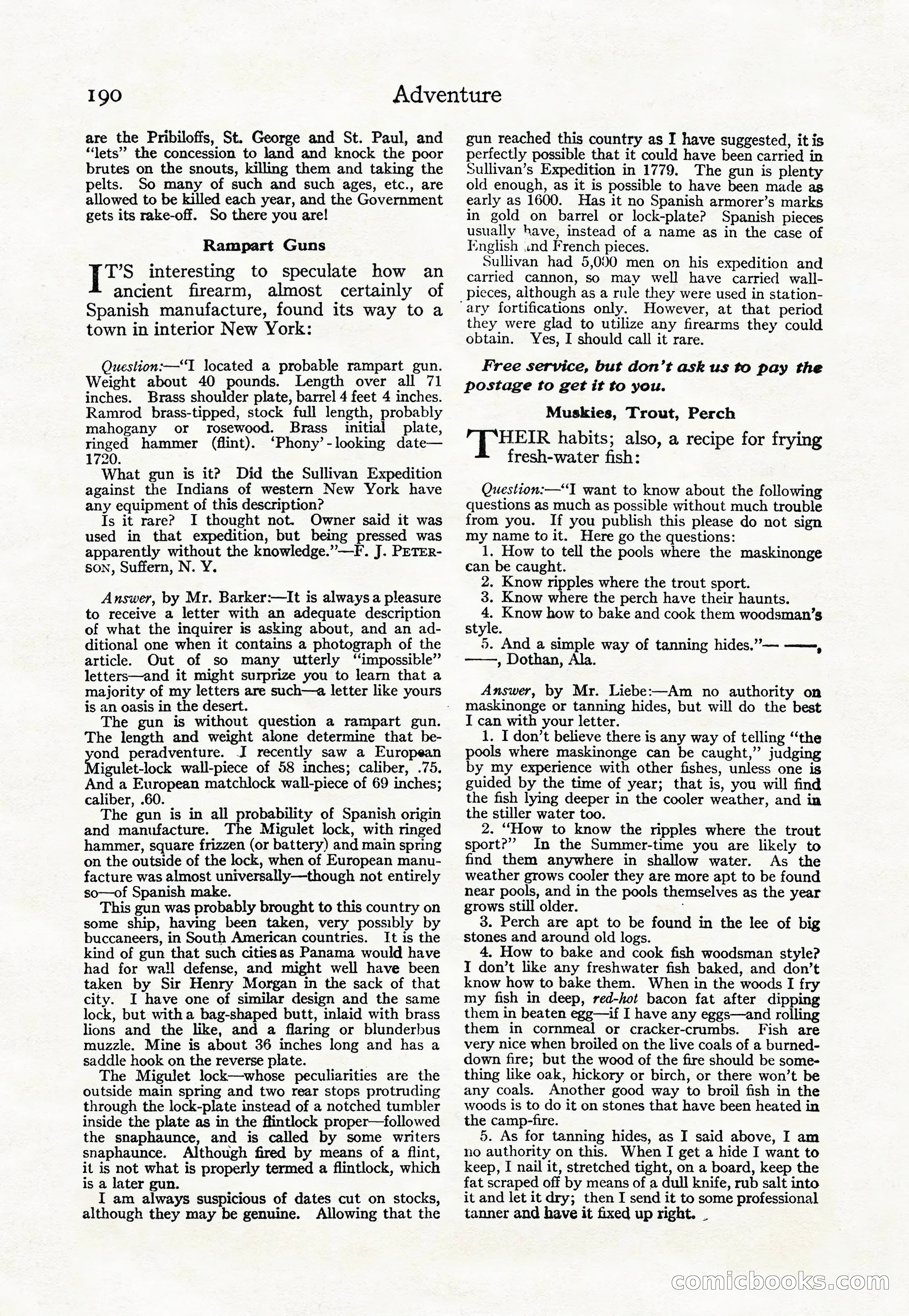
A restored page from Pulp Fiction, 1924. Page through the whole issue in the reader above.
📄 Transcribed text from this page (OCR, searchable)
Machine-transcribed from the original scan — historical spelling and the odd misread are preserved.
190 are the Pribilofis, St. George and St. Paul, and “lets” the concession to land and knock the poor brutes on the snouts, killing them and taking the pelts. So many of such and such ages, etc., are allowed to be killed each year, and the Government gets its rake-off. So there you are! Rampart Guns T’S interesting to speculate how an ancient firearm, almost certainly of Spanish manufacture, found its way to a town in interior New York: Question:—“T located a probable rampart gun. Weight about 40 pounds. Length over all 71 inches. Brass shoulder plate, barrel 4 feet 4 inches. Ramrod brass-tipped, stock full length, probably mahogany or rosewood. Brass initial plate, ringed hammer (flint). ‘Phony’-looking date— 1720. What gun is it? Did the Sullivan Expedition against the Indians of western New York have any equipment of this description? ; Is it rare? I thought not. Owner said it was used in that expedition, but being pressed was apparently without the knowledge.” —F. J. PETER- SON, Suffern, N. Y. Answer, by Mr. Barker:—It is always a pleasure to receive a letter with an adequate description of what the inquirer is asking about, and an ad- ditional one when it contains a photograph of the article. Out of so many utterly “impossible” letters—and it might surprize you to learn that a majority of my letters are such—a letter like yours is an oasis in the desert. The gun is without question a rampart gun. The length and weight alone determine that be- rond peradventure. J recently saw a European ‘Migulet lock wall-piece of 58 inches; caliber, .75. And a European matchlock wall-piece of 69 inches; caliber, .60. S The gun is in all probability of Spanish origin and manufacture. The Migulet lock, with ringed hammer, square frizzen (or battery) and main spring on the outside of the lock, when of European manu- facture was almost universally—though not entirely so—of Spanish make. : This gun was probably brought to this country on some ship, having been taken, very possibly by buccaneers, in South American countries. It is the kind of gun that such citiesas Panama would have had for wall defense, and might well have been taken by Sir Henry Morgan im the sack of that city. I have one of similar design and the same lock, but witha bag-shaped butt, inlaid with brass lions and the like, and a flaring or blunderbus muzzle. Mine is about 36 inches long and has a saddle hook on the reverse plate. : The Migulet lock—whose peculiarities are the outside main spring and two rear stops protruding through the lock-plate instead of a notched tumbler inside the plate as in the ftintlock proper—followed the snaphaunce, and is called by some wniters snaphaunce. Although fired by means of a flint, it is not what is properly termed a flintlock, which is a later gun. I am always suspicious of dates cut on stocks, although they may be genuine. Allowing that the ‘ary fortifications only. Adventure gun reached this country as I have suggested, itis perfectly possible that it could have been carried in Sullivan’s Expedition in 1779. The gun is plenty old enough, as it is possible to have been made as early as 1600. Has it no Spanish armorer’s marks in gold on barrel or lock-plate? Spanish pieces usually have, instead of a name as in the case of Knglish .nd French pieces. Sullivan had 5,090 men on his expedition and carried cannon, so may well have carried wall- pieces, although as a rule they were used in station- However, at that period they were glad to utilize any firearms they could obtain. Yes, I should call it rare. Free service, but don’t ask us to pay the postage to get it to you. Muskies, Trout, Perch "THER habits; also, a recipe for frying fresh-water fish: Question: —“T want to know about the following questions as much as possible without much trouble from you. If you publish this please do not sign my name to it. Here go the questions: 1, How to tell the pools where the maskinonge can be caught. 2. Know ripples where the trout sport. 3. Know where the perch have their haunts. ss Know how to bake and cook them woodsman’s style. 5. And a simple way of tanning hides,’— ——, ——, Dothan, Ala. Answer, by Mr. Liebe:—Am no authority on maskinonge or tanning hides, but will do the best I can with your letter. 1. I don’t believe there is any way of telling “the pools where maskinonge can be caught,” judging by my experience with other fishes, unless one is guided by the time of year; that is, you will find the fish lying deeper in the cooler weather, and in the stiller water too. 2. “How to know the npples where the trout sport?” In the Summer-time you are likely to find them anywhere in shallow water. As the weather grows cooler they are more apt to be found near pools, and in the pools themselves as the year grows still older. ; 3. Perch are apt to be found in the lee of big stones and around old logs. 4. How to bake and cook fish woodsman style? I don’t like any freshwater fish baked, and don’t know how to bake them. When in the woods I fry my fish in deep, red-hot bacon fat after dipping them in beaten egg—if I have any eggs—and rolling them in cornmeal or cracker-crumbs. Fish are very nice when broiled on the live coals of a burned- down fire; but the wood of the fire should be some- thing like oak, hickory or birch, or there won’t be any coals. Another good way to broil fish in the woods is to do it on stones that have been heated in the camp-fire. 5. As for tanning hides, as I said above, I am no authority on this. When I get a hide I want to keep, I nail it, stretched tight, on a board, keep the fat scraped off by means of a dull knife, rub salt into it and let it dry; then I send it to some professional tanner and have it fixed up right. | oO COmiclbook S|