
Pulp Fiction, 1924 · page 194 of 200
Adventure Magazine Cover — page 194: what you’re looking at
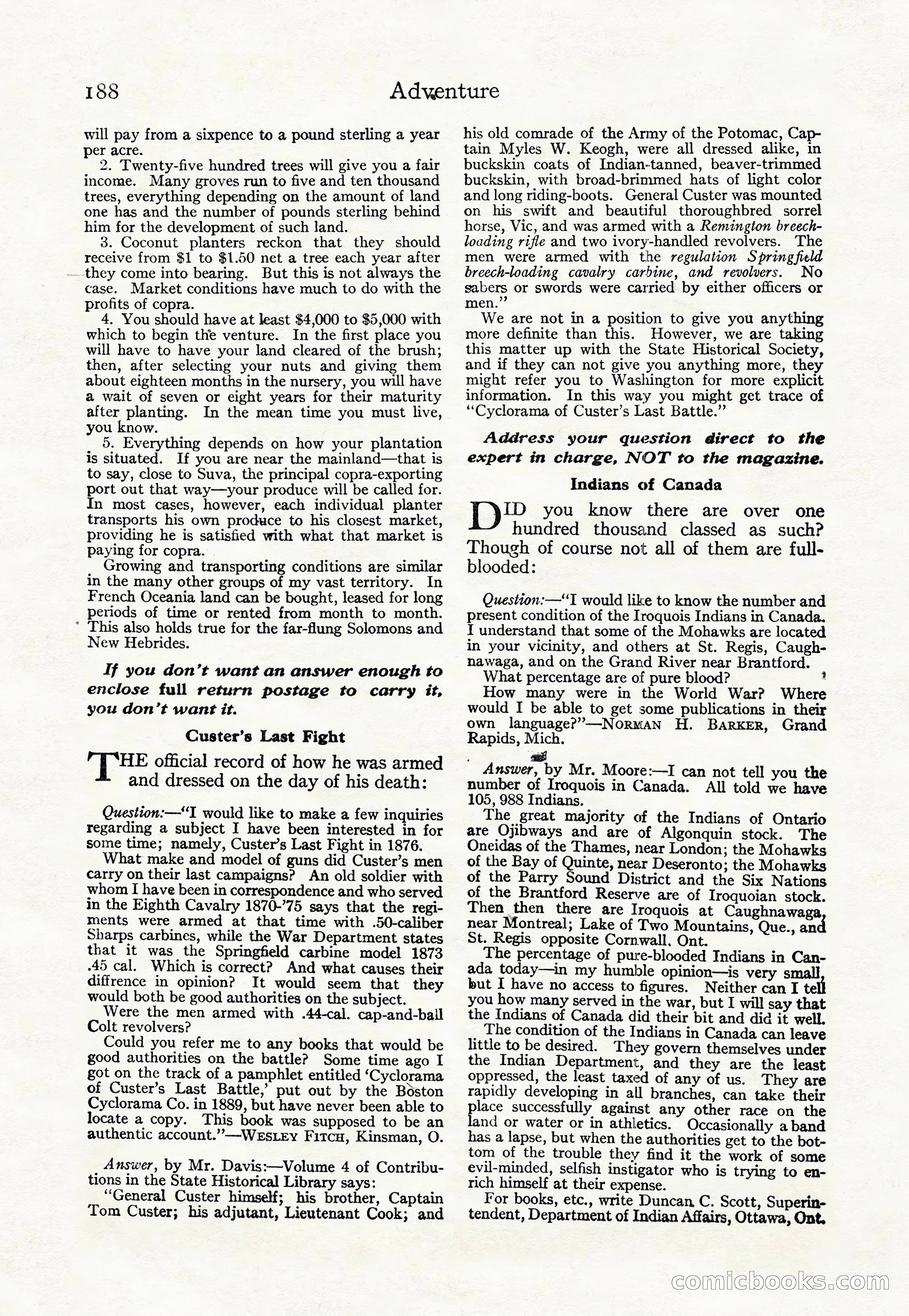
A restored page from Pulp Fiction, 1924. Page through the whole issue in the reader above.
📄 Transcribed text from this page (OCR, searchable)
Machine-transcribed from the original scan — historical spelling and the odd misread are preserved.
1838 will pay from a sixpence to a pound sterling a year per acre. 2. Twenty-five hundred trees will give you a fair income. Many groves run to five and ten thousand trees, everything depending on the amount of land one has and the number of pounds sterling behind him for the development of such land. 3. Coconut planters reckon that they should receive from $1 to $1.50 net a tree each year after they come into bearing. But this is not always the case. Market conditions have much to do with the profits of copra. 4. You should have at least $4,000 to $5,000 with which to begin the venture. In the first place you will have to have your land cleared of the brush; then, after selecting your nuts and giving them about eighteen months in the nursery, you will have a wait of seven or eight years for their maturity after planting. In the mean time you must live, you know. 5. Everything depends on how your plantation is situated. If you are near the mainland—that is to say, close to Suva, the principal copra-exporting port out that way—your produce will be called for. In most cases, however, each individual planter transports his own produce to his closest market, providing he is satisfied with what that market is paying for copra. Growing and transporting conditions are similar in the many other groups of my vast territory. In French Oceania land can be bought, leased for long periods of time or rented from month to month. * This also holds true for the far-flung Solomons and New Hebrides. If you don’t want an answer enough to enclose full return postage to carry it, you don’t want it. Custer’s Last Fight HE official record of how he was armed and dressed on the day of his death: Question: —“T would like to make a few inquiries regarding a subject I have been interested in for some time; namely, Custer’s Last Fight in 1876. What make and model of guns did Custer’s men carry on their last campaigns? An old soldier with whom I have been in correspondence and who served in the Eighth Cavalry 1870-75 says that the regi- ments were armed at that time with .50-caliber Sharps carbines, while the War Department states that it was the Springfield carbine model 1873 45 cal. Which is correct? And what causes their diffrence in opinion? It would seem that they would both be good authorities on the subject. Were the men armed with .44-cal. cap-and-ball Colt revolvers? Could you refer me to any books that would be good authorities on the battle? Some time ago I got on the track of a pamphlet entitled ‘Cyclorama of Custer’s Last Battle,’ put out by the Boston Cyclorama Co. in 1889, but have never been able to locate a copy. This book was supposed to be an authentic account.”—WeEsLEy Fitcu, Kinsman, O. Answer, by Mr. Davis:—Volume 4 of Contribu- tions in the State Historical Library says: ‘General Custer himself; his brother, Captain Tom Custer; his adjutant, Lieutenant Cook; and Adventure his old comrade of the Army of the Potomac, Cap- tain Myles W. Keogh, were all dressed alike, in buckskin coats of Indian-tanned, beaver-trimmed buckskin, with broad-brimmed hats of light color and long riding-boots. General Custer was mounted on his swift and beautiful thoroughbred sorrel horse, Vic, and was armed with a Remington breech- loading rifle and two ivory-handled revolvers. The men were armed with the regulation Springfield breech-loading cavalry carbine, and revolvers. No sabers or swords were carried by either officers or men.” We are not in a position to give you anything more definite than this. However, we are taking this matter up with the State Historical Society, and if they can not give you anything more, they might refer you to Washington for more explicit information. In this way you might get trace of ““Cyclorama of Custer’s Last Battle.” Address your question direct to the expert in charge, NOT to the magazine. Indians of Canada ID you know there are over one hundred thousand classed as such? Though of course not all of them are full- blooded: Question: —“T would like to know the number and present condition of the Iroquois Indians in Canada. I understand that some of the Mohawks are located in your vicinity, and others at St. Regis, Caugh- nawaga, and on the Grand River near Brantford. What percentage are of pure blood? How many were in the World War? Where would I be able to get some publications in their own language?”—NormMaAN H. Barker, Grand Rapids, Mich. a Answer, by Mr. Moore:—I can not tell you the number of Iroquois in Canada. All told we have 105, 988 Indians. The great majority of the Indians of Ontario are Ojibways and are of Algonquin stock. The Oneidas of the Thames, near London; the Mohawks of the Bay of Quinte, near Deseronto; the Mohawks of the Parry Sound District and the Six Nations of the Brantford Reserve are of Iroquoian stock. Then then there are Iroquois at Caughnawaga near Montreal; Lake of Two Mountains, Que., and St. Regis opposite Cornwall, Ont. The percentage of pure-blooded Indians in Can- ada today—in my humble opinion—is very small but I have no access to figures. Neither can I tell you how many served in the war, but I will say that the Indians of Canada did their bit and did it well. _ The condition of the Indians in Canada can leave little to be desired. They govern themselves under the Indian Department, and they are the least oppressed, the least taxed of any of us. They are rapidly developing in all branches, can take their place successfully against any other race on the nd or water or in athletics. Occasionally a band has a lapse, but when the authorities get to the bot- tom of the trouble they find it the work of some evil-minded, selfish instigator who is trying to en- rich himself at their expense. For books, etc., write Duncan C. Scott, Superin- tendent, Department of Indian Affairs, Ottawa, Ont. oO mn Comicboooks S|