
Pulp Fiction, 1924 · page 159 of 200
Adventure Magazine Cover — page 159: what you’re looking at
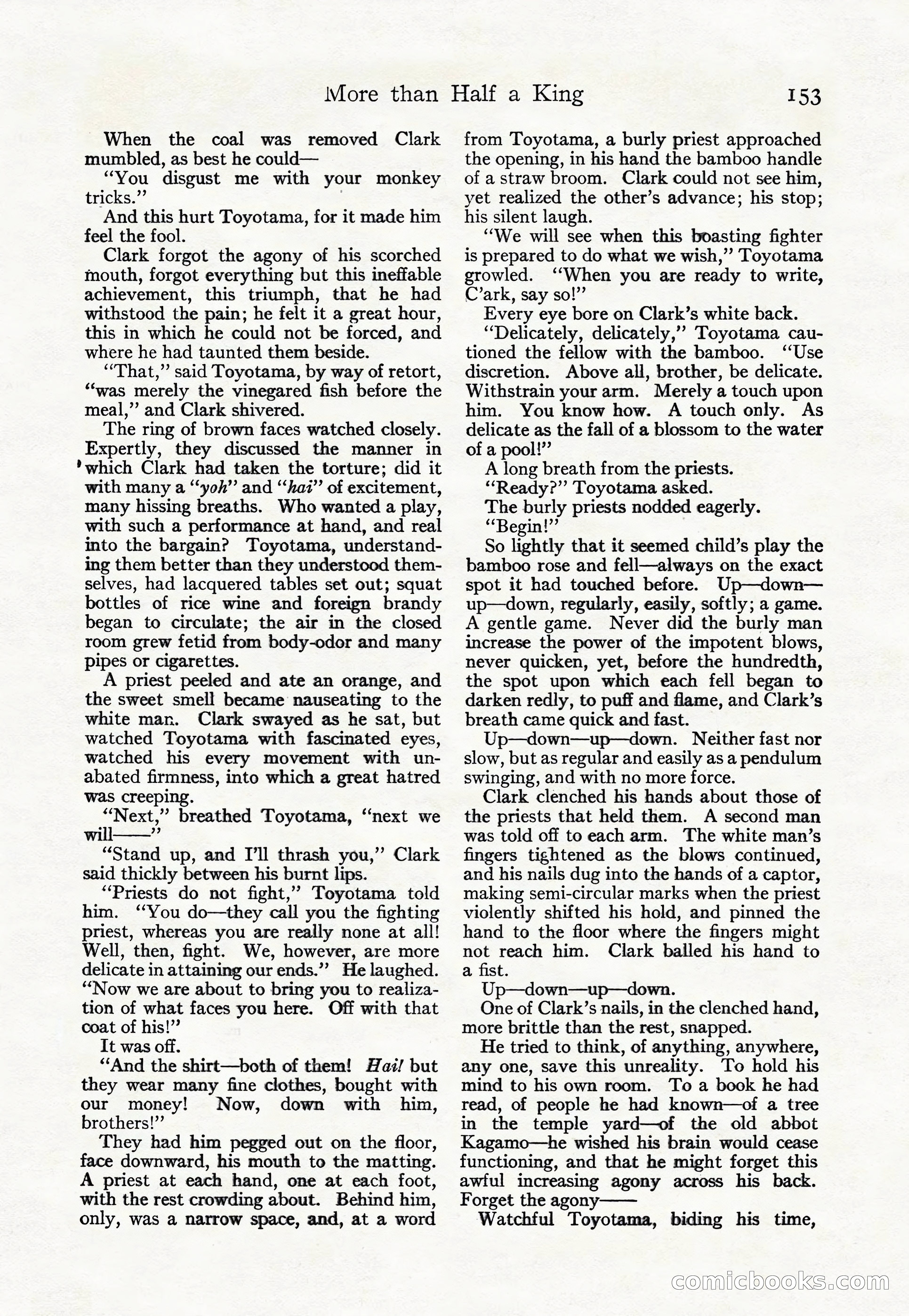
A restored page from Pulp Fiction, 1924. Page through the whole issue in the reader above.
📄 Transcribed text from this page (OCR, searchable)
Machine-transcribed from the original scan — historical spelling and the odd misread are preserved.
More than Half a King When the coal was removed Clark mumbled, as best he could— “You disgust me with your monkey tricks.” And this hurt Toyotama, for it made him feel the fool. Clark forgot the agony of his scorched mouth, forgot everything but this ineffable achievement, this triumph, that he had withstood the pain; he felt it a great hour, this in which he could not be forced, and where he had taunted them beside. “That,” said Toyotama, by way of retort, ‘‘was merely the vinegared fish before the meal,” and Clark shivered. The ring of brown faces watched closely. Expertly, they discussed the manner in *which Clark had taken the torture; did it with many a “‘yoh”’ and “‘haz”’ of excitement, many hissing breaths. Who wanted a play, with such a performance at hand, and real into the bargain? Toyotama, understand- ing them better than they understood them- selves, had lacquered tables set out; squat bottles of rice wine and foreign brandy began to circulate; the air in the closed room grew fetid from body-odor and many pipes or cigarettes. A priest peeled and ate an orange, and the sweet smell became nauseating to the white man. Clark swayed as he sat, but watched Toyotama with fascinated eyes, watched his every movement with un- abated firmness, into which a great hatred was creeping. “Next,” breathed Toyotama, “next we “Stand up, and J’ll thrash you,” Clark said thickly between his burnt lips. “Priests do not fight,” Toyotama told him. “You do—they call you the fighting priest, whereas you are really none at all! Well, then, fight. We, however, are more delicate in attaining our ends.”’ He laughed. ‘“‘Now we are about to bring you to realiza- tion of what faces you here. Off with that coat of his!” It was off. ‘And the shirt—both of them! Haz! but they wear many fine clothes, bought with our money! Now, down with him, brothers!”’ They had him pegged out on the floor, face downward, his mouth to the matting. A priest at each hand, one at each foot, with the rest crowding about. Behind him, only, was a narrow space, and, at a word 153 from Toyotama, a burly priest approached the opening, in his hand the bamboo handle of astraw broom. Clark could not see him, yet realized the other’s advance; his stop; his silent laugh. ‘We will see when this boasting fighter is prepared to do what we wish,” Toyotama growled. ‘‘When you are ready to write, C’ark, say so!” Every eye bore on Clark’s white back. “Delicately, delicately,’’ Toyotama cau- tioned the fellow with the bamboo. “Use discretion. Above all, brother, be delicate. Withstrain your arm. Merely a touch upon him. You know how. A touch only. As delicate as the fall of a blossom to the water of a pool!” A long breath from the priests. “Ready?” Toyotama asked. The burly priests nodded eagerly. So lightly that it seemed child’s play the bamboo rose and fell—always on the exact spot it had touched before. Up—down— up—down, regularly, easily, softly; a game. A gentle game. Never did the burly man increase the power of the impotent blows, never quicken, yet, before the hundredth, the spot upon which each fell began to darken redly, to puff and flame, and Clark’s breath came quick and fast. Up—down—up—down. Neither fast nor slow, but as regular and easily as a pendulum swinging, and with no more force. Clark clenched his hands about those of the priests that held them. A second man was told off to each arm. The white man’s fingers tightened as the blows continued, and his nails dug into the hands of a captor, making semi-circular marks when the priest violently shifted his hold, and pinned the hand to the floor where the fingers might not reach him. Clark balled his hand to a fist. Up—down—up—down. One of Clark’s nails, in the clenched hand, more brittle than the rest, snapped. He tried to think, of anything, anywhere, any one, save this unreality. To hold his mind to his own room. To a book he had read, of people he had known—of a tree in the temple yard—of the old abbot Kagamo—he wished his brain would cease functioning, and that he might forget this awful increasing agony across his back. Forget the agony —— Watchful Toyotama, biding his time, oO MICLOO© C© S ©