
Pulp Fiction, 1924 · page 146 of 200
Adventure Magazine Cover — page 146: what you’re looking at
A restored page from Pulp Fiction, 1924. Page through the whole issue in the reader above.
📄 Transcribed text from this page (OCR, searchable)
Machine-transcribed from the original scan — historical spelling and the odd misread are preserved.
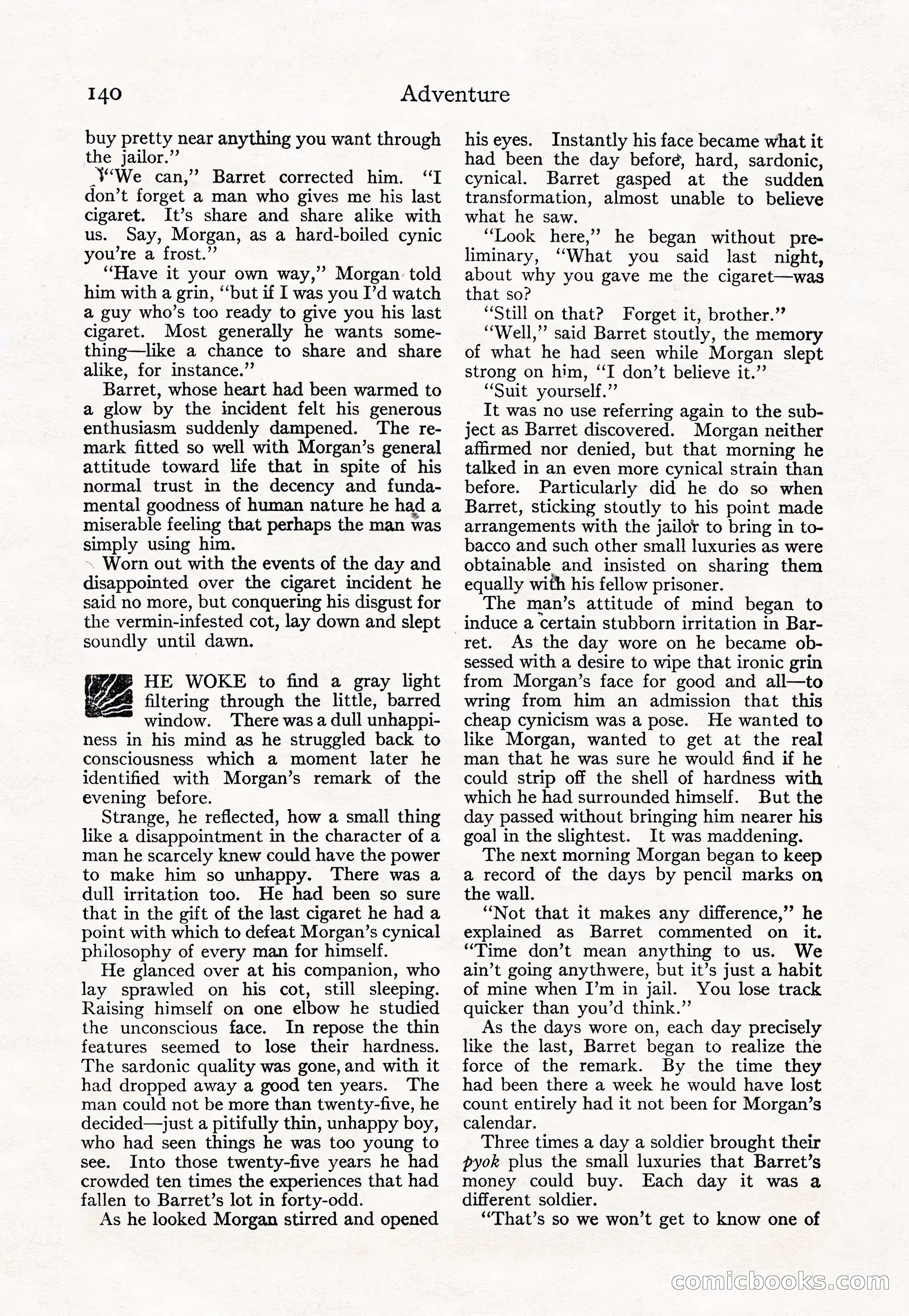
140 buy pretty near anything you want through the jailor.”’ _¥‘We can,” Barret corrected him. “I don’t forget a man who gives me his last cigaret. It’s share and share alike with us. Say, Morgan, as a hard-boiled cynic you’re a frost.” “Have it your own way,” Morgan told him with a grin, “‘but if I was you I’d watch a guy who’s too ready to give you his last cigaret. Most generally he wants some- thing—like a chance to share and share alike, for instance.” Barret, whose heart had been warmed to a glow by the incident felt his generous enthusiasm suddenly dampened. The re- mark fitted so well with Morgan’s general attitude toward life that in spite of his normal trust in the decency and funda- mental goodness of human nature he had a miserable feeling that perhaps the man was simply using him. ~ Worn out with the events of the day and disappointed over the cigaret incident he said no more, but conquering his disgust for the vermin-infested cot, lay down and slept soundly until dawn. Ly filtering through the little, barred window. ‘There was a dull unhappi- ness in his mind as he struggled back to consciousness which a moment later he identified with Morgan’s remark of the evening before. Strange, he reflected, how a small thing like a disappointment in the character of a man he scarcely knew could have the power to make him so unhappy. There was a dull irritation too. He had been so sure that in the gift of the last cigaret he had a point with which to defeat Morgan’s cynical philosophy of every man for himself. He glanced over at his companion, who lay sprawled on his cot, still sleeping. Raising himself on one elbow he studied the unconscious face. In repose the thin features seemed to lose their hardness. The sardonic quality was gone, and with it had dropped away a good ten years. The man could not be more than twenty-five, he decided—just a pitifully thin, unhappy boy, who had seen things he was too young to see. Into those twenty-five years he had crowded ten times the experiences that had fallen to Barret’s lot in forty-odd. As he looked Morgan stirred and opened HE WOKE to find a gray light Adventure his eyes. Instantly his face became what it had been the day before, hard, sardonic, cynical. Barret gasped at the sudden transformation, almost unable to believe what he saw. “Look here,’ he began without pre- liminary, ‘What you said last night, about why you gave me the cigaret—was that so? “Still on that? Forget it, brother.’’ “Well,” said Barret stoutly, the memory of what he had seen while Morgan slept strong on him, “I don’t believe it.” “Suit yourself.” It was no use referring again to the sub- ject as Barret discovered. Morgan neither affirmed nor denied, but that morning he talked in an even more cynical strain than before. Particularly did he do so when Barret, sticking stoutly to his point made arrangements with the jailor to bring in to- bacco and such other small luxuries as were obtainable and insisted on sharing them equally with his fellow prisoner. The man’s attitude of mind began to induce a certain stubborn irritation in Bar- ret. As the day wore on he became ob- sessed with a desire to wipe that ironic grin from Morgan’s face for good and all—to wring from him an admission that this cheap cynicism was a pose. He wanted to like Morgan, wanted to get at the real man that he was sure he would find if he could strip off the shell of hardness with which he had surrounded himself. But the day passed without bringing him nearer his goal in the slightest. It was maddening. The next morning Morgan began to keep a record of the days by pencil marks on the wall. “Not that it makes any difference,” he explained as Barret commented on it. “Time don’t mean anything to us. We ain’t going anythwere, but it’s just a habit of mine when I’m in jail. You lose track quicker than you’d think.”’ As the days wore on, each day precisely like the last, Barret began to realize the force of the remark. By the time they had been there a week he would have lost count entirely had it not been for Morgan’s calendar. Three times a day a soldier brought their pyok plus the small luxuries that Barret’s money could buy. Each day it was a different soldier. ‘‘That’s so we won’t get to know one of © MICLOOKS CO