
Pulp Fiction, 1924 · page 122 of 200
Adventure Magazine Cover — page 122: what you’re looking at
A restored page from Pulp Fiction, 1924. Page through the whole issue in the reader above.
📄 Transcribed text from this page (OCR, searchable)
Machine-transcribed from the original scan — historical spelling and the odd misread are preserved.
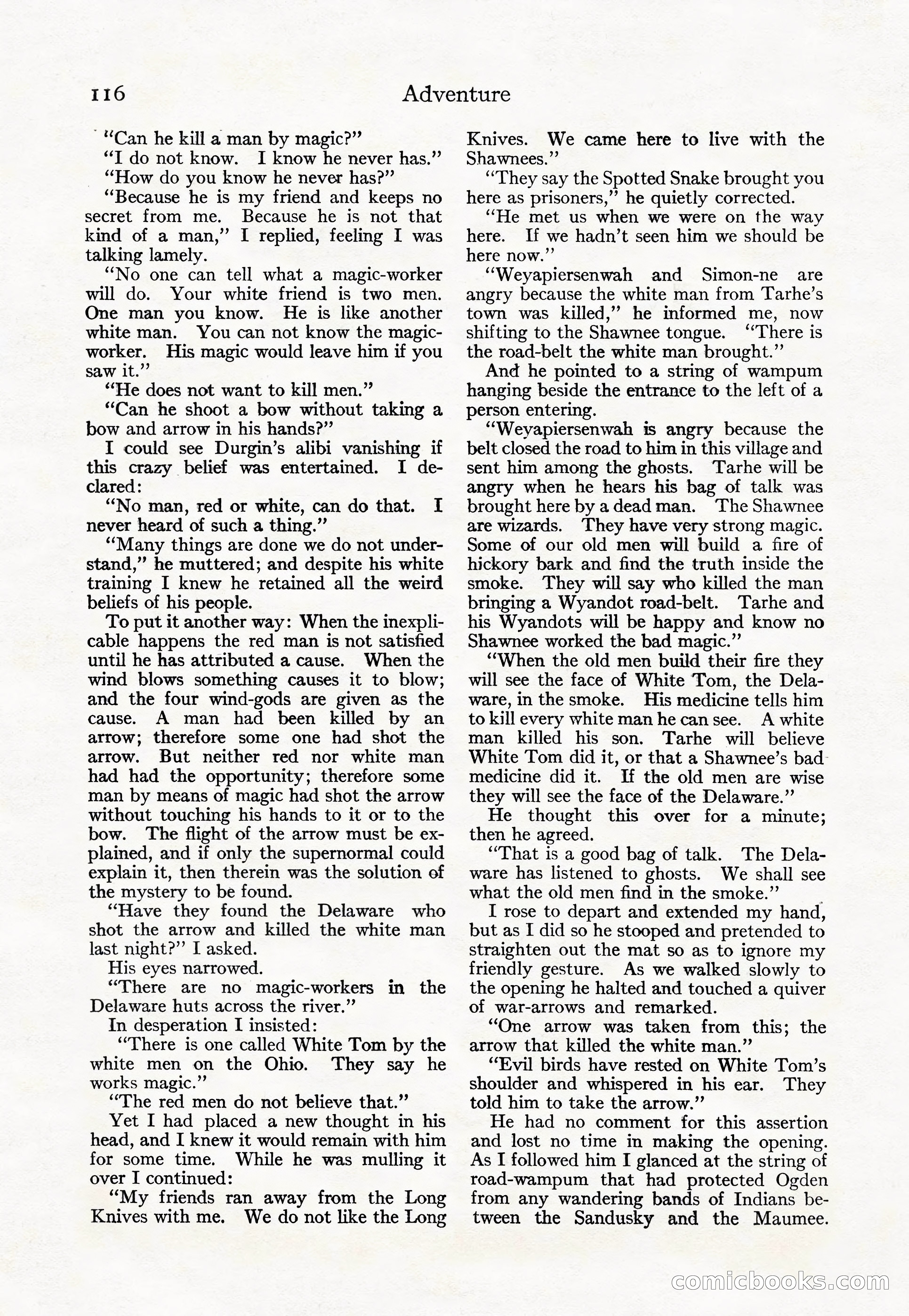
116 “Can he kill a man by magic?” “I do not know. I know he never has.” _ “How do you know he never has?” ‘Because he is my friend and keeps no secret from me. Because he is not that kind of a man,” I replied, feelmg I was talking lamely. “No one can tell what a magic-worker will do. Your white friend is two men. One man you know. He is like another white man. You can not know the magic- worker. His magic would leave him if you saw it.” “He does not want to kill men.” “Can he shoot a bow without taking a bow and arrow in his hands?” I could see Durgin’s alibi vanishing if this crazy belief was entertained. I de- clared: ‘“‘No man, red or white, can do that. I never heard of such a thing.” ‘“‘Many things are done we do not under- stand,” he muttered; and despite his white training I knew he retained all the weird beliefs of his people. To put it another way: When the inexpli- cable happens the red man is not satisfied until he has attributed a cause. When the wind blows something causes it to blow; and the four wind-gods are given as the cause. A man had been killed by an arrow; therefore some one had shot the arrow. But neither red nor white man had had the opportunity; therefore some man by means of magic had shot the arrow without touching his hands to it or to the bow. The flight of the arrow must be ex- plained, and if only the supernormal could explain it, then therein was the solution of the mystery to be found. ‘“‘Have they found the Delaware who shot the arrow and killed the white man last night?” I asked. His eyes narrowed. “There are no magic-workers in the Delaware huts across the river.” In desperation I insisted: ‘There is one called White Tom by the white men on the Ohio. They say he works magic.”’ “‘The red men do not believe that.” Yet I had placed a new thought in his head, and I knew it would remain with him for some time. While he was mulling it over I continued: “My friends ran away from the Long Knives with me. We do not like the Long Adventure Knives. We came here to live with the Shawnees.”’ ‘They say the Spotted Snake brought you here as prisoners,” he quietly corrected. “He met us when we were on the way here. If we hadn’t seen him we should be here now.” ‘“‘Weyapiersenwah and Simon-ne are angry because the white man from Tarhe’s town was killed,” he informed me, now shifting to the Shawnee tongue. ‘There is the road-belt the white man brought.”’ And he pomted to a string of wampum hanging beside the entrance to the left of a person entering. ‘““‘Weyapiersenwah ts angry because the belt closed the road to him in this village and sent him among the ghosts. Tarhe will be angry when he hears his bag of talk was brought here by adead man. ‘The Shawnee are wizards. ‘They have very strong magic. Some of our old men will build a fire of hickory bark and find the truth inside the smoke. They will say who killed the man bringing a Wyandot road-belt. Tarhe and his Wyandots will be happy and know no Shawnee worked the bad magic.”’ ‘“‘When the old men build their fire they will see the face of White Tom, the Dela- ware, in the smoke. His medicine tells him to kill every white man he can see. A white man killed his son. Tarhe will believe White Tom did it, or that a Shawnee’s bad- medicine did it. If the old men are wise they will see the face of the Delaware.” He thought this over for a minute; then he agreed. “That is a good bag of talk. The Dela- ware has listened to ghosts. We shall see what the old men find in the smoke.”’ I rose to depart and extended my hand, but as I did so he stooped and pretended to straighten out the mat so as to ignore my friendly gesture. As we walked slowly to the opening he halted and touched a quiver of war-arrows and remarked. “One arrow was taken from this; the arrow that killed the white man.” “Evil birds have rested on White Tom’s shoulder and whispered in his ear. They told him to take the arrow.” He had no comment for this assertion and lost no time in making the opening. As I followed him I glanced at the string of road-wampum that had protected Ogden from any wandering bands of Indians be- tween the Sandusky and the Maumee. COMG HOO S ©