
Pulp Fiction, 1924 · page 117 of 200
Adventure Magazine Cover — page 117: what you’re looking at
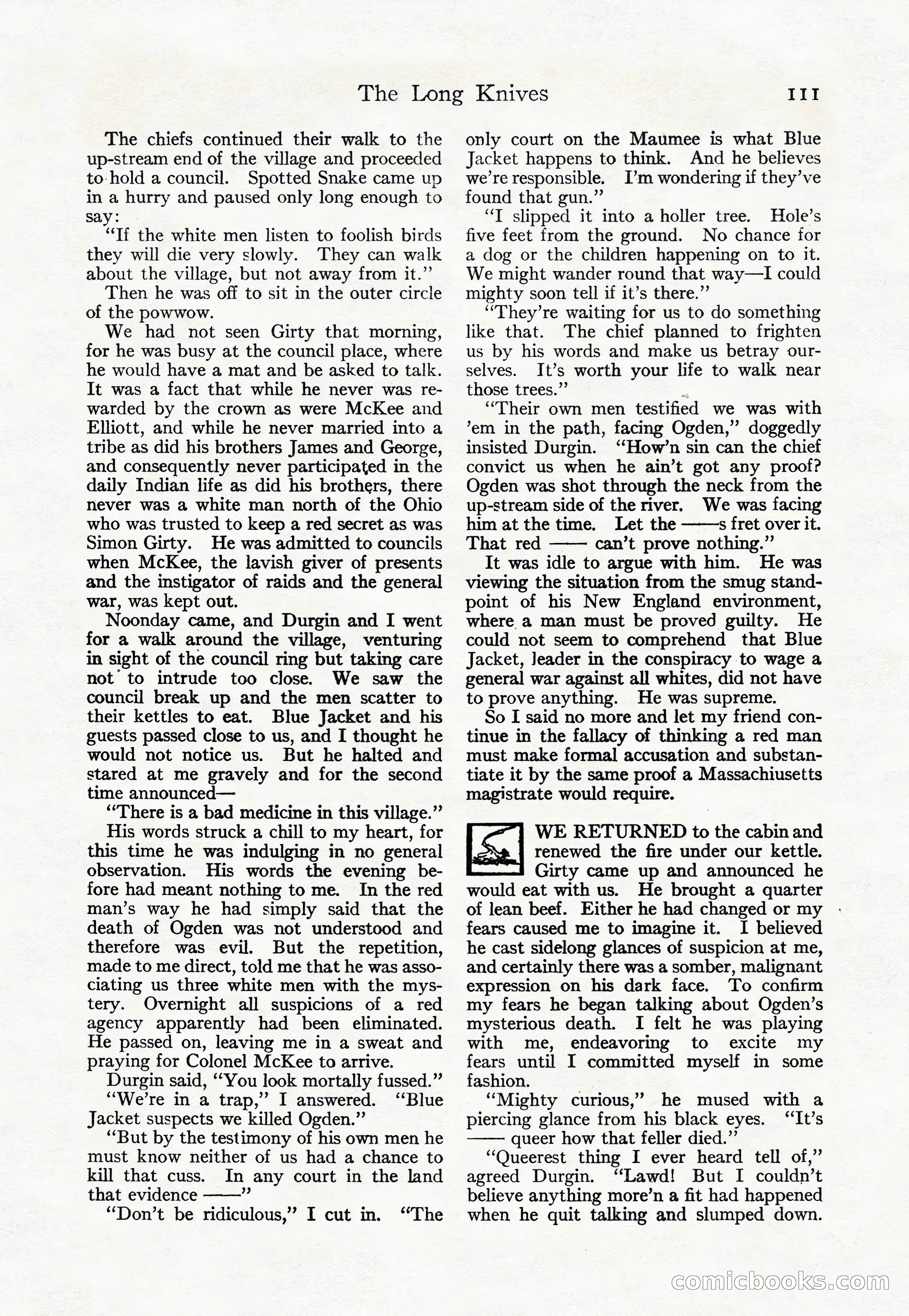
A restored page from Pulp Fiction, 1924. Page through the whole issue in the reader above.
📄 Transcribed text from this page (OCR, searchable)
Machine-transcribed from the original scan — historical spelling and the odd misread are preserved.
The Long Knives The chiefs continued their walk to the up-stream end of the village and proceeded to: hold a council. Spotted Snake came up in a hurry and paused only long enough to say: “If the white men listen to foolish birds they will die very slowly. They can walk about the village, but not away from it.” Then he was off to sit in the outer circle of the powwow. We had not seen Girty that morning, for he was busy at the council place, where he would have a mat and be asked to talk. It was a fact that while he never was re- warded by the crown as were McKee and Elliott, and while he never married into a tribe as did his brothers James and George, and consequently never participated in the daily Indian life as did his brothers, there never was a white man north of the Ohio who was trusted to keep a red secret as was Simon Girty. He was admitted to councils when McKee, the lavish giver of presents and the instigator of raids and the general war, was kept out. Noonday came, and Durgin and I went for a walk around the village, venturing in sight of the council ring but taking care not to intrude too close. We saw the council break up and the men scatter to their kettles to eat. Blue Jacket and his guests passed close to us, and I thought he would not notice us. But he halted and stared at me gravely and for the second time announced— “‘There is a bad medicine in this village.”’ His words struck a chill to my heart, for this time he was indulging in no general observation. His words the evening be- fore had meant nothing to me. In the red man’s way he had simply said that the death of Ogden was not understood and therefore was evil. But the repetition, made to me direct, told me that he was asso- ciating us three white men with the mys- tery. Overnight all suspicions of a red agency apparently had been eliminated. He passed on, leaving me in a sweat and praying for Colonel McKee to arrive. Durgin said, ‘‘You look mortally fussed.”’ ‘““We’re in a trap,” I answered. ‘Blue Jacket suspects we killed Ogden.”’ “But by the testimony of his own men he must know neither of us had a chance to kill that cuss. In any court in the land that evidence se “Don’t be ridiculous,” I cut in. “‘The II! only court on the Maumee is what Blue Jacket happens to think. And he believes we're responsible. I’m wondering if they’ve found that gun.” “T slipped it into a holler tree. Hole’s five feet from the ground. No chance for a dog or the children happening on to it. We might wander round that way—I could mighty soon tell if it’s there.” ‘“‘They’re waiting for us to do something like that. The chief planned to frighten us by his words and make us betray our- selves. It’s worth your life to walk near those trees.” | “Their own men testified we was with ‘em in the path, facing Ogden,” doggedly insisted Durgin. ‘‘How’n sin can the chief convict us when he ain’t got any proof? Ogden was shot through the neck from the up-stream side of the river. We was facing him at the time. Let the s fret over it. That red can’t prove nothing.”’ It was idle to argue with him. He was viewing the situation from the smug stand- point of his New England environment, where a man must be proved guilty. He could not seem to comprehend that Blue Jacket, Jeader in the conspiracy to wage a general war against all whites, did not have to prove anything. He was supreme. So I said no more and let my friend con- tinue in the fallacy of thinking a red man must make formal accusation and substan- tiate it by the same proof a Massachiusetts magistrate would require. WE RETURNED to the cabin and renewed the fire under our kettle. would eat with us. Girty came up and announced he He brought a quarter of lean beef. Either he had changed or my . fears caused me to imagine it. I believed he cast sidelong glances of suspicion at me, and certainly there was a somber, malignant expression on his dark face. To confirm my fears he began talking about Ogden’s mysterious death. I felt he was playing with me, endeavoring to excite my fears until I committed myself in some fashion. “Mighty curious,’ he mused with a piercing glance from his black eyes. “It’s queer how that feller died.” “Queerest thing I ever heard tell of,” agreed Durgin. “‘Lawd! But I couldn’t believe anything more’n a fit had happened when he quit talking and slumped down. oO COMmicloo S (©