
Pulp Fiction, 1924 · page 101 of 200
Adventure Magazine Cover — page 101: what you’re looking at
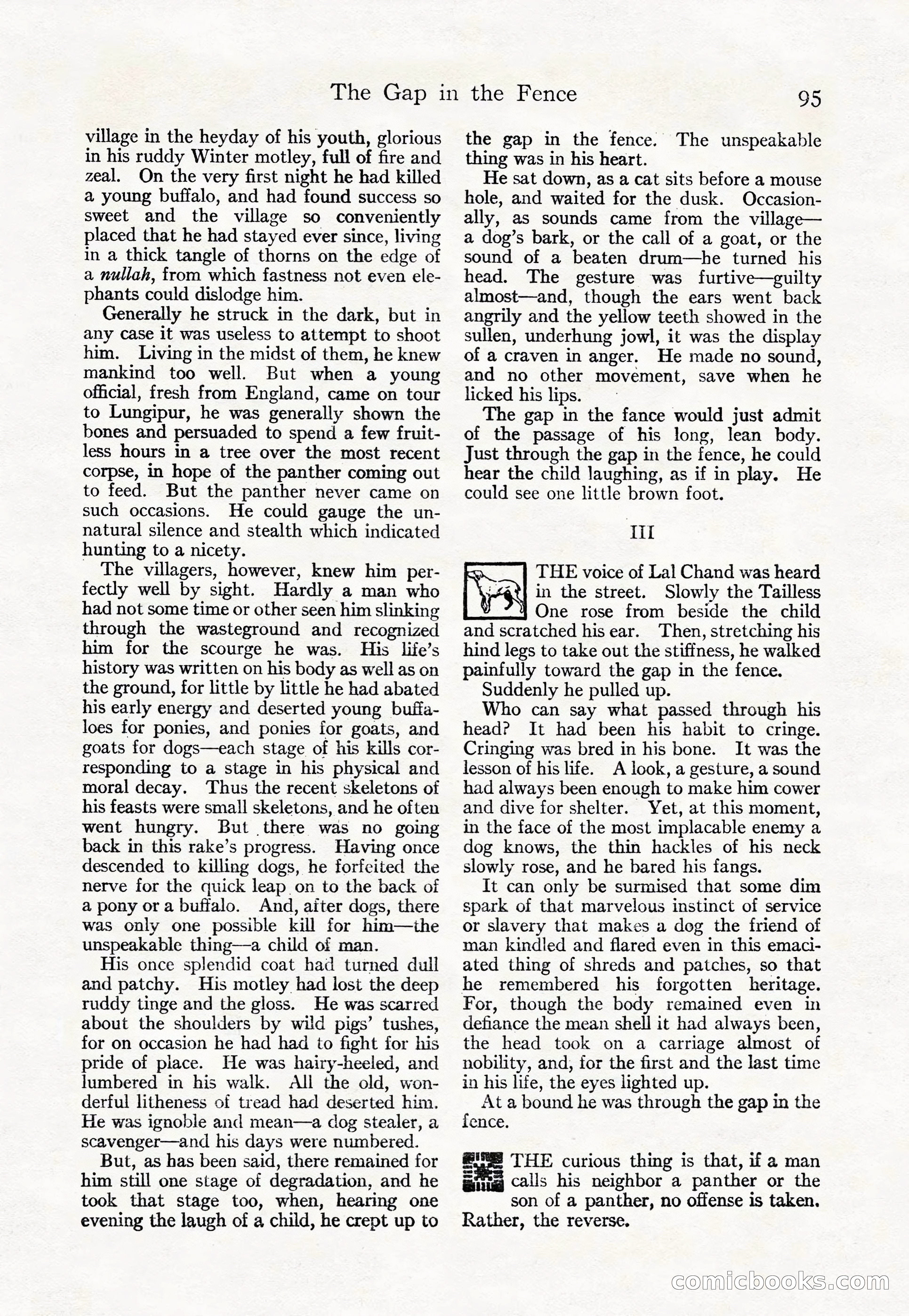
A restored page from Pulp Fiction, 1924. Page through the whole issue in the reader above.
📄 Transcribed text from this page (OCR, searchable)
Machine-transcribed from the original scan — historical spelling and the odd misread are preserved.
The Gap in the Fence village in the heyday of his youth, glorious in his ruddy Winter motley, full of fire and zeal. On the very first night he had killed a young buffalo, and had found success so sweet and the village so conveniently placed that he had stayed ever since, living in a thick tangle of thorns on the edge of a nullak, from which fastness not even ele- phants could dislodge him. Generally he struck in the dark, but in any case it was useless to attempt to shoot him. Living in the midst of them, he knew mankind too well. But when a young official, fresh from England, came on tour to Lungipur, he was generally shown the bones and persuaded to spend a few fruit- less hours in a tree over the most recent corpse, in hope of the panther coming out to feed. But the panther never came on such occasions. He could gauge the un- natural silence and stealth which indicated hunting to a nicety. The villagers, however, knew him per- fectly well by sight. Hardly a man who had not some time or other seen him slinking through the wasteground and recognized him for the scourge he was. His life’s history was written on his body as well as on the ground, for little by little he had abated his early energy and deserted young buffa- loes for ponies, and ponies for goats, and goats for dogs—each stage of his kills cor- responding to a stage in his physical and moral decay. Thus the recent skeletons of his feasts were small skeletons, and he often went hungry. But there was no going back in this rake’s progress. Having once descended to killing dogs, he forfeited the nerve for the quick leap on to the back of a pony ora buffalo. And, after dogs, there was only one possible kill for him—ihe unspeakable thing—a child of man. His once splendid coat had turned dull and patchy. His motley had lost the deep ruddy tinge and the gloss. He was scarred about the shoulders by wild pigs’ tushes, for on occasion he had had to fight for his pride of place. He was hairy-heeled, and lumbered in his walk. All the old, won- derful litheness of tread had deserted him. He was ignoble and mean—a dog stealer, a scavenger—and his days were numbered. But, as has been said, there remained for him still one stage of degradation, and he took that stage too, when, hearing one evening the laugh of a child, he crept up to 95 the gap in the fence. thing was in his heart. He sat down, as a cat sits before a mouse hole, and waited for the dusk. Occasion- ally, as sounds came from the village— a dog’s bark, or the call of a goat, or the sound of a beaten drum—he turned his head. The gesture was furtive—guilty almost—and, though the ears went back angrily and the yellow teeth showed in the sullen, underhung jowl, it was the display of a craven in anger. He made no sound, and no other movement, save when he licked his lips. The gap in the fance would just admit of the passage of his long, lean body. Just through the gap in the fence, he could hear the child laughing, as if in play. He could see one little brown foot. The unspeakable Tl THE voice of Lal Chand was heard in the street. Slowly the Tailless } One rose from beside the child and scratched his ear. Then, stretching his hind legs to take out the stiffness, he walked painfully toward the gap in the fence. Suddenly he pulled up. | Who can say what passed through his head? It had been his habit to cringe. Cringing was bred in his bone. It was the lesson of his life. A look, a gesture, a sound had always been enough to make him cower and dive for shelter. Yet, at this moment, in the face of the most implacable enemy a dog knows, the thin hackles of his neck slowly rose, and he bared his fangs. It can only be surmised that some dim spark of that marvelous instinct of service or slavery that makes a dog the friend of man kindled and flared even in this emaci- ated thing of shreds and patches, so that he remembered his forgotten heritage. For, though the body remained even in defiance the mean shell it had always been, the head took on a carriage almost of nobility, and, for the first and the last time in his life, the eyes lighted up. At a bound he was through the gap in the fence. #8 THE curious thing is that, if a man mitt calls his neighbor a panther or the son of a panther, no offense is taken. Rather, the reverse. COmiclbook (©