
Pulp Fiction, 1922 · page 76 of 204
Adventure Magazine Cover — page 76: what you’re looking at
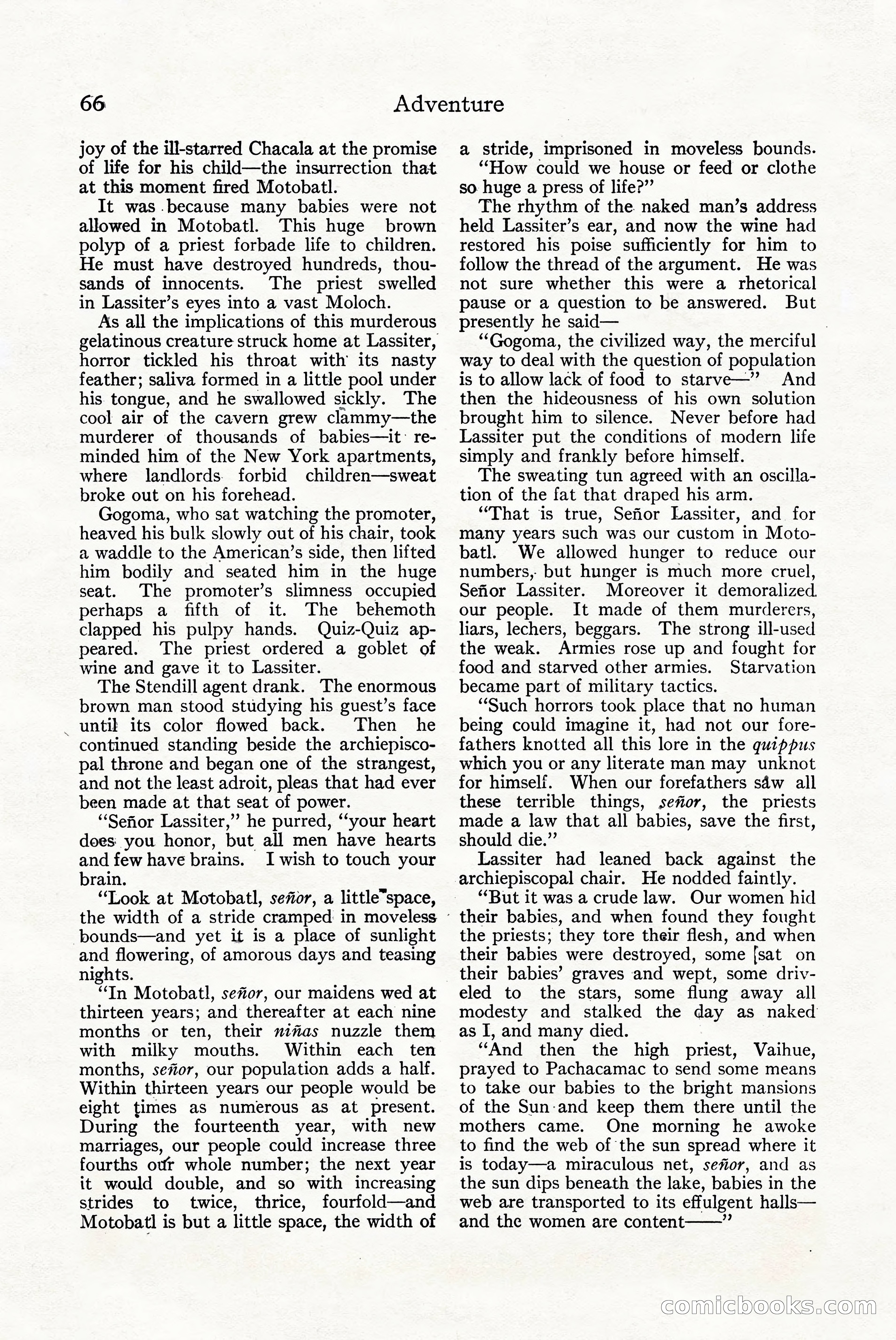
A restored page from Pulp Fiction, 1922. Page through the whole issue in the reader above.
📄 Transcribed text from this page (OCR, searchable)
Machine-transcribed from the original scan — historical spelling and the odd misread are preserved.
66 joy of the ill-starred Chacala at the promise of life for his child—the insurrection that at this moment fired Motobatl. It was .because many babies were not allowed in Motobatl. This huge brown polyp of a priest forbade life to children. He must have destroyed hundreds, thou- sands of innocents. The priest swelled in Lassiter’s eyes into a vast Moloch. As all the implications of this murderous gelatinous creature struck home at Lassiter, horror tickled his throat with its nasty feather; saliva formed in a little pool under his tongue, and he swallowed sickly. The cool air of the cavern grew clammy—the murderer of thousands of babies—it: re- minded him of the New York apartments, where landlords. forbid children—sweat broke out on his forehead. Gogoma, who sat watching the promoter, heaved his bulk slowly out of his chair, took a waddle to the American’s side, then lifted him bodily and seated him in the huge seat. The promoter’s slimness occupied perhaps a fifth of it. The behemoth clapped his pulpy hands. Quiz-Quiz ap- peared. The priest ordered a goblet of wine and gave it to Lassiter. The Stendill agent drank. The enormous brown man stood studying his guest’s face _ until its color flowed back. Then he continued standing beside the archiepisco- pal throne and began one of the strangest, and not the least adroit, pleas that had ever been made at that seat of power. ‘“‘Sefior Lassiter,”’ he purred, ‘‘your heart does you honor, but all men have hearts and few have brains. I wish to touch your brain. “Took at Motobatl, sefior, a little"space, the width of a stride cramped in moveless ~ -bounds—and yet it is a place of sunlight and flowering, of amorous days and teasing nights. ‘In Motobatl, sevor, our maidens wed at thirteen years; and thereafter at each nine months or ten, their mzfas nuzzle them with milky mouths. Within each ten months, sef#ior, our population adds a half. Within thirteen years our people would be eight times as numerous as at present. During the fourteenth year, with new marriages, our people could increase three fourths ovr whole number; the next year it would double, and so with increasing strides to twice, thrice, fourfold—and Motobatl is but a little space, the width of Adventure a stride, imprisoned in moveless bounds. “How could we house or feed or clothe so huge a press of life?”’ The rhythm of the naked man’s address held Lassiter’s ear, and now the wine had restored his poise sufficiently for him to follow the thread of the argument. He was not sure whether this were a rhetorical pause or a question to be answered. But presently he said— “‘Gogoma, the civilized way, the merciful | way to deal with the question of population is to allow lack of food to starve—” And then the hideousness of his own solution brought him to silence. Never before had Lassiter put the conditions of modern life simply and frankly before himself. The sweating tun agreed with an oscilla- tion of the fat that draped his arm. “That is true, Sefior Lassiter, and for many years such was our custom in Moto- batl. We allowed hunger to reduce our numbers, but hunger is much more cruel, Sefior Lassiter. Moreover it demoralized. our people. It made of them murdercrs, liars, lechers, beggars. The strong ill-used the weak. Armies rose up and fought for food and starved other armies. Starvation became part of military tactics. ‘Such horrors took place that no human being could imagine it, had not our fore- fathers knotted all this lore in the quippus which you or any literate man may unknot for himself. When our forefathers s4w all these terrible things, sefor, the priests made a law that all babies, save the first, should die.” Lassiter had leaned back against the archiepiscopal chair. He nodded faintly. “But it was a crude law. Our women hid their babies, and when found they fought the priests; they tore their flesh, and when their babies were destroyed, some [sat on _ their babies’ graves and wept, some driv- eled to the stars, some flung away all modesty and stalked the day as naked as I, and many died. “And then the high priest, Vaihue, prayed to Pachacamac to send some means to take our babies to the bright mansions of the Sun-and keep them there until the mothers came. One morning he awoke to find the web of the sun spread where it is today—a miraculous net, sefior, and as the sun dips beneath the lake, babies in the web are transported to its effulgent halls— and the women are conten ‘sg DOOK (©