
Pulp Fiction, 1922 · page 67 of 204
Adventure Magazine Cover — page 67: what you’re looking at
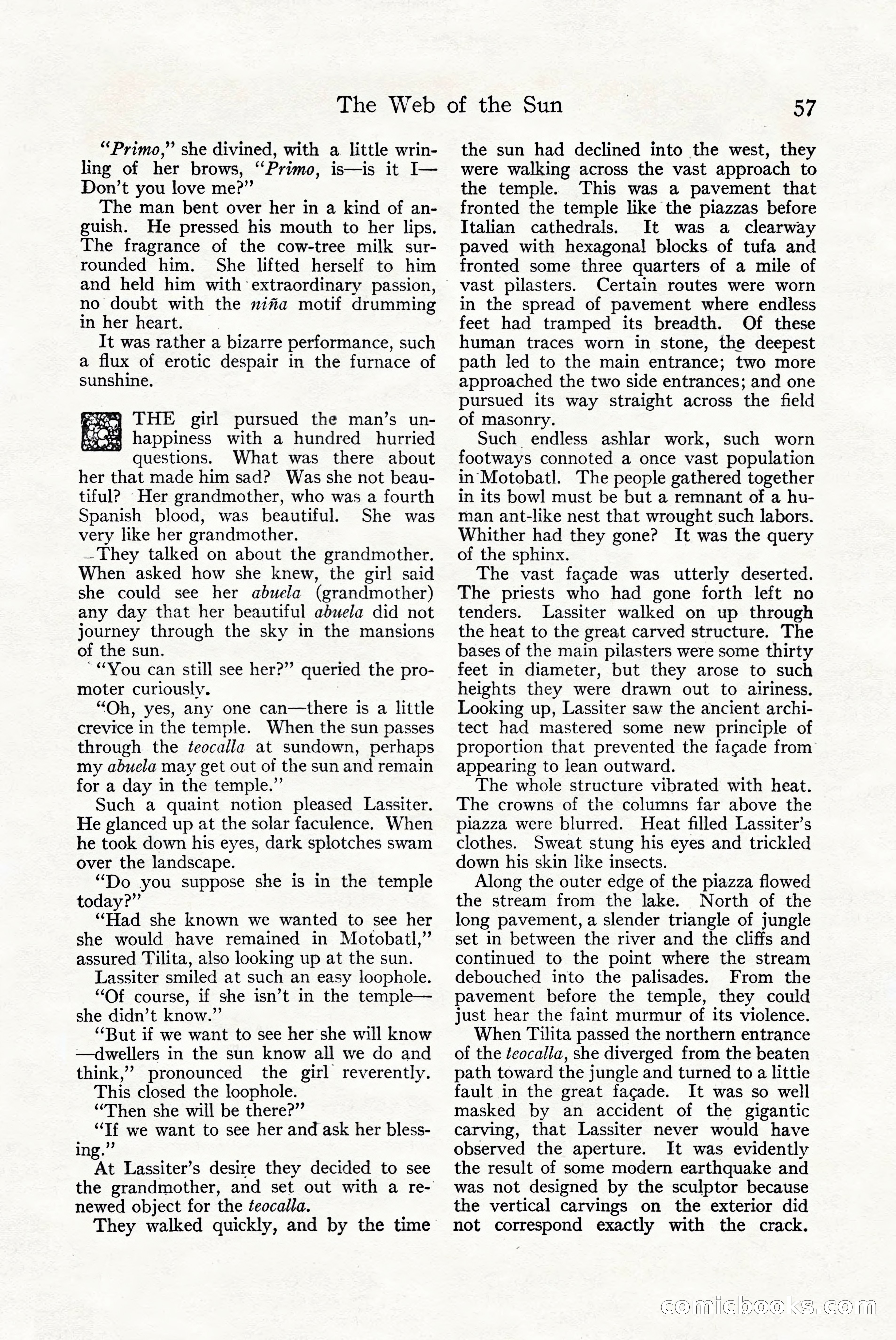
A restored page from Pulp Fiction, 1922. Page through the whole issue in the reader above.
📄 Transcribed text from this page (OCR, searchable)
Machine-transcribed from the original scan — historical spelling and the odd misread are preserved.
The Web of the Sun “Primo,” she divined, with a little wrin- ling of her brows, ‘Primo, is—is it I— Don’t you love me?” The man bent over her in a kind of an- guish. He pressed his mouth to her lips. The fragrance of the cow-tree milk sur- rounded him. She lifted herself to him and held him with extraordinary passion, no doubt with the nifa motif drumming in her heart. It was rather a bizarre performance, such a flux of erotic despair in the furnace of sunshine. “ fee see with a hundred ae questions. What was there about her that made him sad? Was she not beau- tiful? Her grandmother, who was a fourth Spanish blood, was beautiful. She was very like her grandmother. -They talked on about the grandmother. When asked how she knew, the girl said she could see her abuela (grandmother) any day that her beautiful adbmuela did not journey through the sky in the mansions of the sun. ~“You can still see her?”’ queried the pro- moter curiously. “Oh, yes, any one can—there is a little crevice in the temple. When the sun passes through the feocalla at sundown, perhaps my abuela may get out of the sun and remain for a day in the temple.” Such a quaint notion pleased Lassiter. He glanced up at the solar faculence. When he took down his eyes, dark splotches swam over the landscape. “Do you suppose she is in the temple today?” ‘“Had she known we wanted to see her she would have remained in Motobatl,” assured Tilita, also looking up at the sun. Lassiter smiled at such an easy loophole. “Of course, if she isn’t in the temple— she didn’t know.” “But if we want to see her she will know —dwellers in the sun know all we do and think,” pronounced the girl reverently. This closed the loophole. “Then she will be there?” “Tf we want to see her and ask her bless- ing.” “At Lassiter’s desire they decided to see the grandmother, and set out with a re- newed object for the ¢eocalla. They walked quickly, and by the time 57 the sun had declined into the west, they were walking across the vast approach to the temple. This was a pavement that fronted the temple like the piazzas before Italian cathedrals. It was a clearway paved with hexagonal blocks of tufa and fronted some three quarters of a mile of vast pilasters. Certain routes were worn in the spread of pavement where endless feet had tramped its breadth. Of these human traces worn in stone, the deepest path led to the main entrance; two more approached the two side entrances; and one pursued its way straight across the field of masonry. Such endless ashlar work, such worn footways connoted a once vast population in Motobatl. The people gathered together in its bowl must be but a remnant of a hu- man ant-like nest that wrought such labors. Whither had they gone? It was the query of the sphinx. The vast facade was utterly deserted. The priests who had gone forth left no tenders. Lassiter walked on up through the heat to the great carved structure. The bases of the main pilasters were some thirty feet in diameter, but they arose to such heights they were drawn out to airiness. Looking up, Lassiter saw the ancient archi- tect had mastered some new principle of proportion that prevented the facade from appearing to lean outward. The whole structure vibrated with heat. The crowns of the columns far above the piazza were blurred. Heat filled Lassiter’s clothes. Sweat stung his eyes and trickled down his skin like insects. Along the outer edge of the piazza flowed the stream from the lake. North of the long pavement, a slender triangle of jungle set in between the river and the cliffs and continued to the point where the stream debouched into the palisades. From the pavement before the temple, they could just hear the faint murmur of its violence. When Tilita passed the northern entrance of the teocalla, she diverged from the beaten path toward the jungle and turned to a little fault in the great facade. It was so well masked by an accident of the gigantic carving, that Lassiter never would have observed the aperture. It was evidently the result of some modern earthquake and was not designed by the sculptor because the vertical carvings on the exterior did not correspond exactly with the crack. DOOK (©