
Pulp Fiction, 1922 · page 60 of 204
Adventure Magazine Cover — page 60: what you’re looking at
A restored page from Pulp Fiction, 1922. Page through the whole issue in the reader above.
📄 Transcribed text from this page (OCR, searchable)
Machine-transcribed from the original scan — historical spelling and the odd misread are preserved.
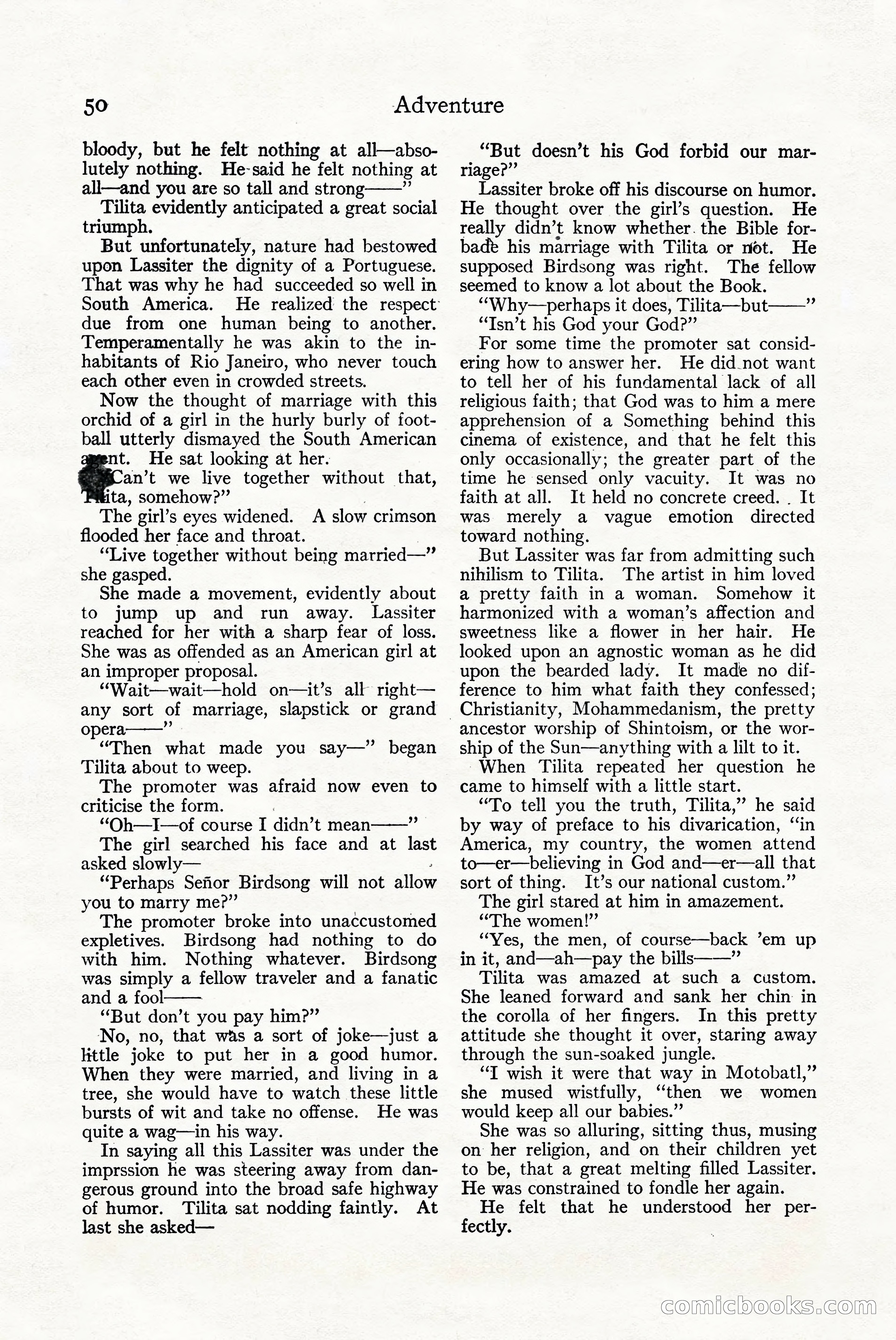
50 bloody, but he felt nothing at all—abso- lutely nothing. He-said he felt nothing at all—and you are so tall and strong Tilita evidently anticipated a great social triumph. But unfortunately, nature had bestowed upon Lassiter the dignity of a Portuguese. That was why he had succeeded so well in South America. He realized the respect due from one human being to another. Temperamentally he was akin to the in- habitants of Rio Janeiro, who never touch each other even in crowded streets. Now the thought of marriage with this orchid of a girl in the hurly burly of foot- ball utterly dismayed the South American nt. He sat looking at her. ae we live together without that, ta, somehow?” The girl’s eyes widened. A slow crimson flooded her face and throat. “Live together without being matried—” she gasped. She made a movement, evidently about to jump up and run away. Lassiter reached for her with a sharp fear of loss. She was as offended as an American girl at an improper proposal. “Wait—wait—hold on—it’s all right— any sort of marriage, slapstick or grand opera . “Then what made you say—” began Tilita about to weep. The promoter was afraid now even to criticise the form. ““OQh—I—of course I didn’t mean——’ The girl searched his face and at last asked slowly— “Perhaps Sefior Birdsong will not allow you to marry me?” The promoter broke into unaccustomed expletives. Birdsong had nothing to do with him. Nothing whatever. Birdsong was simply a fellow traveler and a fanatic and a fool “But don’t you pay him?” No, no, that wis a sort of joke—just a little joke to put her in a good humor. When they were married, and living in a tree, she would have to watch these little bursts of wit and take no offense. He was quite a wag—in his way. In saying all this Lassiter was under the imprssion he was steering away from dan- gerous ground into the broad safe highway of humor. ‘Tilita sat nodding faintly. At last she asked— .- Adventure “But doesn’t his God forbid our mar- riage?” Lassiter broke off his discourse on humor. He thought over the girl’s question. He really didn’t know whether. the Bible for- bade his marriage with Tilita or not. He supposed Birdsong was right. The fellow seemed to know a lot about the Book. ‘““Why—perhaps it does, Tilita—but——”’ “Isn’t his God your God?” For some time the promoter sat consid- ering how to answer her. He did_not want to tell her of his fundamental lack of all religious faith; that God was to him a mere apprehension of a Something behind this cinema of existence, and that he felt this only occasionally; the greater part of the time he sensed only vacuity. It was no faith at all. It held no concrete creed. . It was merely a vague emotion directed toward nothing. But Lassiter was far from admitting such nihilism to Tilita. The artist in him loved a pretty faith in a woman. Somehow it harmonized with a woman’s affection and sweetness like a flower in her hair. He looked upon an agnostic woman as he did upon the bearded lady. It made no dif- ference to him what faith they confessed; Christianity, Mohammedanism, the pretty ancestor worship of Shintoism, or the wor- ship of the Sun—anything with a lilt to it. When Tilita repeated her question he came to himself with a little start. “To tell you the truth, Tilita,” he said by way of preface to his divarication, “‘in America, my country, the women attend to—er—believing in God and—er—all that sort of thing. It’s our national custom.” The girl stared at him in amazement. “The women!”’ ‘““Yes, the men, of course—back ’em up in it, and—ah—pay the bills——” Tilita was amazed at such a custom. She leaned forward and sank her chin in the corolla of her fingers. In this pretty attitude she thought it over, staring away through the sun-soaked jungle. “T wish it were that way in Motobatl,” she mused wistfully, “then we women would keep all our babies.” She was so alluring, sitting thus, musing on her religion, and on their children yet to be, that a great melting filled Lassiter. He was constrained to fondle her again. He felt that he understood her per- fectly. MICLOOOK (C@