
Pulp Fiction, 1922 · page 52 of 204
Adventure Magazine Cover — page 52: what you’re looking at
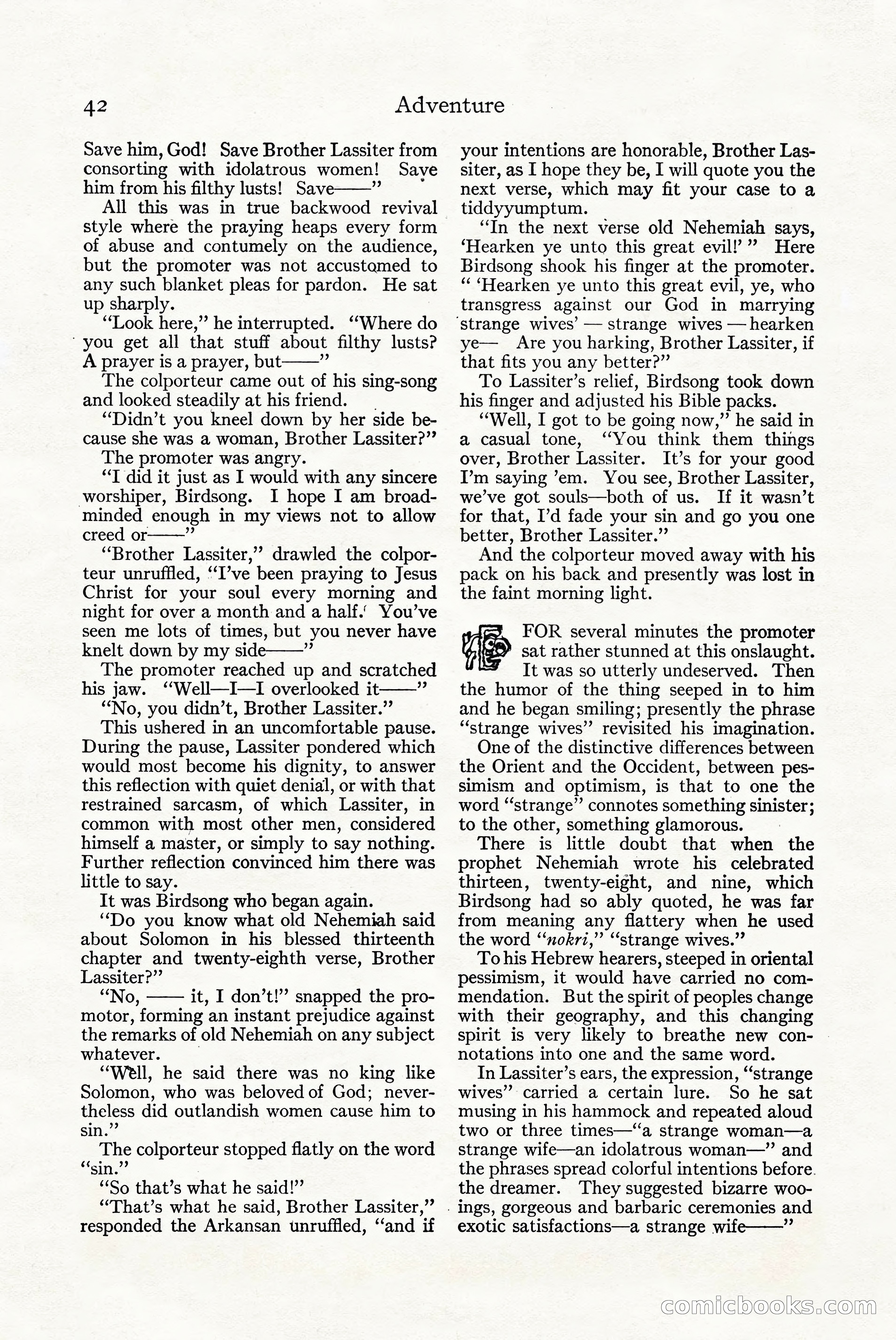
A restored page from Pulp Fiction, 1922. Page through the whole issue in the reader above.
📄 Transcribed text from this page (OCR, searchable)
Machine-transcribed from the original scan — historical spelling and the odd misread are preserved.
42 Save him, God! Save Brother Lassiter from consorting with idolatrous women! Save him from his filthy lusts! Save——” All this was in true backwood revival style where the praying heaps every form of abuse and contumely on the audience, but the promoter was not accustamed to any such blanket pleas for pardon. He sat up sharply. “Look here,” he interrupted. ‘‘Where do ‘you get all that stuff about filthy lusts? A prayer is a prayer, but——”’ The colporteur came out of his sing-song and looked steadily at his friend. “‘Didn’t you kneel down by her side be- cause she was a woman, Brother Lassiter?”’ The promoter was angry. “IT did it just as I would with any sincere worshiper, Birdsong. I hope I am broad- minded enough in my views not to allow creed or és “Brother Lassiter,’’ drawled the colpor- teur unruffled, ‘I’ve been praying to Jesus Christ for your soul every morning and night for over a month and a half.’ You’ve seen me lots of times, but you never have knelt down by my side——”’ The promoter reached up and scratched his jaw. ‘‘Well—I—I overlooked it “ “‘No, you didn’t, Brother Lassiter.”’ This ushered in an uncomfortable pause. During the pause, Lassiter pondered which would most become his dignity, to answer this reflection with quiet denial, or with that restrained sarcasm, of which Lassiter, in common with most other men, considered himself a master, or simply to say nothing. Further reflection convinced him there was little to say. It was Birdsong who began again. ‘Do you know what old Nehemiah said about Solomon in his blessed thirteenth chapter and twenty-eighth verse, Brother Lassiter?”’ “No, it, I don’t!’ snapped the pro- motor, forming an instant prejudice against the remarks of old Nehemiah on any subject whatever. : “Well, he said there was no king like Solomon, who was beloved of God; never- theless did outlandish women cause him to sin.” The colporteur stopped flatly on the word é ‘sin.’ : ‘‘So that’s what he said!” ‘““That’s what he said, Brother Lassiter,” responded the Arkansan unruffled, “and if Adventure your intentions are honorable, Brother Las- siter, as I hope they be, I will quote you the next verse, which may fit your case to a tiddyyumptum. “In the next verse old Nehemiah says, ‘Hearken ye unto this great evil!’ Here Birdsong shook his finger at the promoter. “ ‘Hearken ye unto this great evil, ye, who transgress against our God in marrying ‘strange wives’ — strange wives — hearken ye— Are you harking, Brother Lassiter, if that fits you any better?” To Lassiter’s relief, Birdsong took down his finger and adjusted his Bible packs. “Well, I got to be going now,” he said in a casual tone, ‘You think them things over, Brother Lassiter. It’s for your good I’m saying ’em. You see, Brother Lassiter, we’ve got souls—both of us. If it wasn’t for that, I’d fade your sin and go you one better, Brother Lassiter.” And the colporteur moved away with his pack on his back and presently was lost in the faint morning light. ale sat rather stunned at this onslaught. It was so utterly undeserved. Then the humor of the thing seeped in to him and he began smiling; presently the phrase “strange wives” revisited his imagination. One of the distinctive differences between the Orient and the Occident, between pes- simism and optimism, is that to one the word “‘strange’”’ connotes something sinister; to the other, something glamorous. There is little doubt that when the prophet Nehemiah wrote his celebrated thirteen, twenty-eight, and nine, which Birdsong had so ably quoted, he was far from meaning any flattery when he used the word ‘“‘xokri,” “‘strange wives.” To his Hebrew hearers, steeped in oriental pessimism, it would have carried no com- mendation. But the spirit of peoples change with their geography, and this changing FOR several minutes the promoter spirit is very likely to breathe new con- - notations into one and the same word. In Lassiter’s ears, the expression, “strange wives” carried a certain lure. So he sat musing in his hammock and repeated aloud two or three times—‘‘a strange woman—a strange wife—an idolatrous woman—” and the phrases spread colorful intentions before. the dreamer. They suggested bizarre woo- . Ings, gorgeous and barbaric ceremonies and exotic satisfactions—a strange wife——”’ MICLOOOK (©