
Pulp Fiction, 1922 · page 35 of 204
Adventure Magazine Cover — page 35: what you’re looking at
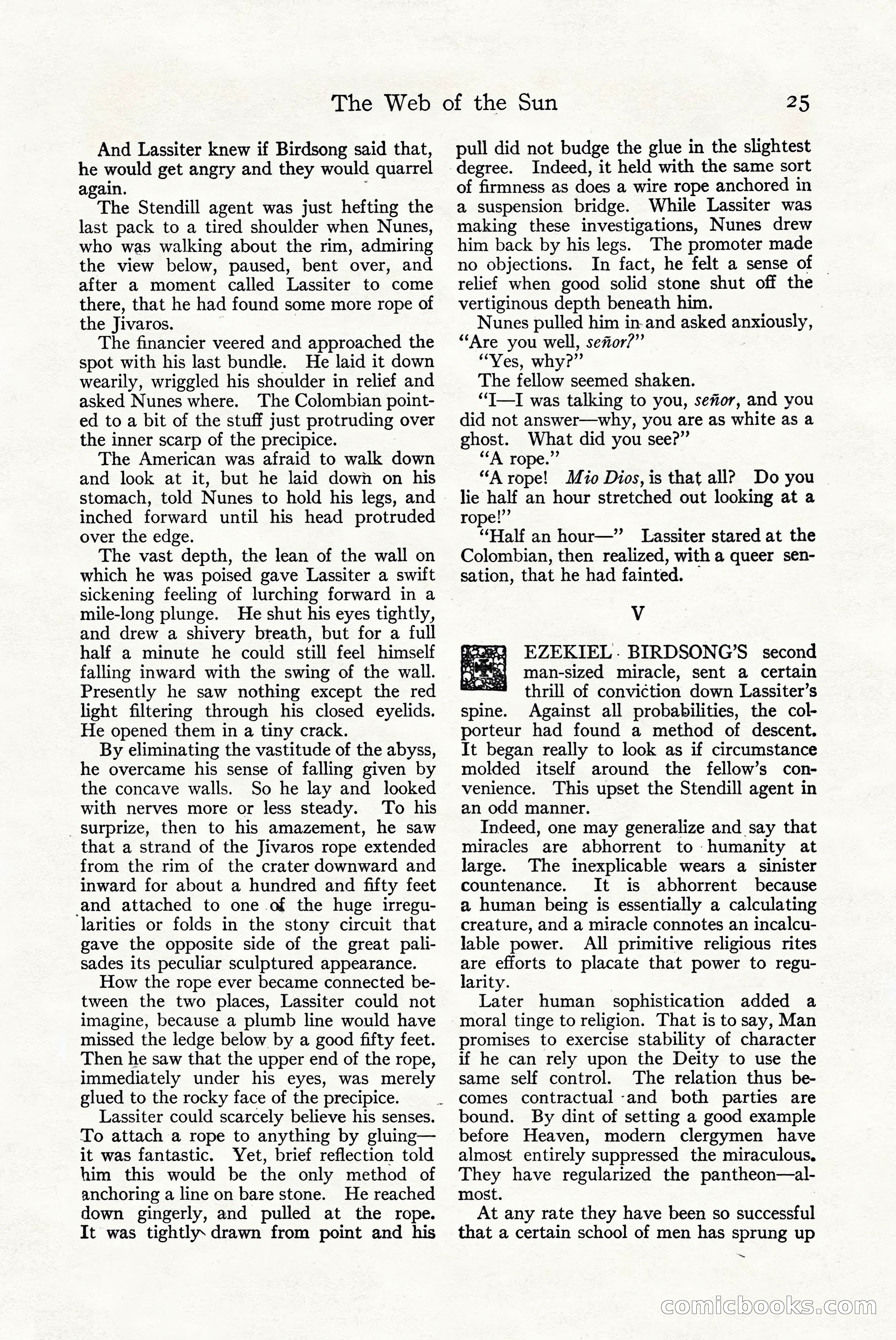
A restored page from Pulp Fiction, 1922. Page through the whole issue in the reader above.
📄 Transcribed text from this page (OCR, searchable)
Machine-transcribed from the original scan — historical spelling and the odd misread are preserved.
The Web of the Sun And Lassiter knew if Birdsong said that, he would get angry and they would quarrel again. The Stendill agent was just hefting the last pack to a tired shoulder when Nunes, who was walking about the rim, admiring the view below, paused, bent over, and after a moment called Lassiter to come there, that he had found some more rope of the Jivaros. | The financier veered and approached the spot with his last bundle. He laid it down wearily, wriggled his shoulder in relief and asked Nunes where. The Colombian point- ed to a bit of the stuff just protruding over the inner scarp of the precipice. The American was afraid to walk down and look at it, but he laid down on his stomach, told Nunes to hold his legs, and © inched forward until his head protruded over the edge. The vast depth, the lean of the wall on which he was poised gave Lassiter a swift sickening feeling of lurching forward in a mile-long plunge. He shut his eyes tightly, and drew a shivery breath, but for a full half a minute he could still feel himself falling inward with the swing of the wall. Presently he saw nothing except the red light filtering through his closed eyelids. He opened them in a tiny crack. By eliminating the vastitude of the abyss, he overcame his sense of falling given by the concave walls. So he lay and looked with nerves more or less steady. To his _surprize, then to his amazement, he saw that a strand of the Jivaros rope extended from the rim of the crater downward and inward for about a hundred and fifty feet and attached to one of the huge irregu- larities or folds in the stony circuit that gave the opposite side of the great pali- sades its peculiar sculptured appearance. How the rope ever became connected be- tween the two places, Lassiter could not imagine, because a plumb line would have missed the ledge below by a good fifty feet. Then he saw that the upper end of the rope, immediately under his eyes, was merely glued to the rocky face of the precipice. Lassiter could scarcely believe his senses. To attach a rope to anything by gluing— it was fantastic. Yet, brief reflection told him this would be the only method of anchoring a line on bare stone. He reached down gingerly, and pulled at the rope. It was tightly. drawn from point and his 25 pull did not budge the glue in the slightest degree. Indeed, it held with the same sort of firmness as does a wire rope anchored in a suspension bridge. While Lassiter was making these investigations, Nunes drew him back by his legs. The promoter made no objections. } relief when good solid stone shut off the vertiginous depth beneath him. In fact, he felt a sense of | Nunes pulled him in-and asked anxiously, . ‘‘Are you well, sevor?”’ “Yes, why?” The fellow seemed shaken. “T—J was talking to you, sefior, and you did not answer—why, you are as white as a ghost. What did you see?” **A rope.” “A rope! Mio Dios, is that all? Do you lie half an hour stretched out looking at a rope!” “Half an hour—” Lassiter stared at the Colombian, then realized, with a queer sen- sation, that he had fainted. V EZEKIEL. BIRDSONG’S second Pie nan-sized miracle, sent a certain =asé# thrill of conviction down Lassiter’s spine. Against all probabilities, the col- porteur had found a method of descent. It began really to look as if circumstance molded itself around the fellow’s con- venience. This upset the Stendill agent in an odd manner. Indeed, one may generalize and say that miracles are abhorrent to humanity at large. The inexplicable wears a sinister countenance. It is abhorrent because a human being is essentially a calculating creature, and a miracle connotes an incalcu- lable power. All primitive religious rites are efforts to placate that power to regu- larity. Later human sophistication added a moral tinge to religion. That is to say, Man promises to exercise stability of character if he can rely upon the Deity to use the same self control. The relation thus be- comes contractual -and both parties are bound. By dint of setting a good example before Heaven, modern clergymen have almost entirely suppressed the miraculous. They have regularized the pantheon—al- most. : At any rate they have been so successful that a certain school of men has sprung up ™~ DOOK C©