
Pulp Fiction, 1922 · page 32 of 204
Adventure Magazine Cover — page 32: what you’re looking at
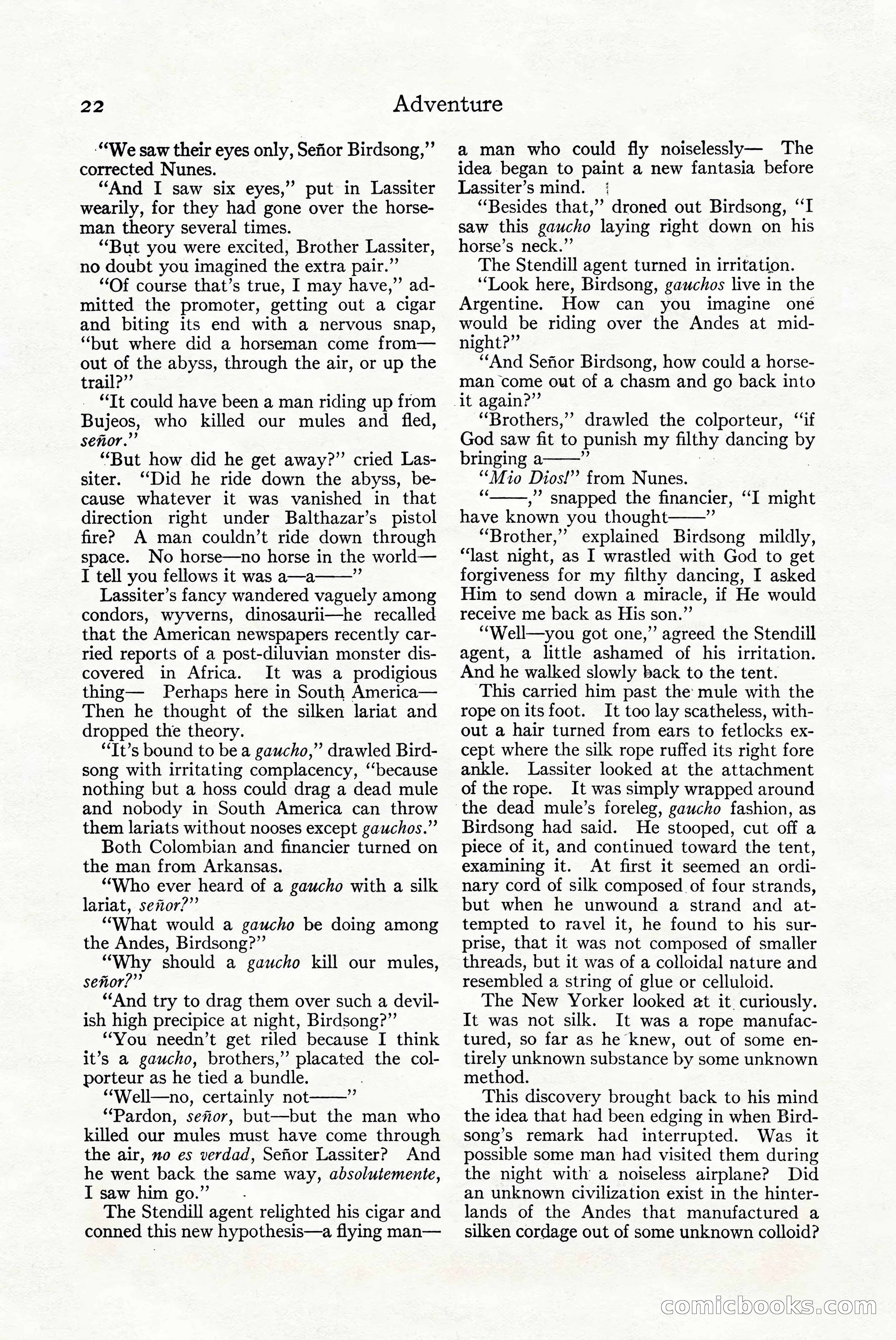
A restored page from Pulp Fiction, 1922. Page through the whole issue in the reader above.
📄 Transcribed text from this page (OCR, searchable)
Machine-transcribed from the original scan — historical spelling and the odd misread are preserved.
22 “We saw their eyes only, Sefior Birdsong,”’ corrected Nunes. “And I saw six eyes,” put in Lassiter wearily, for they had gone over the horse- man theory several times. “But you were excited, Brother Lassiter, no doubt you imagined the extra pair.” “Of course that’s true, I may have,” ad- mitted the promoter, getting out a cigar and biting its end with a nervous snap, “but where did a horseman come from— out of the abyss, through the air, or up the trail?’”’ “Tt could have been a man riding up from Bujeos, who killed our mules and fled, senor.” “But how did he get away?” cried Las- siter. ‘Did he ride down the abyss, be- cause whatever it was vanished in that direction right under Balthazar’s pistol fireP A man couldn’t ride down through space. No horse—no horse in the world— I tell you fellows it was a—a S Lassiter’s fancy wandered vaguely among condors, wyverns, dinosaurli—he recalled that the American newspapers recently car- ried reports of a post-diluvian monster dis- covered in Africa. It was a prodigious thing— Perhaps here in South America— Then he thought of the silken lariat and dropped the theory. “It’s bound to be a gaucho,” drawled Bird- song with irritating complacency, ‘‘because nothing but a hoss could drag a dead mule and nobody in South America can throw them lariats without nooses except gauchos.” Both Colombian and financier turned on the man from Arkansas. “Who ever heard of a gaucho with a silk lariat, sewor?”’ ‘“‘What would a gaucho be doing among the Andes, Birdsong?” “Why should a gaucho kill our mules, senor?” ‘And try to drag them over such a devil- ish high precipice at night, Birdsong?”’ ‘You needn’t get riled because I think it’s a gaucho, brothers,” placated the col- porteur as he tied a bundle. ‘‘Well—no, certainly not ‘Pardon, sefior, but—but the man who killed our mules must have come through the air, no es verdad, Sefior Lassiter? And he went back the same way, absolutemente, I saw him go.” The Stendill agent relighted his cigar and conned this new hypothesis—a flying man— Adventure a man who could fly noiselessly— The idea began to paint a new fantasia before Lassiter’s mind. ; “Besides that,” droned out Birdsong, “‘I saw this gaucho laying right down on his horse’s neck.” | The Stendill agent turned in irritation. ‘‘Look here, Birdsong, gauchos live in the Argentine. How can you imagine one would be riding over the Andes at mid- night?” ‘“‘And Sefior Birdsong, how could a horse- man come out of a chasm and go back into it again?” “Brothers,” drawled the colporteur, “if God saw fit to punish my nitn yy dancing PY bringing a “Mio Diost!’”’ from Nunes. = ,’ snapped the financier, “I might have known you thought , “Brother,” explained Birdsong mildly, “last night, as I wrastled with God to get forgiveness for my filthy dancing, I asked Him to send down a miracle, if He would receive me back as His son.”’ “‘Well—you got one,” agreed the Stendill agent, a little ashamed of his irritation. And he walked slowly back to the tent. This carried him past the mule with the rope on itsfoot. It too lay scatheless, with- out a hair turned from ears to fetlocks ex- cept where the silk rope ruffed its right fore ankle. Lassiter looked at the attachment of the rope. It was simply wrapped around the dead mule’s foreleg, gaucho fashion, as Birdsong had said. He stooped, cut off a piece of it, and continued toward the tent, examining it. At first it seemed an ordi- nary cord of silk composed of four strands, but when he unwound a strand and at- tempted to ravel it, he found to his sur- prise, that it was not composed of smaller threads, but it was of a colloidal nature and resembled a string of glue or celluloid. The New Yorker looked at it. curiously. It was not silk. It was a rope manufac- tured, so far as he knew, out of some en- tirely unknown substance by some unknown method. This discovery brought back to his mind the idea that had been edging in when Bird- song’s remark had interrupted. Was it possible some man had visited them during the night with a noiseless airplane? Did an unknown civilization exist in the hinter- lands of the Andes that manufactured a silken cordage out of some unknown colloid? MICLOOOK (©