
Pulp Fiction, 1922 · page 23 of 204
Adventure Magazine Cover — page 23: what you’re looking at
A restored page from Pulp Fiction, 1922. Page through the whole issue in the reader above.
📄 Transcribed text from this page (OCR, searchable)
Machine-transcribed from the original scan — historical spelling and the odd misread are preserved.
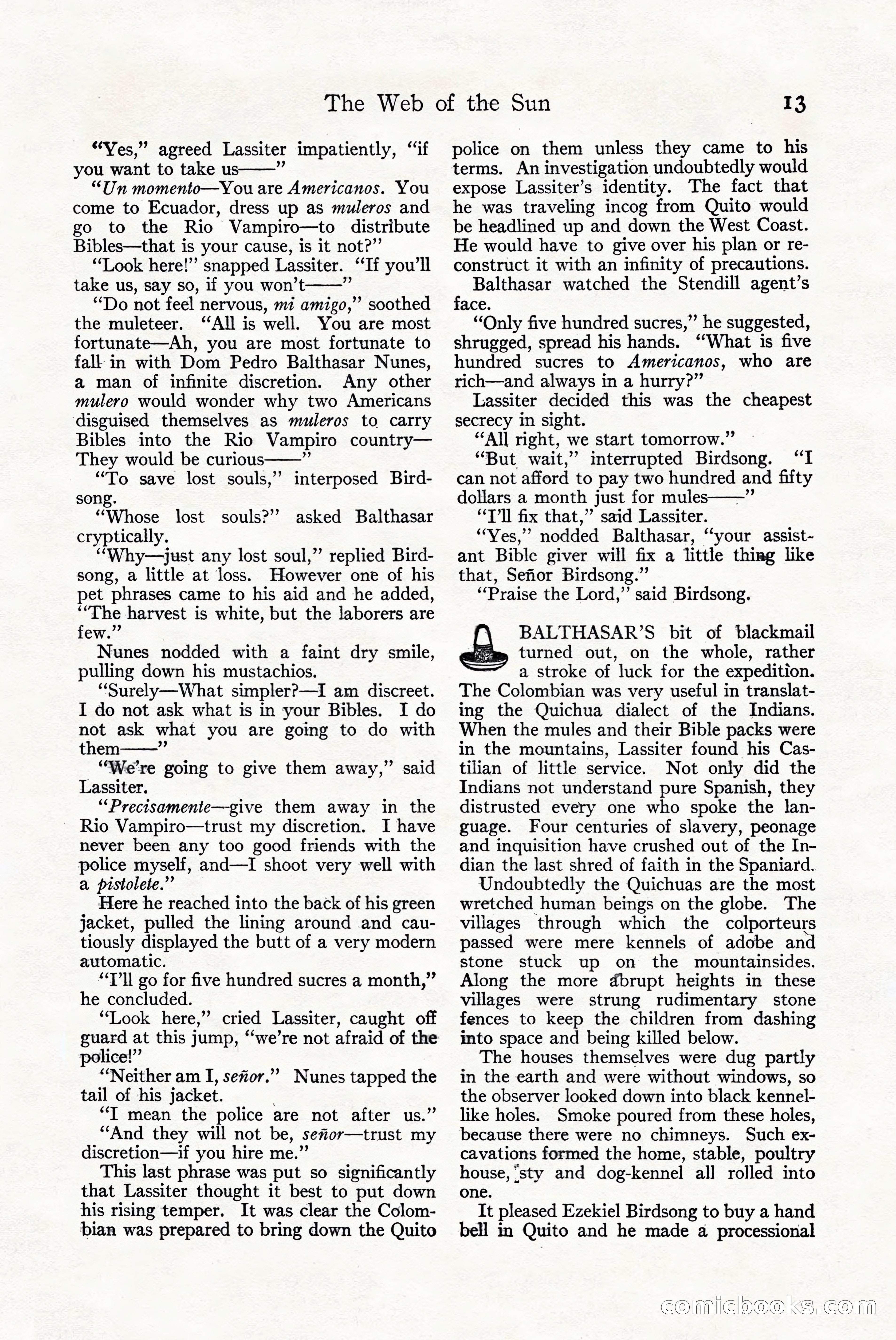
The Web of the Sun “Yes,” agreed Lassiter impatiently, “‘if you want to take us——” ““Un momento—You are Americanos. You come to Ecuador, dress up as muleros and go to the Rio Vampiro—to distribute Bibles—that is your cause, is it not?” “Look here!’ snapped Lassiter. “If you'll take us, say so, if you won’ . “Do not feel nervous, mi amigo,’”’ soothed the muleteer. ‘‘All is well. You are most fortunate—Ah, you are most fortunate to fall in with Dom Pedro Balthasar Nunes, a man of infinite discretion. Any other mulero would wonder why two Americans disguised themselves as muleros to carry Bibles into the Rio Vampiro country— They would be curious . “To save lost souls,’’ interposed Bird- song. “Whose lost souls?” asked Balthasar cryptically. ‘“‘Why—just any lost soul,” replied Bird- song, a little at loss. However one of his pet phrases came to his aid and he added, ‘‘The harvest is white, but the laborers are few.” Nunes nodded with a faint dry smile, pulling down his mustachios. “‘Surely—What simpler?—I am discreet. I do not ask what is in your Bibles. I do not ask what you are going to do with them Ki “We're going to give them away,” Lassiter. ““Precisamente—give them away in the Rio Vampiro—trust my discretion. I have never been any too good friends with the police myself, and—I shoot very well with a pistolete.” Here he reached into the back of his green jacket, pulled the lining around and cau- tiously displayed the butt of a very modern automatic. “T’ll go for five hundred sucres a month,” he concluded. “Look here,” cried Lassiter, caught off guard at this jump, “we’re not afraid of the police!”’ “Neither am I, sevor.’”’ Nunes tapped the tail of his jacket. : “T mean the police are not after us.” “And they will not be, se%or—trust my discretion—if you hire me.” This last phrase was put so significantly that Lassiter thought it best to put down his rising temper. It was clear the Colom- bian was prepared to bring down the Quito said 13 police on them unless they came to his terms. An investigation undoubtedly would expose Lassiter’s identity. The fact that he was traveling incog from Quito would be headlined up and down the West Coast. He would have to give over his plan or re- construct it with an infinity of precautions. Balthasar watched the Stendill agent’s face. “Only five hundred sucres,” he suggested, shrugged, spread his hands. ‘What is five hundred sucres to Americanos, who are rich—and always in a hurry?” Lassiter decided this was the cheapest secrecy in sight. ‘All right, we start tomorrow.” “But wait,’ interrupted Birdsong. “TI can not afford to pay two hundred and fifty dollars a month just for mules——” “‘T’ll fix that,” said Lassiter. “Yes,” nodded Balthasar, “your assist- ant Bible giver will fix a little thing like that, Sefior Birdsong.” ‘Praise the Lord,” said Birdsong. BALTHASAR’S bit of blackmail ) turned out, on the whole, rather a stroke of luck for the expedition. The Colombian was very useful in translat- ing the Quichua dialect of the Indians. When the mules and their Bible packs were in the mountains, Lassiter found his Cas- tilian of little service. Not only did the Indians not understand pure Spanish, they distrusted every one who spoke the lan- guage. Four centuries of slavery, peonage and inquisition have crushed out of the In- dian the last shred of faith in the Spaniard. Undoubtedly the Quichuas are the most wretched human beings on the globe. The villages through which the colporteurs passed were mere kennels of adobe and stone stuck up on the mountainsides. Along the more dbrupt heights in these villages were strung rudimentary stone fences to keep the children from dashing into space and being killed below. The houses themselves were dug partly in the earth and were without windows, so the observer looked down into black kennel- like holes. Smoke poured from these holes, because there were no chimneys. Such ex- cavations formed the home, stable, poultry house, ‘sty and dog-kennel all rolled into one. It pleased Ezekiel Birdsong to buy a hand bell in Quito and he made a processional COMIC OOo S C@