
Pulp Fiction, 1922 · page 20 of 204
Adventure Magazine Cover — page 20: what you’re looking at
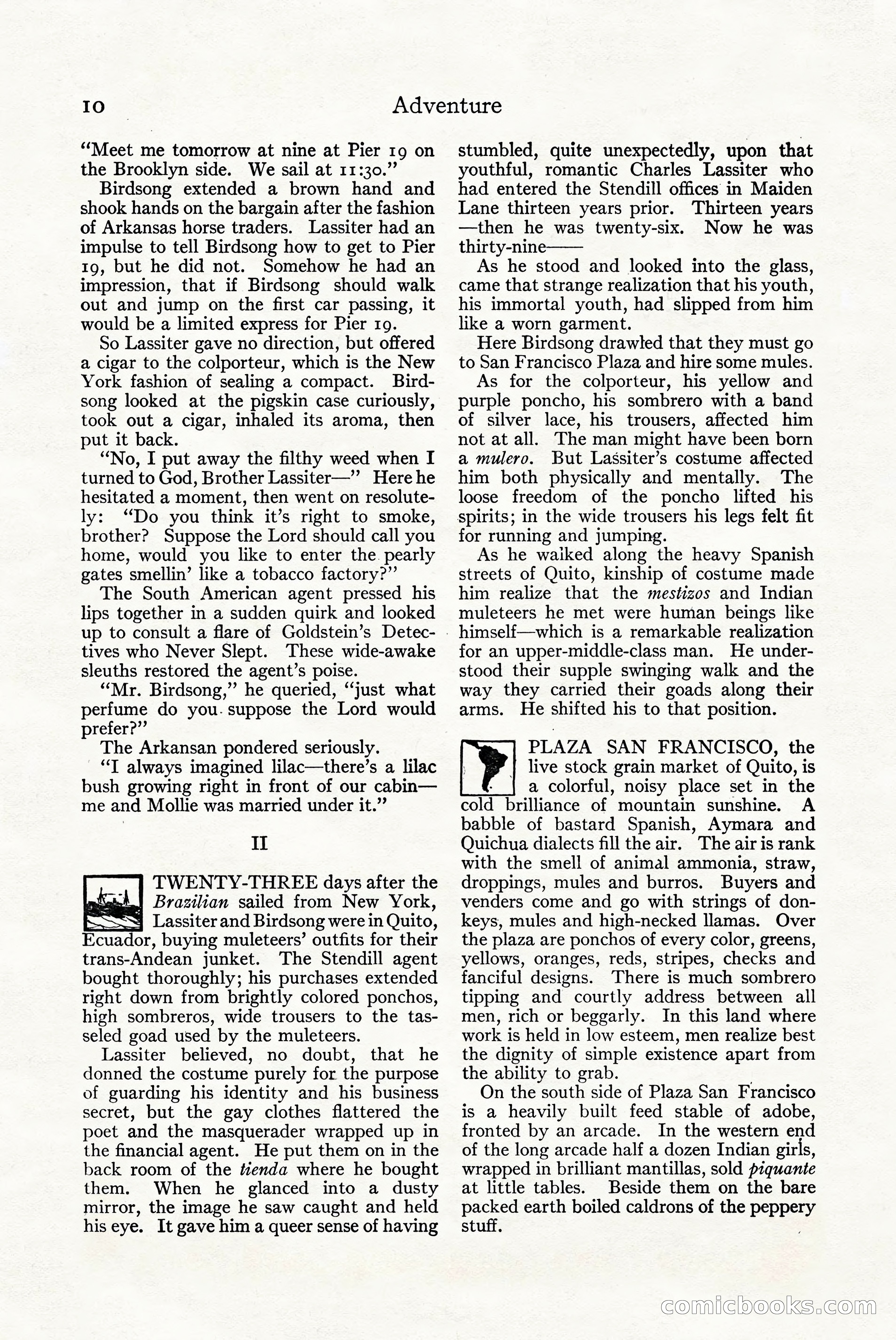
A restored page from Pulp Fiction, 1922. Page through the whole issue in the reader above.
📄 Transcribed text from this page (OCR, searchable)
Machine-transcribed from the original scan — historical spelling and the odd misread are preserved.
1 Fe) ‘“‘Meet me tomorrow at nine at Pier 19 on the Brooklyn side. We sail at 11:30.” Birdsong extended a brown hand and shook hands on the bargain after the fashion of Arkansas horse traders. Lassiter had an impulse to tell Birdsong how to get to Pier 19, but he did not. Somehow he had an impression, that if Birdsong should walk out and jump on the first car passing, it would be a limited express for Pier 19. So Lassiter gave no direction, but offered a cigar to the colporteur, which is the New York fashion of sealing a compact. Bird- song looked at the pigskin case curiously, took out a cigar, inhaled its aroma, then put it back. “No, I put away the filthy weed when I turned to God, Brother Lassiter—’”’ Here he hesitated a moment, then went on resolute- ly: ‘Do you think it’s right to smoke, brother? Suppose the Lord should call you home, would you like to enter the. pearly gates smellin’ like a tobacco factory?” The South American agent pressed his lips together in a sudden quirk and looked up to consult a flare of Goldstein’s Detec- tives who Never Slept. These wide-awake sleuths restored the agent’s poise. “Mr. Birdsong,” he queried, “‘just what perfume do you. suppose the Lord would prefer?” The Arkansan pondered seriously. “T always imagined lilac—there’s a lilac bush growing right in front of our cabin— me and Mollie was married under it.” II TWENTY-THREE days after the pret! Brazilian sailed from New York, Sey Lassiter and Birdsong were in Quito, Ecuador, buying muleteers’ outfits for their trans-Andean junket. The Stendill agent bought thoroughly; his purchases extended right down from brightly colored ponchos, high sombreros, wide trousers to the tas- seled goad used by the muleteers. Lassiter believed, no doubt, that he donned the costume purely for the purpose of guarding his identity and his business secret, but the gay clothes flattered the poet and the masquerader wrapped up in the financial agent. He put them on in the back room of the tenda where he bought them. When he glanced into a dusty mirror, the image he saw caught and held his eye. It gave him a queer sense of having Adventure stumbled, quite unexpectedly, upon that youthful, romantic Charles Lassiter who had entered the Stendill offices in Maiden Lane thirteen years prior. Thirteen years —then he was twenty-six. Now he was thirty-nine As he stood and looked into the glass, came that strange realization that his youth, his immortal youth, had slipped from him like a worn garment. Here Birdsong drawled that they must go to San Francisco Plaza and hire some mules. As for the colporteur, his yellow and purple poncho, his sombrero with a band of silver lace, his trousers, affected him not at all. The man might have been born a mulero. But Lassiter’s costume affected him both physically and mentally. The loose freedom of the poncho lifted his spirits; in the wide trousers his legs felt fit for running and jumping. As he waiked along the heavy Spanish streets of Quito, kinship of costume made him realize that the mestizos and Indian muleteers he met were human beings like himself—which is a remarkable realization for an upper-middle-class man. He under- stood their supple swinging walk and the way they carried their goads along their arms. He shifted his to that position. a colorful, noisy place set in the cold brilliance of mountain sunshine. A babble of bastard Spanish, Aymara and Quichua dialects fill the air. The air is rank with the smell of animal ammonia, straw, droppings, mules and burros. Buyers and venders come and go with strings of don- keys, mules and high-necked llamas. Over the plaza are ponchos of every color, greens, yellows, oranges, reds, stripes, checks and fanciful designs. There is much sombrero tipping and courtly address between all men, rich or beggarly. In this land where work is held in low esteem, men realize best the dignity of simple existence apart from the ability to grab. On the south side of Plaza San Francisco is a heavily built feed stable of adobe, fronted by an arcade. In the western end of the long arcade half a dozen Indian girls, wrapped in brilliant mantillas, sold pzquante at little tables. Beside them on the bare packed earth boiled caldrons of the peppery stuff. PLAZA SAN FRANCISCO, the live stock grain market of Quito, is DOOK (C©