
Pulp Fiction, 1922 · page 199 of 204
Adventure Magazine Cover — page 199: what you’re looking at
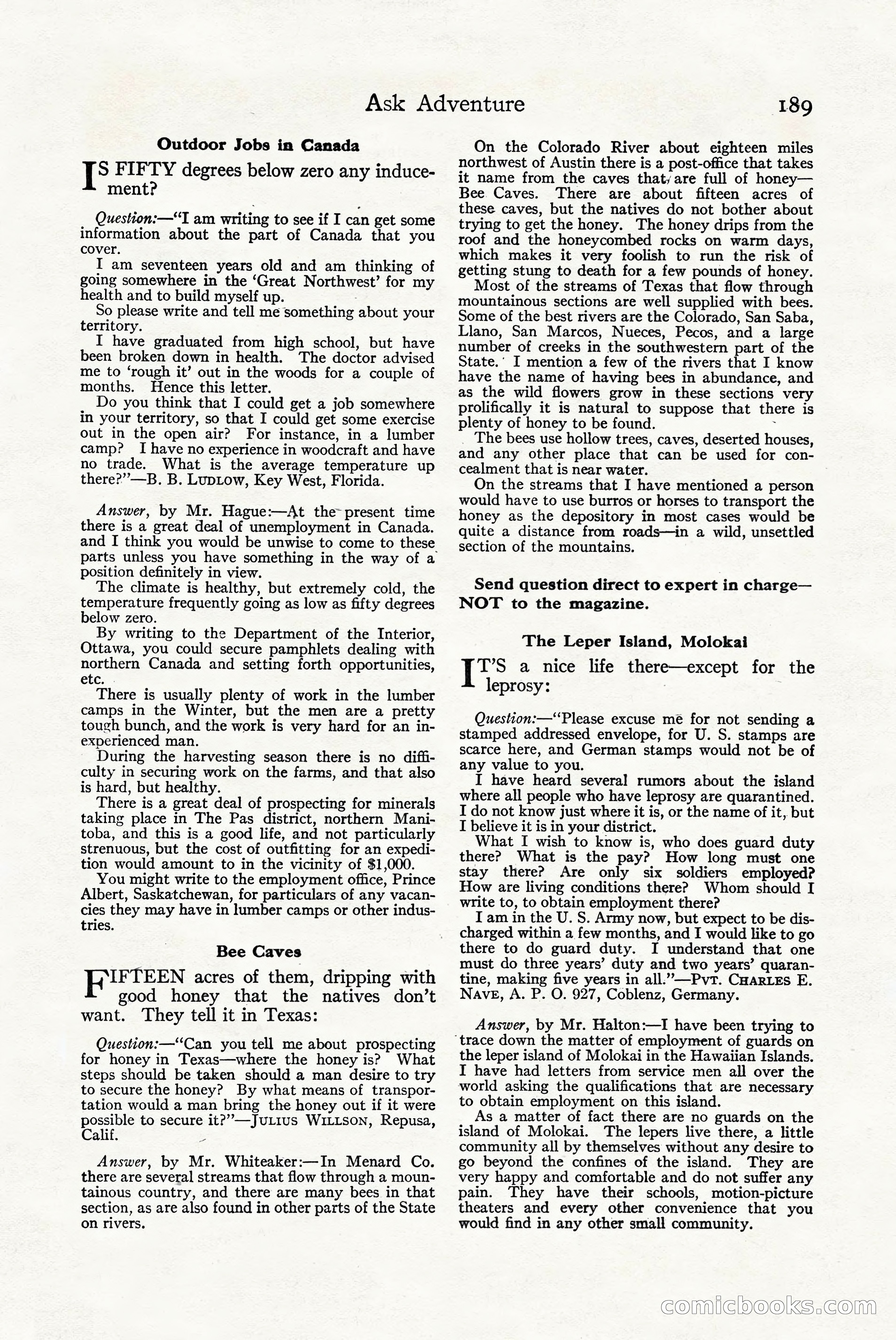
A restored page from Pulp Fiction, 1922. Page through the whole issue in the reader above.
📄 Transcribed text from this page (OCR, searchable)
Machine-transcribed from the original scan — historical spelling and the odd misread are preserved.
Ask Adventure Outdoor Jobs in Canada [S FIFTY degrees below zero any induce- ment? Question: —“T am writing to see if I can get some information about the part of Canada that you cover. I am seventeen years old and am thinking of going somewhere in the ‘Great Northwest’ for my health and to build myself up. So please write and tell me something about your territory. I have graduated from high school, but have been broken down in health. The doctor advised me to ‘rough it’ out in the woods for a couple of months. Hence this letter. Do you think that I could get a job somewhere in your territory, so that I could get some exercise out in the open air? For instance, in a lumber camp? I have no experience in woodcraft and have no trade. What is the average temperature up there?”’—B. B. Luptow, Key West, Florida. Answer, by Mr. Hague:—At the present time there is a great deal of unemployment in Canada. and I think you would be unwise to come to these parts unless you have something in the way of a position definitely in view. The climate is healthy, but extremely cold, the temperature frequently going as low as fifty degrees below zero. By writing to the Department of the Interior, Ottawa, you could secure pamphlets dealing with northern Canada and setting forth opportunities, etc; There is usually plenty of work in the lumber camps in the Winter, but the men are a pretty tough bunch, and the work is very hard for an in- experienced man. During the harvesting season there is no diffi- culty in securing work on the farms, and that also is hard, but healthy. There is a great deal of prospecting for minerals taking place in The Pas district, northern Mani- toba, and this is a good life, and not particularly strenuous, but the cost of outfitting for an expedi- tion would amount to in the vicinity of $1,000. You might write to the employment office, Prince Albert, Saskatchewan, for particulars of any vacan- cies they may have in lumber camps or other indus- tries. Bee Caves PRETEEN acres of them, dripping with good honey that the natives don’t want. They tell it in Texas: Question: —“Can you tell me about prospecting for honey in Texas—where the honey is? What steps should be taken should a man desire to try to secure the honey? By what means of transpor- tation would a man bring the honey out if it were possible to secure it?”—JuLius WILLSON, Repusa, Calif. 2 Answer, by Mr. Whiteaker:—In Menard Co. there are several streams that flow through a moun- tainous country, and there are many bees in that section, as are also found in other parts of the State on rivers. 189 On the Colorado River about eighteen miles northwest of Austin there is a post-office that takes it name from the caves that/are full of honey— Bee Caves. There are about fifteen acres of these caves, but the natives do not bother about trying to get the honey. The honey drips from the roof and the honeycombed rocks on warm days, which makes it very foolish to run the risk of getting stung to death for a few pounds of honey. Most of the streams of Texas that flow through mountainous sections are well supplied with bees. Some of the best rivers are the Colorado, San Saba, Llano, San Marcos, Nueces, Pecos, and a large number of creeks in the southwestern part of the State.’ I mention a few of the rivers that I know have the name of having bees in abundance, and as the wild flowers grow in these sections very prolifically it is natural to suppose that there is plenty of honey to be found. : _ The bees use hollow trees, caves, deserted houses, and any other place that can be used for con- cealment that is near water. On the streams that I have mentioned a person would have to use burros or horses to transport the honey as the depository in most cases would be quite a distance from roads—in a wild, unsettled section of the mountains. Send question direct to expert in charge— NOT to the magazine. The Leper Island, Molokai T’S a nice life there—except for the leprosy: Question: —‘‘Please excuse me for not sending a stamped addressed envelope, for U. S. stamps are scarce here, and German stamps would not be of any value to you. I have heard several rumors about the island where all people who have leprosy are quarantined. I do not know just where it is, or the name of it,. but I believe it is in your district. What I wish to know is, who does guard duty there? What is the pay? How long must one stay there? Are only six soldiers employed? How are living conditions there? Whom should [ write to, to obtain employment there? I am in the U. S. Army now, but expect to be dis- charged within a few months, and I would like to go there to do guard duty. I understand that one must do three years’ duty and two years’ quaran- tine, making five years in all.”—Pvt. CHARLES E. NAVE, A. P. O. 927, Coblenz, Germany. Answer, by Mr. Halton:—I have been trying to ‘trace down the matter of employment of guards on the leper island of Molokai in the Hawaiian Islands. I have had letters from service men all over the world asking the qualifications that are necessary to obtain employment on this island. As a matter of fact there are no guards on the island of Molokai. The lepers live there, a little community all by themselves without any desire to go beyond the confines of the island. They are very happy and comfortable and do not suffer any pain. They have their schools, motion-picture theaters and every other convenience that you would find in any other small community. DOO C@