
Pulp Fiction, 1922 · page 188 of 204
Adventure Magazine Cover — page 188: what you’re looking at
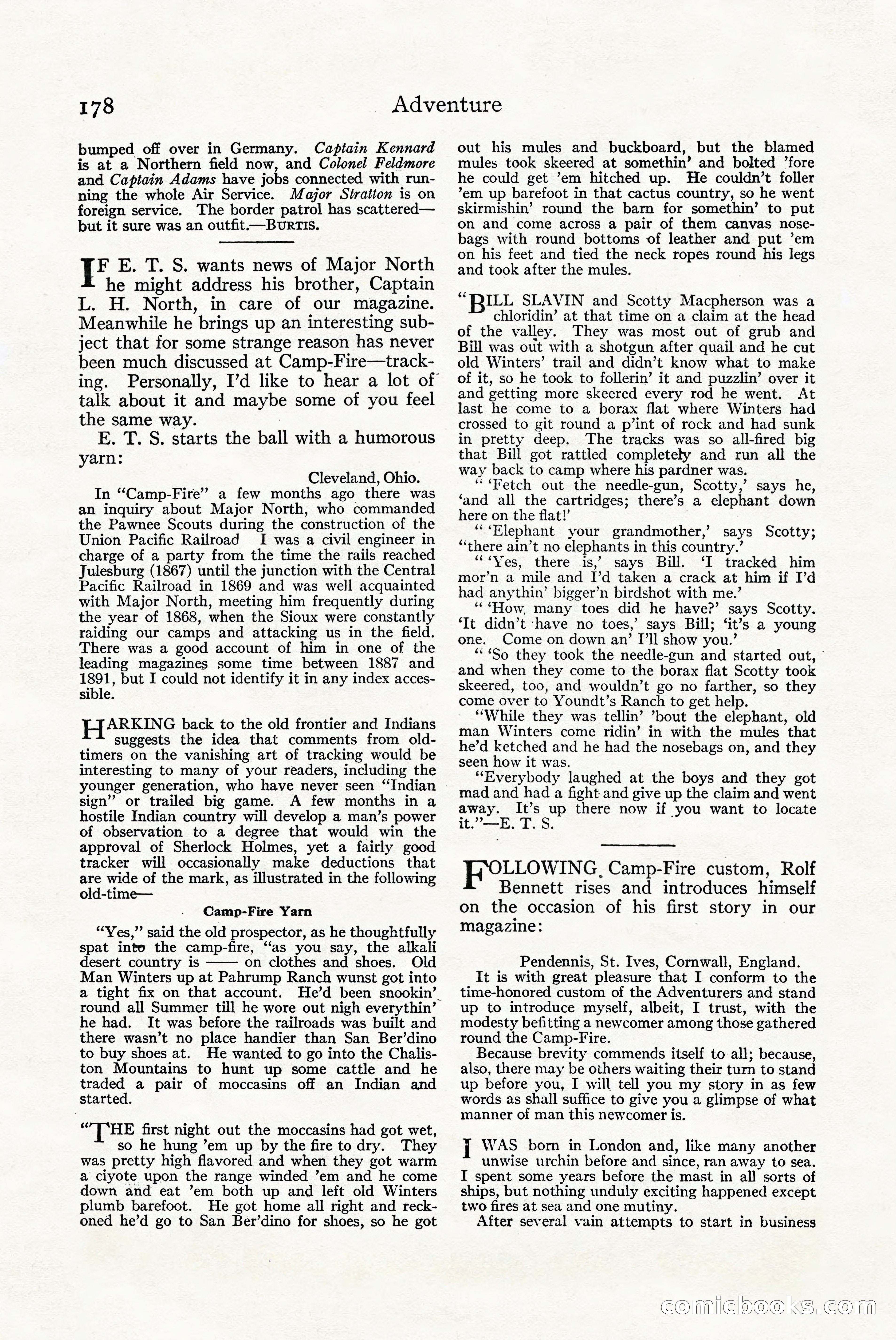
A restored page from Pulp Fiction, 1922. Page through the whole issue in the reader above.
📄 Transcribed text from this page (OCR, searchable)
Machine-transcribed from the original scan — historical spelling and the odd misread are preserved.
178 bumped off over in Germany. Captain Kennard is at a Northern field now, and Colonel Feldmore and Captain Adams have jobs connected with run- ning the whole Air Service. Major Stratton is on foreign service. The border patrol has scattered— but it sure was an outfit.—BURTIS. | E. T. S. wants news of Major North he might address his brother, Captain L. H. North, in care of our magazine. Meanwhile he brings up an interesting sub- ject that for some strange reason has never been much discussed at Camp-Fire—track- ing. Personally, I’d like to hear a lot of talk about it and maybe some of you feel the same way. . E. T. S. starts the ball with a humorous yarn: Cleveland, Ohio. In ‘‘Camp-Fire” a few months ago there was an inquiry about Major North, who commanded the Pawnee Scouts during the construction of the Union Pacific Railroad I was a civil engineer in charge of a party from the time the rails reached Julesburg (1867) until the junction with the Central Pacific Railroad in 1869 and was well acquainted with Major North, meeting him frequently during the year of 1868, when the Sioux were constantly raiding our camps and attacking us in the field. There was a good account of him in one of the leading magazines some time between 1887 and 1891, but I could not identify it in any index acces- sible. HAREING back to the old frontier and Indians suggests the idea that comments from old- timers on the vanishing art of tracking would be interesting to many of your readers, including the younger generation, who have never seen “Indian sign” or trailed big game. A few months in a hostile Indian country will develop a man’s power of observation to a degree that would win the approval of Sherlock Holmes, yet a fairly good tracker will occasionally make deductions that are wide of the mark, as illustrated in the following old-time— Camp-Fire Yarn “Ves,’’ said the old prospector, as he thoughtfully spat inte the camp-fire, ‘‘as you say, the alkali desert country is on clothes and shoes. Old Man Winters up at Pahrump Ranch wunst got into a tight fix on that account. round all Summer till he wore out nigh everythin’ he had. It was before the railroads was built and there wasn’t no place handier than San Ber’dino to buy shoes at. He wanted to go into the Chalis- ton Mountains to hunt up some cattle and he traded a pair of moccasins off an Indian and started. “THE first night out the moccasins had got wet, so he hung ’em up by the fire to dry. They was pretty high flavored and when they got warm a clyote upon the range winded ’em and he come down and eat ’em both up and left old Winters plumb barefoot. He got home all right and reck- oned he’d go to San Ber’dino for shoes, so he got He’d been snookin’ Adventure out his mules and buckboard, but the blamed mules took skeered at somethin’ and bolted ’fore he could get ’em hitched up. He couldn’t foller ’em up barefoot in that cactus country, so he went skirmishin’ round the barn for somethin’ to put on and come across a pair of them canvas nose- bags with round bottoms of leather and put ’em on his feet and tied the neck ropes round his legs and took after the mules. “BILL SLAVIN and Scotty Macpherson was a chloridin’ at that time on a claim at the head of the valley. They was most out of grub and Bill was out with a shotgun after quail and he cut old Winters’ trail and didn’t know what to make of it, so he took to follerin’ it and puzzlin’ over it and getting more skeered every rod he went. At last he come to a borax flat where Winters had crossed to git round a p’int of rock and had sunk in pretty deep. The tracks was so all-fired big that Bill got rattled completely and run all the way back to camp where his pardner was. ‘*“Fetch out the needle-gun, Scotty,’ says he, ‘and all the cartridges; there’s a elephant down here on the flat!’ | ‘““*Elephant your grandmother,’ says Scotty; “there ain’t no elephants in this country.’ ‘“* “Ves, there is,’ says Bill. ‘I tracked him mor’n a mile and I’d taken a crack at him if I’d had anythin’ bigger’n birdshot with me.’ ‘“* “How, many toes did he have?’ says Scotty. ‘It didn’t ‘have no toes,’ says Bill; ‘it’s a young one. Come on down an’ I’ll show you.’ and when they come to the borax flat Scotty took skeered, too, and wouldn’t go no farther, so they come over to Youndt’s Ranch to get help. “While they was tellin’ ’bout the elephant, old man Winters come ridin’ in with the mules that he’d ketched and he had the nosebags on, and they seen how it was. “Everybody laughed at the boys and they got mad and had a fight and give up the claim and went oe sue Ue there now if you want to locate it.””—E. T. S. | BRI ESA EEN Ec Camp-Fire custom, Rolf Bennett rises and introduces himself on the occasion of his first story in our magazine: Pendennis, St. Ives, Cornwall, England. It is with great pleasure that I conform to the time-honored custom of the Adventurers and stand up to introduce myself, albeit, I trust, with the modesty befitting a newcomer among those gathered round the Camp-Fire. Because brevity commends itself to all; because, also, there may be others waiting their turn to stand up before you, I will tell you my story in as few words as shall suffice to give you a glimpse of what manner of man this newcomer is. I WAS born in London and, like many another unwise urchin before and since, ran away to sea. I spent some years before the mast in all sorts of ships, but nothing unduly exciting happened except two fires at sea and one mutiny. After several vain attempts to start in business DOO ‘So they took the needle-gun and started out, | (©