
Pulp Fiction, 1922 · page 173 of 204
Adventure Magazine Cover — page 173: what you’re looking at
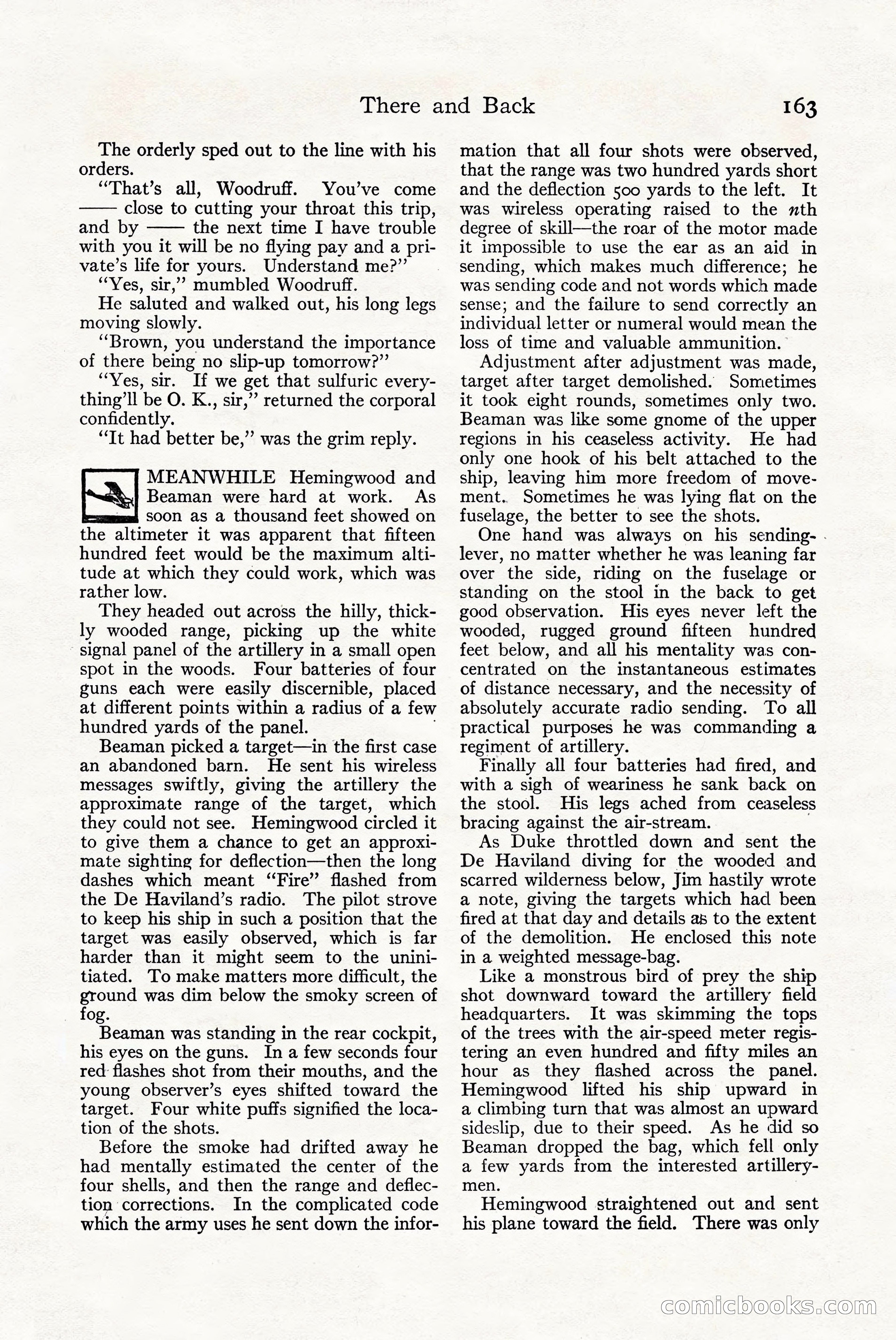
A restored page from Pulp Fiction, 1922. Page through the whole issue in the reader above.
📄 Transcribed text from this page (OCR, searchable)
Machine-transcribed from the original scan — historical spelling and the odd misread are preserved.
There and Back The orderly sped out to the line with his orders. “That’s all, Woodruff. You’ve come close to cutting your throat this trip, and by the next time I have trouble with you it will be no flying pay and a pri- vate’s life for yours. Understand me?”’ “Yes, sir,’ mumbled Woodruff. He saluted and walked out, his long legs moving slowly. ‘Brown, you understand the importance of there being no slip-up tomorrow?”’ “Yes, sir. If we get that sulfuric every- thing’ll be O. K., sir,” returned the corporal confidently. “It had better be,’’ was the grim reply. MEANWHILE Hemingwood and Beaman were hard at work. As soon as a thousand feet showed on the altimeter it was apparent that fifteen hundred feet would be the maximum alti- tude at which they could work, which was rather low. They headed out across the hilly, thick- ly wooded range, picking up the white signal panel of the artillery in a small open spot in the woods. Four batteries of four guns each were easily discernible, placed at different points within a radius of a few hundred yards of the panel. Beaman picked a target—in the first case an abandoned barn. He sent his wireless messages swiftly, giving the artillery the approximate range of the target, which they could not see. Hemingwood circled it to give them a chance to get an approxi- mate sighting for deflection—then the long dashes which meant ‘‘Fire” flashed from the De Haviland’s radio. The pilot strove to keep his ship in such a position that the target was easily observed, which is far harder than it might seem to the unini- tiated. —To make matters more difficult, the ground was dim below the smoky screen of _ fog. Beaman was standing in the rear cockpit, his eyes on the guns. In a few seconds four red flashes shot from their mouths, and the young observer’s eyes shifted toward the target. Four white puffs signified the loca- tion of the shots. Before the smoke had drifted away he had mentally estimated the center of the four shells, and then the range and deflec- tion corrections. In the complicated code which the army uses he sent down the infor- 163 mation that all four shots were observed, that the range was two hundred yards short and the deflection 500 yards to the left. It was wireless operating raised to the uth degree of skill—the roar of the motor made it impossible to use the ear as an aid in sending, which makes much difference; he was sending code and not words which made sense; and the failure to send correctly an individual letter or numeral would mean the loss of time and valuable ammunition. Adjustment after adjustment was made, target after target demolished. Sometimes it took eight rounds, sometimes only two. Beaman was like some gnome of the upper regions in his ceaseless activity. He had only one hook of his belt attached to the ship, leaving him more freedom of move- ment.. Sometimes he was lying flat on the fuselage, the better to see the shots. One hand was always on his sending- . lever, no matter whether he was leaning far over the side, riding on the fuselage or standing on the stool in the back to get good observation. His eyes never left the wooded, rugged ground fifteen hundred feet below, and all his mentality was con- centrated on the instantaneous estimates of distance necessary, and the necessity of absolutely accurate radio sending. To all practical purposes he was commanding a regiment of artillery. Finally all four batteries had fired, and with a sigh of weariness he sank back on the stool. His legs ached from ceaseless bracing against the air-stream. As Duke throttled down and sent the De Haviland diving for the wooded and scarred wilderness below, Jim hastily wrote a note, giving the targets which had been fired at that day and details ab to the extent of the demolition. He enclosed this note in a weighted message-bag. Like a monstrous bird of prey the ship shot downward toward the artillery field headquarters. It was skimming the tops of the trees with the air-speed meter regis- tering an even hundred and fifty miles an hour as they flashed across the panel. Hemingwood lifted his ship upward in a climbing turn that was almost an upward sideslip, due to their speed. As he did so Beaman dropped the bag, which fell only a few yards from the interested artillery- men. Hemingwood straightened out and sent his plane toward the field. There was only MICLOOOK C©@